Steps in this chapter (25)
NGO and fund accounting keeps the books of an organisation that is not run for profit: a donor-funded NGO or foundation, a church or mosque, an association or club, a community-based organisation or a small charity. It keeps the money given for a purpose apart from the rest (funds with and without restrictions), runs grants from donors with their budgets, the money received and the income recognised as it is spent, in the donor's currency, and records donations, gifts in kind, pledges, members' dues and the collection taken at services. Its statements follow the International Non-Profit Accounting Standard (INPAS), with columns for funds without and with restrictions.
It is a paid add-on, available on any plan. Everything it does is an ordinary invoice, credit note, bill, receipt or journal, so the ledger, the bank, aged receivables and the other reports see it all.
In the illustration Savannah Harvest sets up its charity, the Savannah Harvest Foundation (incorporated trustees, IT 182736), as a third company in its subscription. Chukwudi Okeke (administrator) creates it, its settings and its funds on Tuesday 3 November 2026. Hauwa Ibrahim, the foundation's finance officer (the new NGO finance officer role), runs a dollar grant from the Northern Nutrition Fund for its mothers-and-babies programme, donations, a gift in kind, pledges, the Friends of the Foundation's dues and a charity dinner's collection, to the month-end on Monday 30 November.
How NGO and fund accounting works
| Topic | What happens |
|---|---|
| Where | Business → Funds and grants, with tabs for Funds, Grants, Donations, Pledges, Members & dues, Collections and Settings. Reports → NGO: income and expenses, financial position, changes in net assets, expenses by function, grant budget against actual, the donor report, the grants register, donors, giving statements, pledges, dues and arrears, and collections. |
| Add-on | NGO and fund accounting is a paid add-on on any plan, added by the subscription owner on troveuniverse.com. Without it the area and its reports are hidden. A group whose charity is a separate body keeps it as a company of its own in the same subscription. |
| Who | A new area, NGO and fund accounting, in each role. View: see everything. Prepare: draft grants and their budgets, record money received from donors, donations, gifts in kind, pledges and members, bill dues, and count and post collections (never one they counted or changed). Approve: also activate and close grants, recognise income, charge indirect costs, run the month-end, transfer between funds and cancel donations, pledges, dues and collections. Full: also set up funds, shared-cost rules, membership classes, kinds of giving and the settings. A new ready-made role, NGO finance officer, has the area at Approve, with Sales, Purchases and Banking at Prepare; bookkeepers can view it. |
| Funds | A fund is money kept for a purpose. Without restrictions: the general fund (everything not tagged to another fund) and designated funds the trustees set aside themselves. With restrictions: restricted funds a donor gave for a purpose, and endowments, whose capital is kept and only its income spent. Each fund is an option of a Fund tracking category: income and costs tagged with it are the fund's, on any invoice, bill or journal. A fund's balance is its income less its costs, plus transfers in. |
| Grants | A grant from a donor, in any currency, has its own restricted fund, a budget by line and the tranches expected. Income is recognised by one of three bases: as the money is spent (performance: the money received is held as Grants received in advance and becomes income as costs are coded to the grant), when received, or when the agreement is signed (the whole grant, with a receivable). Figures in the donor's currency use the average rate of the money received, the rate on each cost's date, or a fixed rate. |
| Indirect costs | A grant can pay the organisation an agreed rate of its direct costs (8%, say) towards running costs, capped at the indirect costs budget line. The month-end charges it to the grant and credits the general fund. |
| Shared costs | A rule shares accounts' untagged costs (rent, power, an administrator's salary) between funds by fixed percentages each month. |
| Giving | Donations are receipts with a numbered donation receipt (DR-) for the donor; gifts in kind are recorded at what the goods or services would cost. Pledges are invoiced as each instalment falls due, or tracked against what is given. Members' dues and levies are invoiced to every member of a class in one run; dues for a later period are held as Dues billed in advance and recognised month by month. Collections at services are counted note by note by two people, and posted by someone else. |
| Statements | The INPAS statements show funds without and with restrictions side by side. The general fund's balance is everything in net assets not tagged to another fund, so the funds always add up to the net assets. |
| Checks | The month-end checklist checks that the month-end for grants has been run. Book health flags a fund in deficit, a grant past its end date or overspent, a pledge or a dues invoice that could not be raised, a collection left in draft, and a remittance to headquarters not paid. |
32.2 Settings
Why
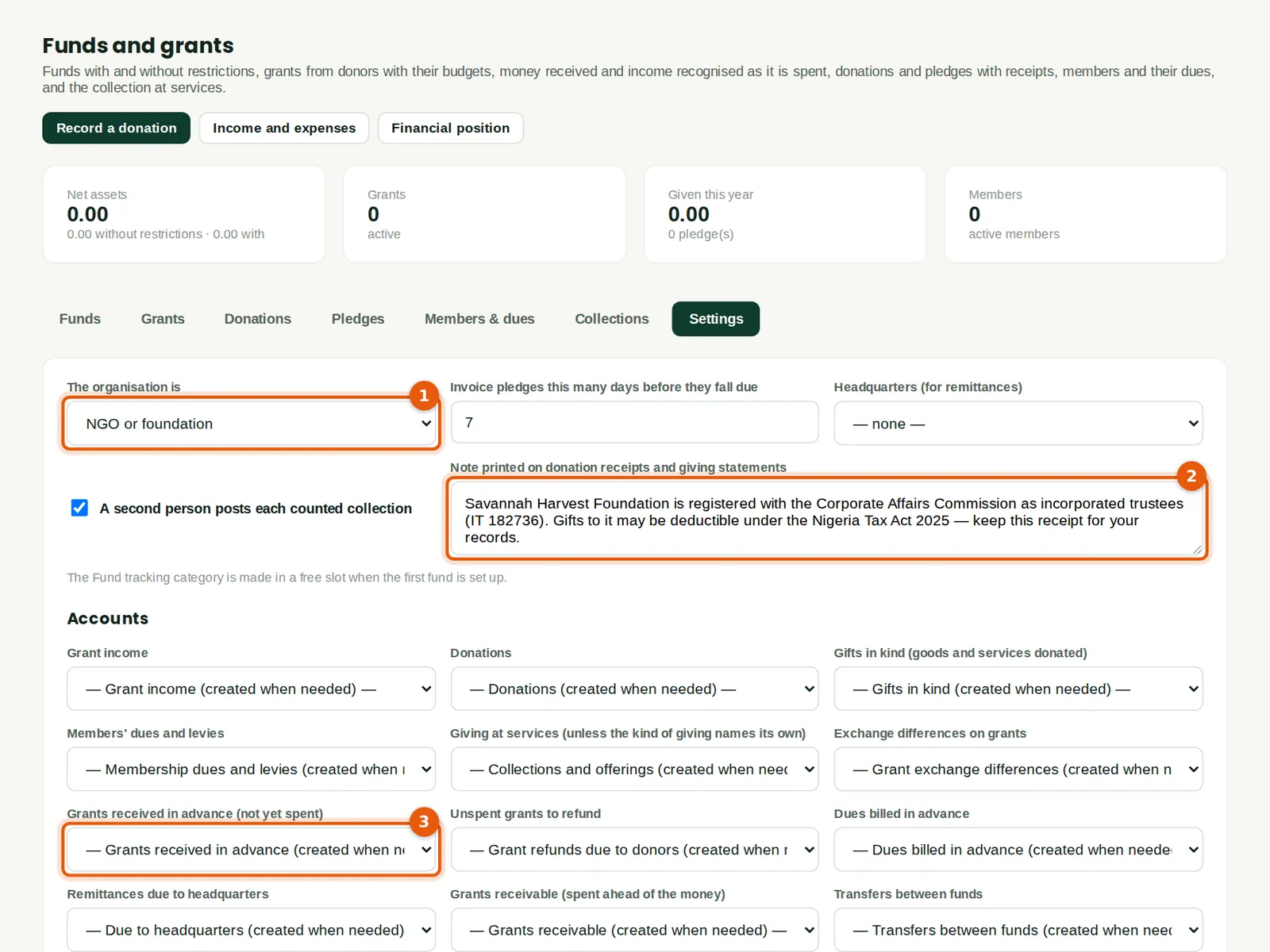
Chukwudi chooses what the organisation is (1): an NGO or foundation, a church, a mosque, an association or club. It sets the kinds of giving offered and the words used. The note (2) is printed on every donation receipt and giving statement: the foundation's registration and the tax position of gifts. The accounts (3) are created the first time each is needed — Donations, Gifts in kind, Membership dues and levies, Collections and offerings, Grant income, Grants received in advance, Dues billed in advance and the rest — or another account of the right type can be chosen. Further down the page, each expense account is given its function: programme activities, management and administration, or fundraising. A second person posts each counted collection unless that is switched off.
Who
Owner or administrator (NGO and fund accounting at Full level). Chukwudi Okeke.
What to do
- Open Funds and grants → Settings. Choose the organisation (1), type the receipt note (2), check the accounts (3) and, further down, the functions, and click Save settings.
32.3 A new fund
Why
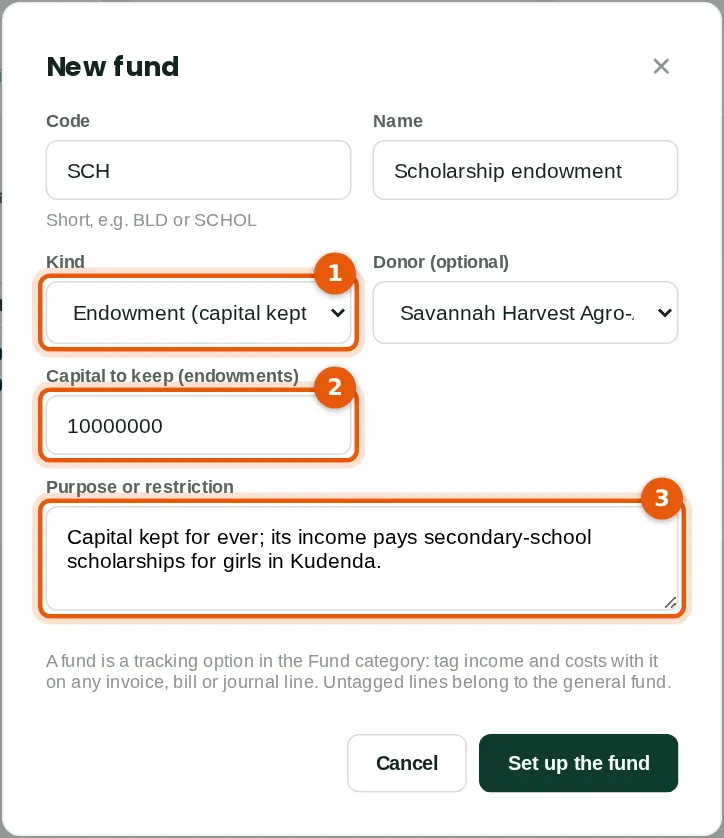
The Scholarship endowment (SCH) is an endowment (1): Savannah Harvest Agro-Allied Limited gave ₦10,000,000 as capital to be kept (2), whose income pays secondary-school scholarships for girls in Kudenda (3). Chukwudi also set up the Emergency reserve (EMR), designated by the trustees, and the Books for schools appeal (BKS), restricted to textbooks for primary schools. The company's founding gifts were recorded the same morning: ₦25,000,000 to the general fund (DR-00001) and the ₦10,000,000 endowment (DR-00002).
Who
Owner or administrator.
What to do
- Open Funds and click New fund. Type the code and name, choose the kind (1), the capital to keep for an endowment (2) and the purpose (3), and click Set up the fund.
32.4 A transfer between funds
Why
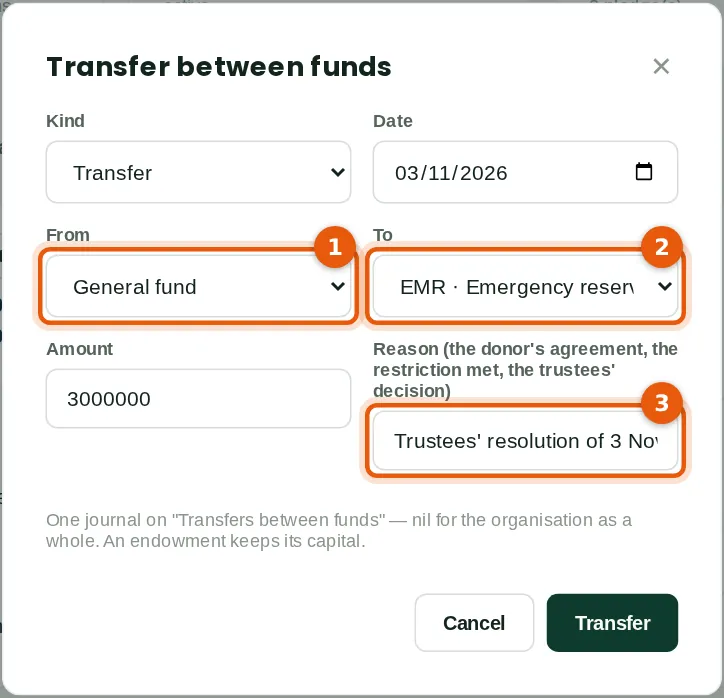
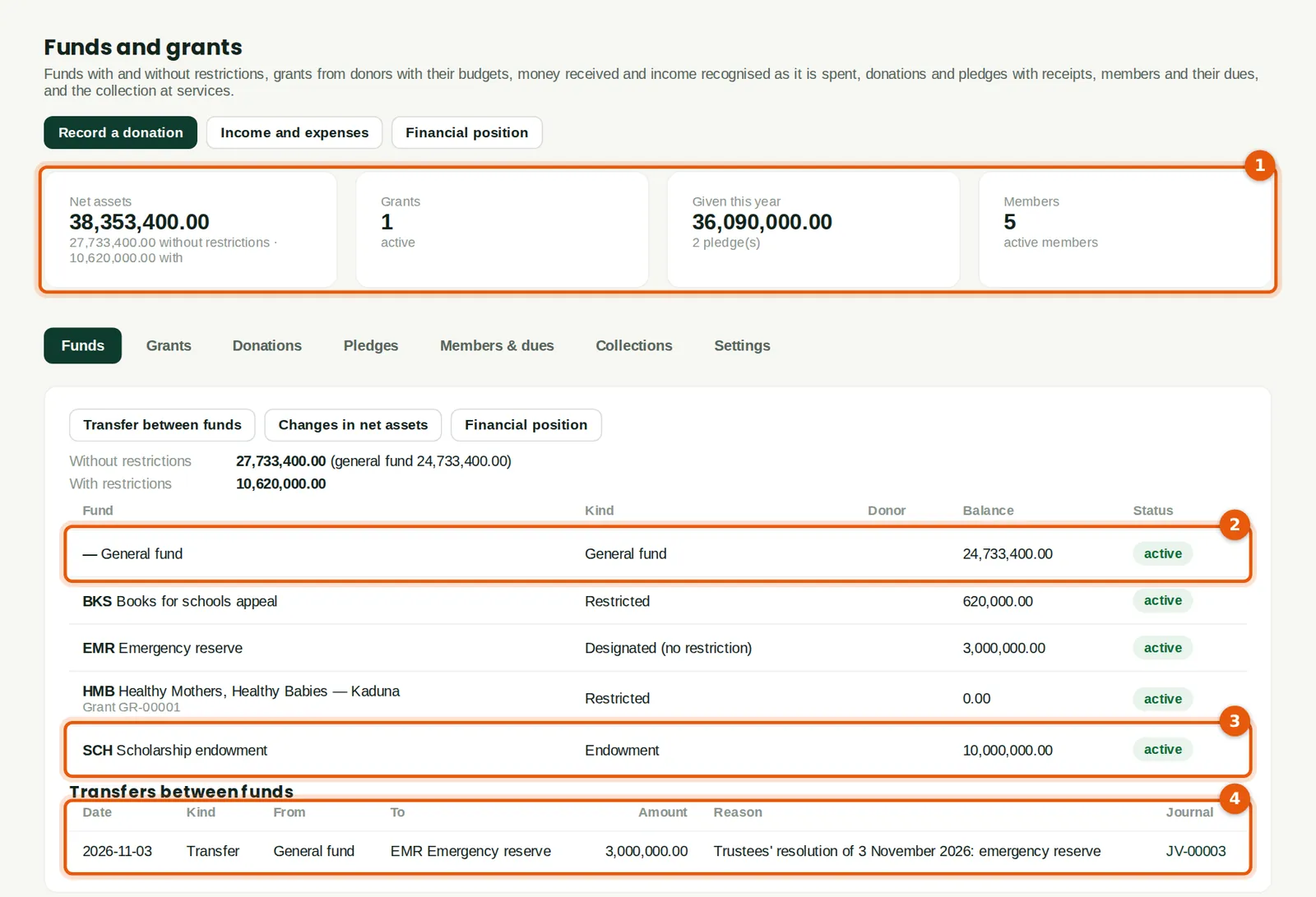
The trustees resolved on 3 November to set ₦3,000,000 aside for floods and outbreaks: from the general fund (1) to the Emergency reserve (2), with the reason (3). The journal (JV-00003) is on Transfers between funds, an equity account, so it changes the funds but not the organisation's total. A release from a restriction (when its purpose is met) is recorded the same way.
Who
NGO and fund accounting at Approve level.
What to do
- Click Transfer between funds. Choose the kind, the fund it comes from (1) and goes to (2), type the amount and the reason (3), and click Transfer.
32.5 A new grant
Why
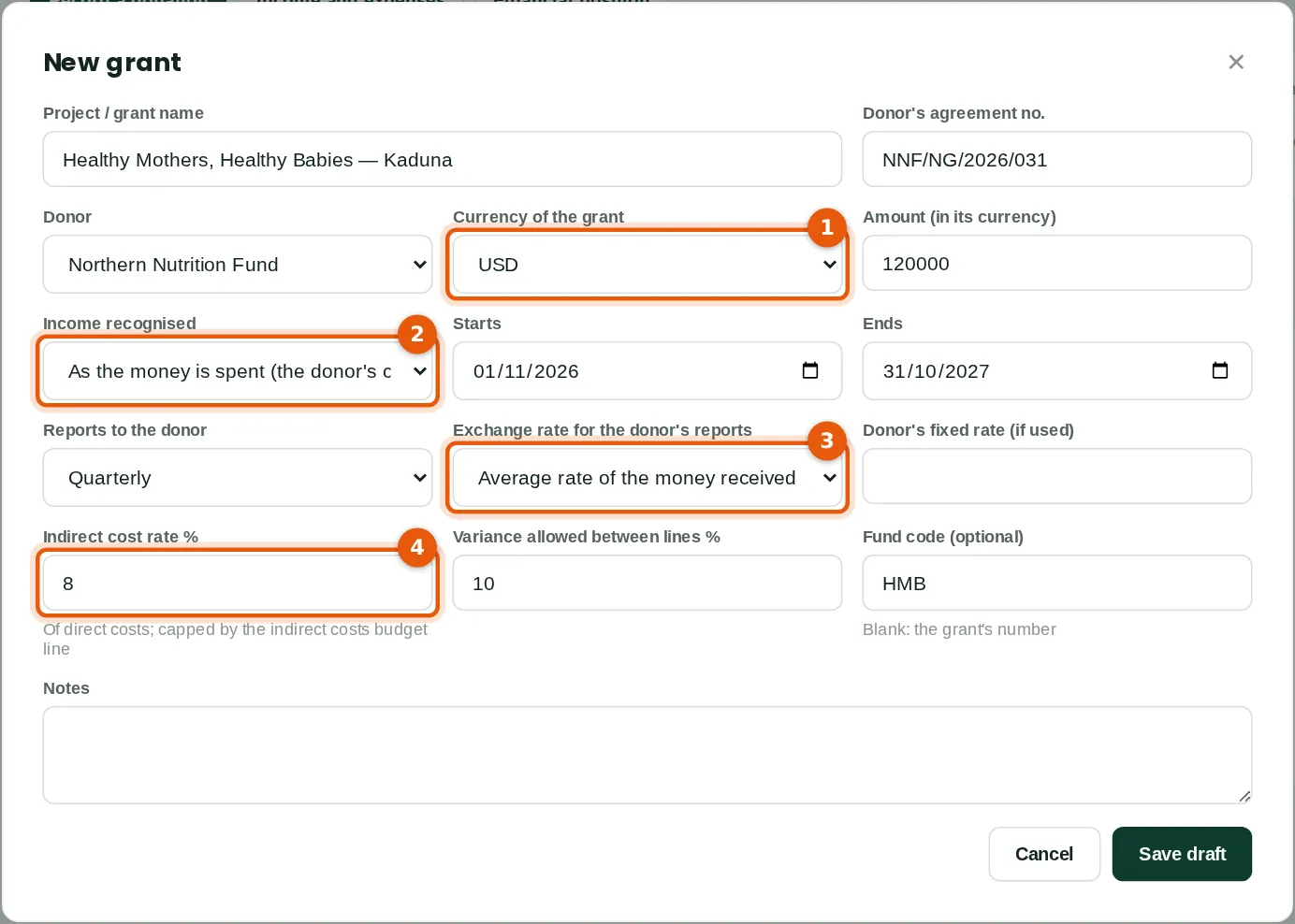
The Northern Nutrition Fund has agreed USD 120,000 (1) for Healthy Mothers, Healthy Babies — Kaduna, agreement NNF/NG/2026/031, from 1 November 2026 to 31 October 2027, with quarterly reports. Its income is recognised as the money is spent (2); the dollar figures use the average rate of the money received (3); the donor pays 8% of direct costs as indirect costs (4) and allows 10% between budget lines. The grant's fund, HMB, is made with it.
Who
NGO finance officer (Prepare level or above). Hauwa Ibrahim.
What to do
- Open Grants and click New grant. Type the donor, the agreement, the currency and amount (1), the dates, the basis (2), the exchange rate method (3) and the indirect cost rate (4), and click Save draft.
32.6 The grant's budget
Why
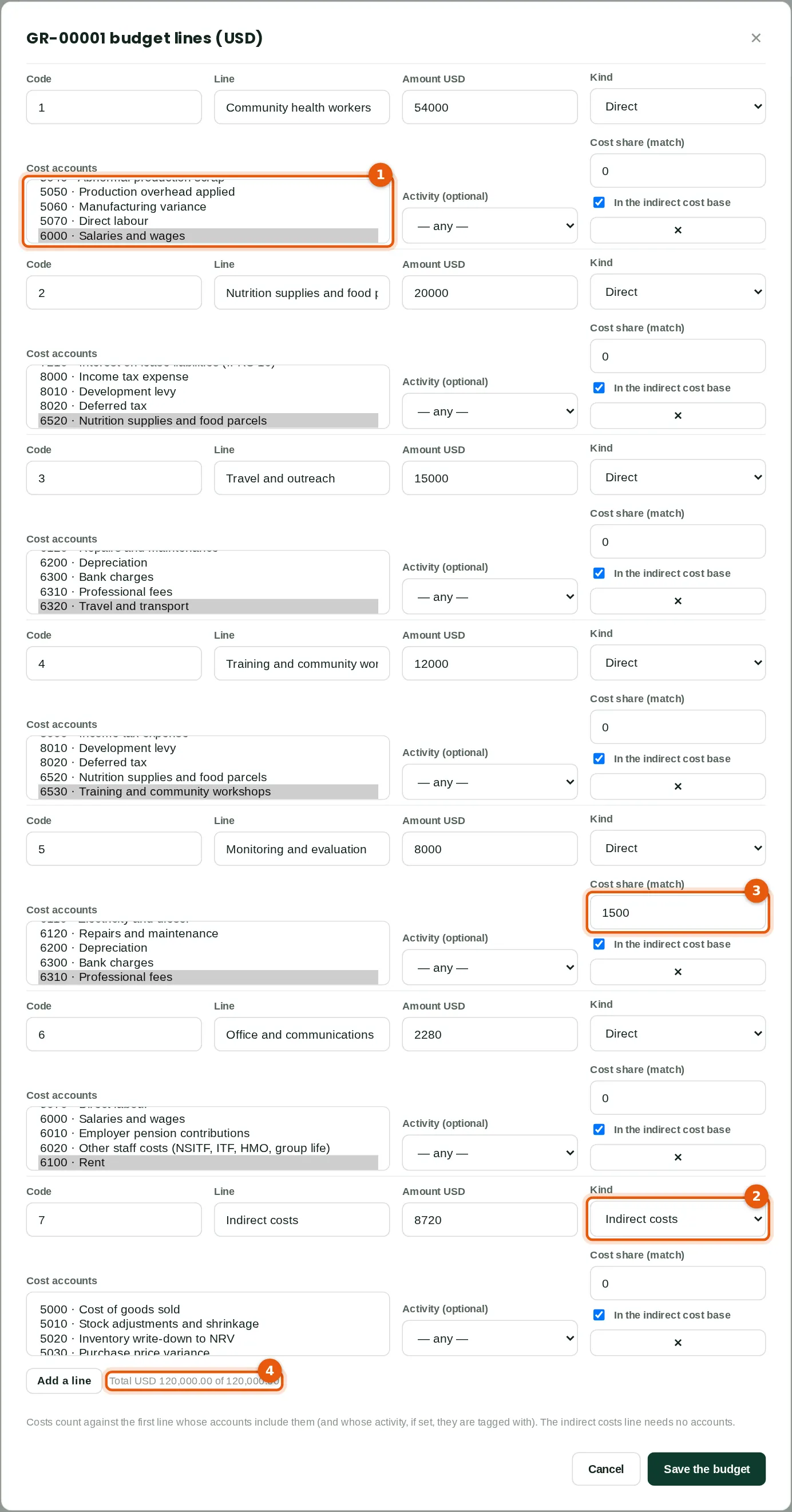
Each line of the donor's budget is entered in dollars with the accounts whose costs count against it (1): community health workers (salaries) USD 54,000, nutrition supplies and food parcels USD 20,000, travel and outreach USD 15,000, training USD 12,000, monitoring and evaluation USD 8,000 and office and communications USD 2,280. The indirect costs line (2), USD 8,720, needs no accounts: it caps the indirect charge. The foundation's own contribution to a line (cost share) is noted (3). The total (4) matches the grant. Hauwa then typed the three tranches expected (USD 40,000 each, on signature, after the first six-month report and after the mid-term review), and Chukwudi activated the grant.
Who
NGO finance officer.
What to do
- Open the grant and click Budget lines. Add a line for each budget line, choose its accounts (1) and kind (2), and click Save the budget. Click Activate when the agreement is signed (Approve level).
32.7 Money received from the donor
Why
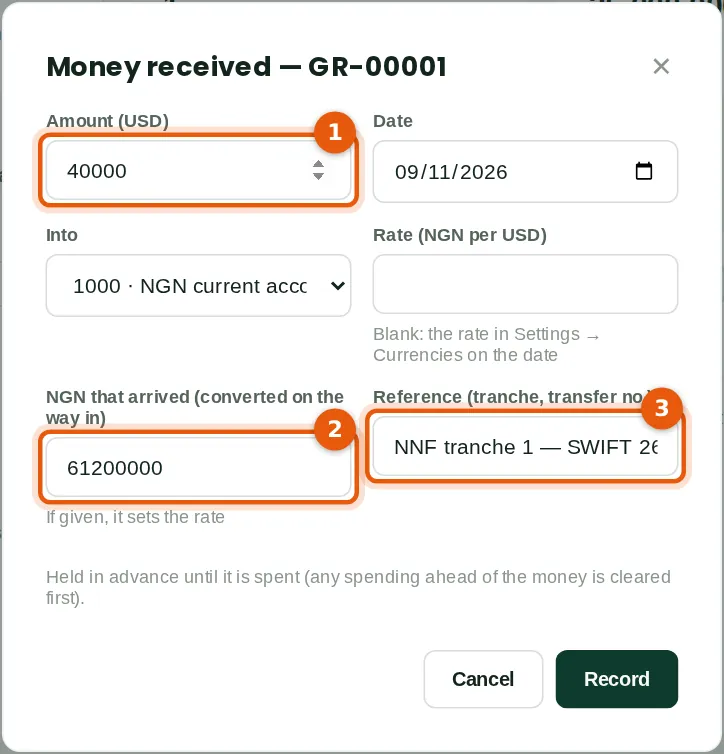
The first tranche, USD 40,000 (1), arrived in the naira account on 9 November as ₦61,200,000 (2), a rate of 1,530; the reference (3) is the donor's transfer. On this basis the money is held in Grants received in advance (2430) until it is spent: journal JV-00004. A tranche paid into a dollar account is recorded in dollars at the day's rate.
Who
NGO finance officer.
What to do
- Open the grant and click Money received. Type the amount in the grant's currency (1), the date and the bank account, the naira that arrived (2) and the reference (3), and click Record.
32.8 Costs coded to the grant
Why
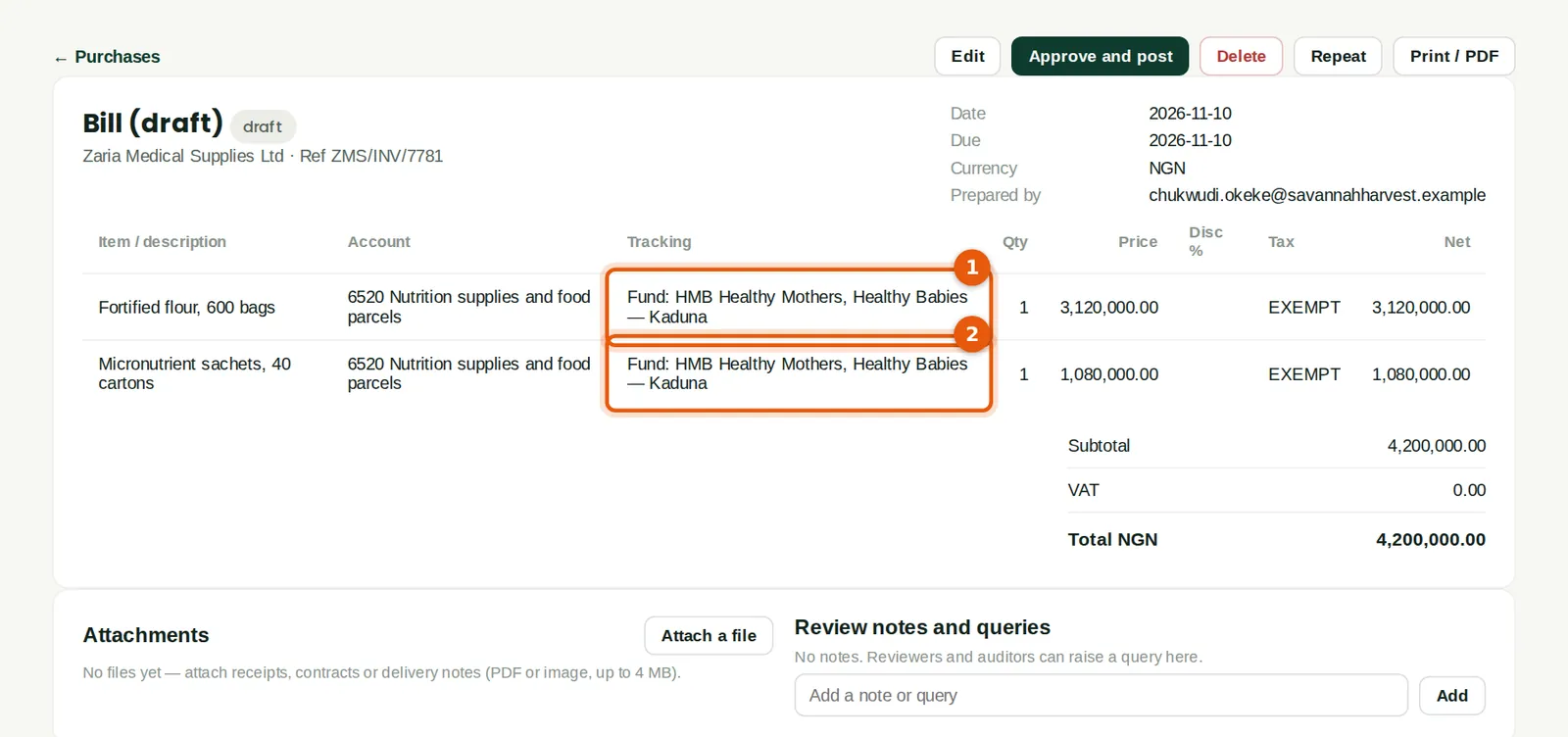
A grant's costs are ordinary bills, expense claims or journals, each line tagged with the grant's fund (1, 2). Zaria Medical Supplies' bill for fortified flour and micronutrient sachets, ₦4,200,000, goes to Nutrition supplies and food parcels, fund HMB. In November the programme also had the community health workers' stipends (₦4,680,000), two days' training (₦980,000) and outreach fuel and vehicle hire (₦1,150,000). The office rent, ₦1,800,000, was left untagged: it is shared at the month end.
Who
Purchases users.
What to do
- On each line of a bill for the programme, choose the grant's fund in the Fund column (1, 2).
32.9 A shared-cost rule
Why
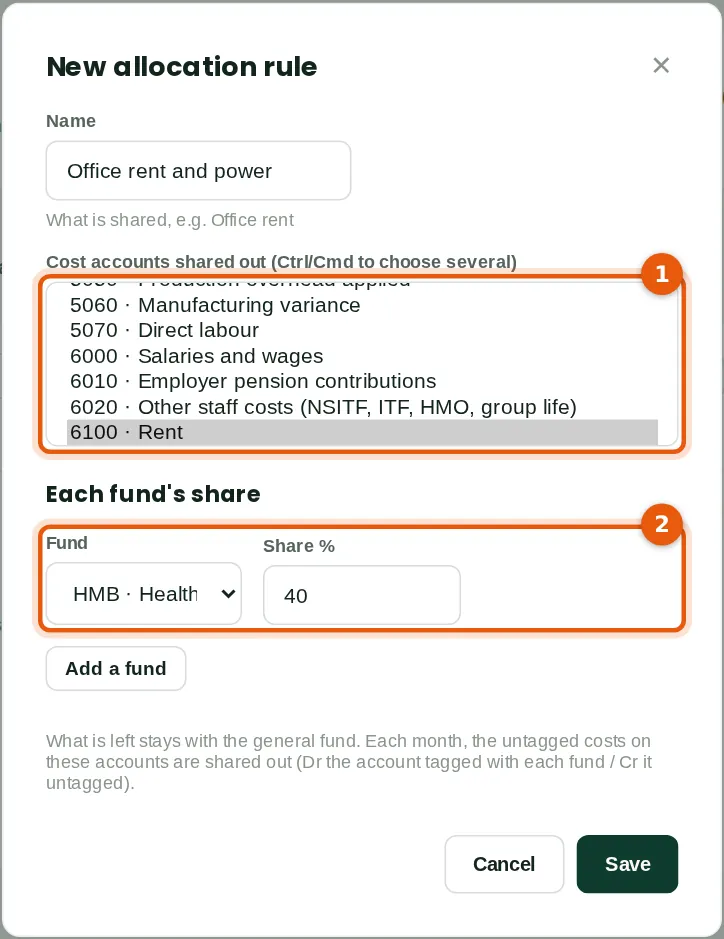
Two days a week of the office are the programme's, so 40% of the untagged costs on Rent and Electricity and diesel (1) are shared to the grant's fund each month (2). What is left stays with the general fund. The month-end runs it.
Who
Owner or administrator.
What to do
- Click New allocation rule. Type the name, choose the accounts (1), add each fund's share (2) and click Save.
32.10 The month-end for grants
Why
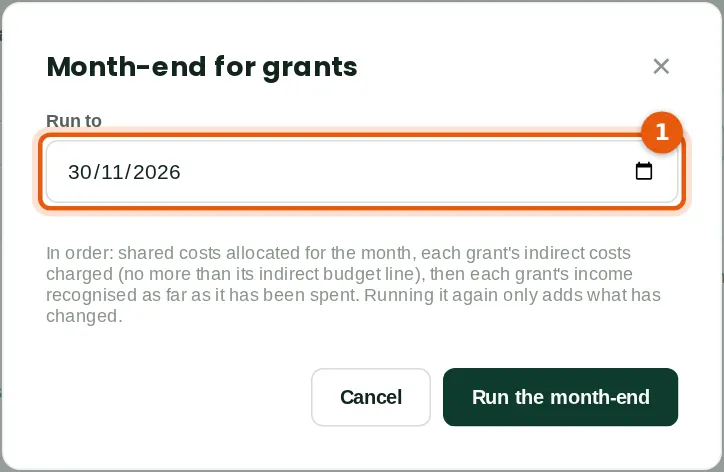
On 30 November Hauwa runs the month-end to the month's last day (1). In order: the shared costs, ₦720,000 of the rent to HMB (JV-00024); the indirect costs, 8% of the ₦11,730,000 of direct costs, ₦938,400 (JV-00025); then the income recognised as spent, ₦12,668,400, from Grants received in advance to Grant income (JV-00026). Running it again adds only what has changed. Each grant's own Recognise income and Charge indirect costs do the same for one grant.
Who
NGO finance officer (Approve level).
What to do
- Open Grants and click Month-end for grants. Choose the date (1) and click Run the month-end.
32.11 The grant
Why
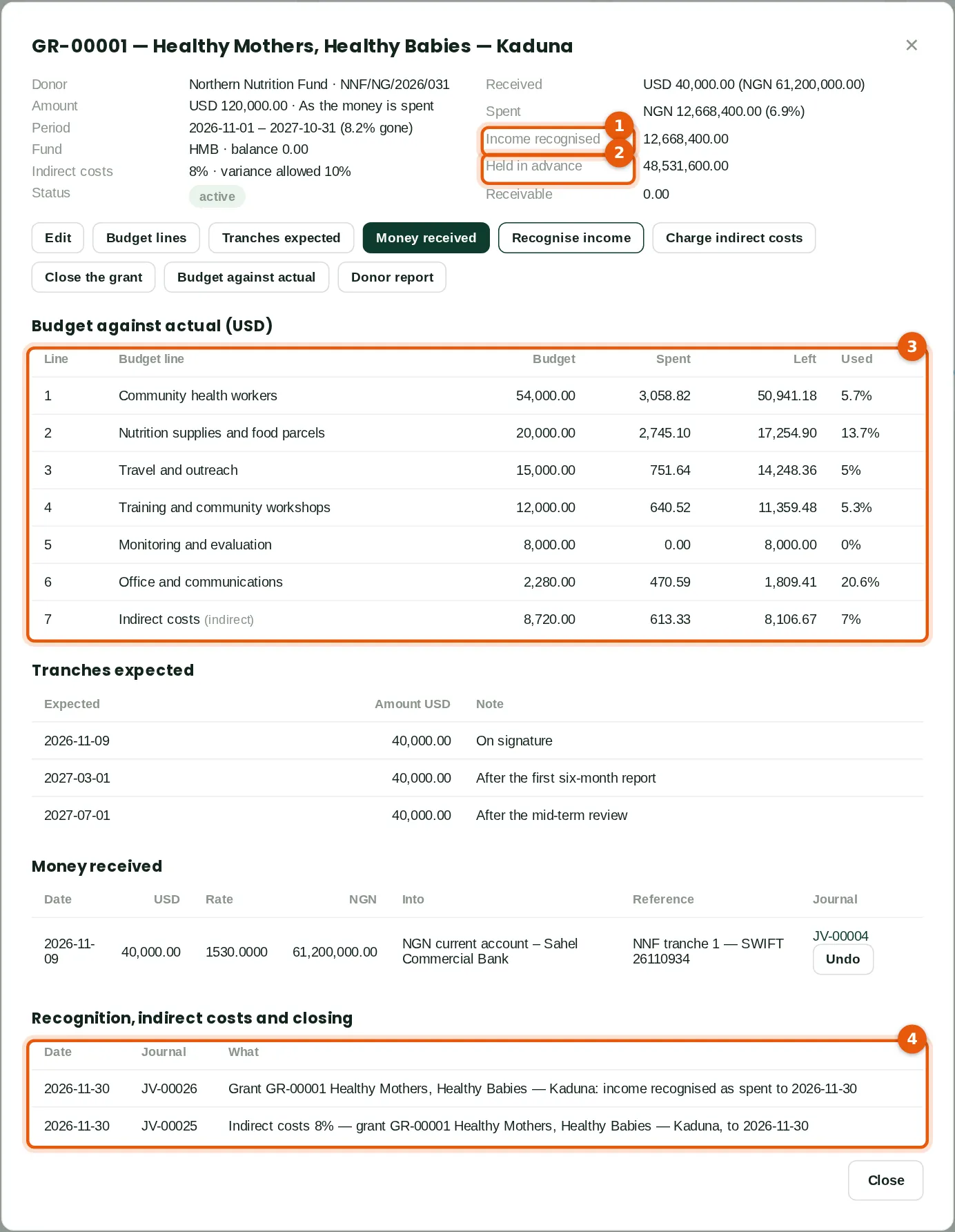
The grant shows what was received (USD 40,000, ₦61,200,000), spent (₦12,668,400, 6.9% of the grant with 8.2% of its time gone), recognised as income (1) and still held in advance, ₦48,531,600 (2). The fund's balance is nil: its income matches its costs. Budget against actual (3) gives each line in dollars at the average rate; the indirect costs line, USD 613.33, is under its USD 8,720 cap. The journals (4) can each be opened.
Who
Everyone with NGO and fund accounting.
What to do
- Open Grants and click the grant. Budget against actual and Donor report open the reports for it.
32.12 The grants
Why
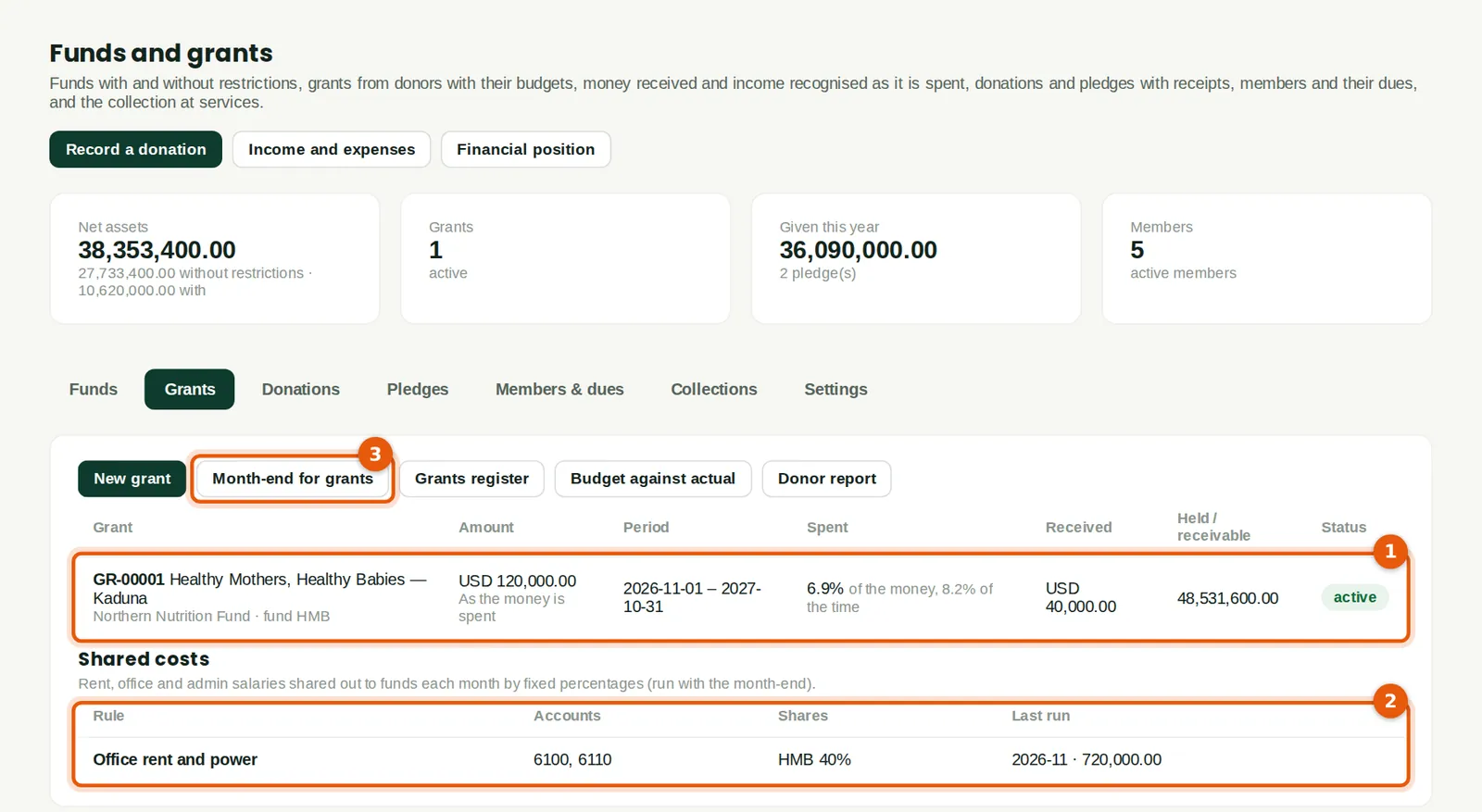
Each grant (1) shows its amount and basis, its period, how much is spent against how much of the time is gone, what was received and what is held or receivable. The shared-cost rules (2) show each one's last run. Month-end for grants (3) is at the top; the Grants register, Budget against actual and Donor report reports are beside it.
Who
Everyone with NGO and fund accounting.
What to do
- Open Grants. Click a grant to open it.
32.13 The donor report
Why
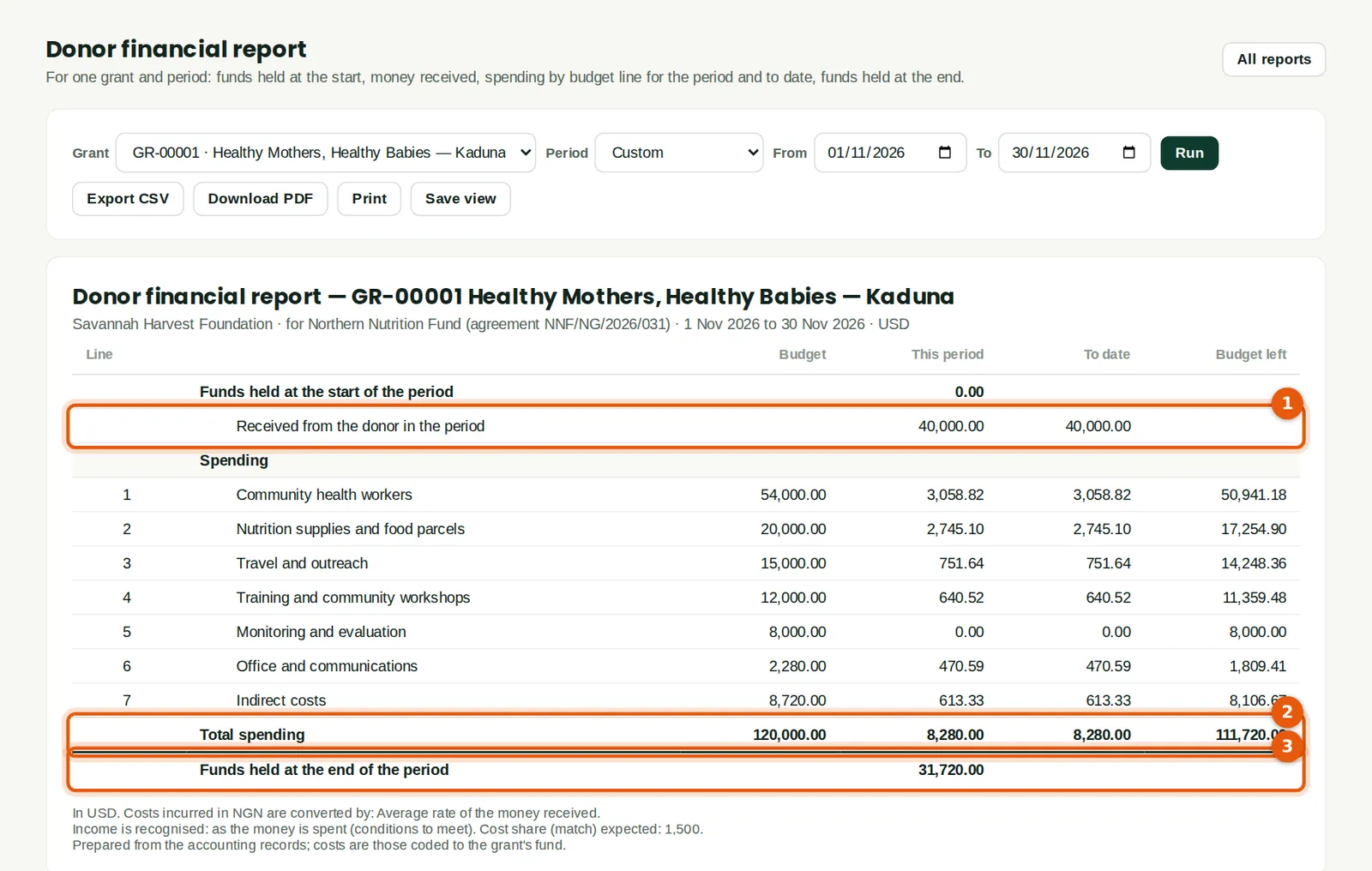
The report a donor asks for, in their currency: what was held at the start, received in the period (1), spent by budget line, against the budget and to date (2), and held at the end (3): USD 40,000 received, USD 8,280 spent, USD 31,720 held. With the average rate an exchange difference row keeps it rolling forward. Download it as a PDF or a spreadsheet to send.
Who
NGO finance officer, reports users.
What to do
- Open Reports → NGO → Donor financial report, choose the grant and the period, and click Run.
32.14 Record a donation
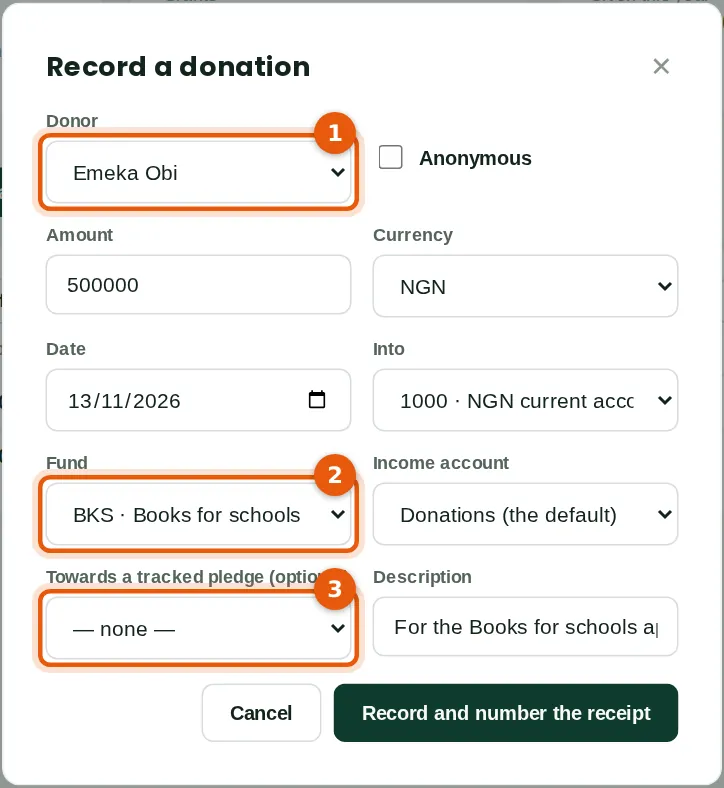
Why
Emeka Obi (1) gave ₦500,000 by transfer for the Books for schools appeal (2). A donation can be anonymous, in another currency, to any income account, and towards a pledge being tracked (3). Recording it posts the receipt and numbers the donation receipt. Fatima Yusuf's ₦150,000 for the general fund was recorded the same day. Money already recorded in Banking is given a receipt with Receipt for money already banked.
Who
NGO finance officer.
What to do
- Click Record a donation. Choose the donor (1), type the amount, date and bank account, choose the fund (2) and any pledge (3), and click Record and number the receipt.
32.15 The donation receipt
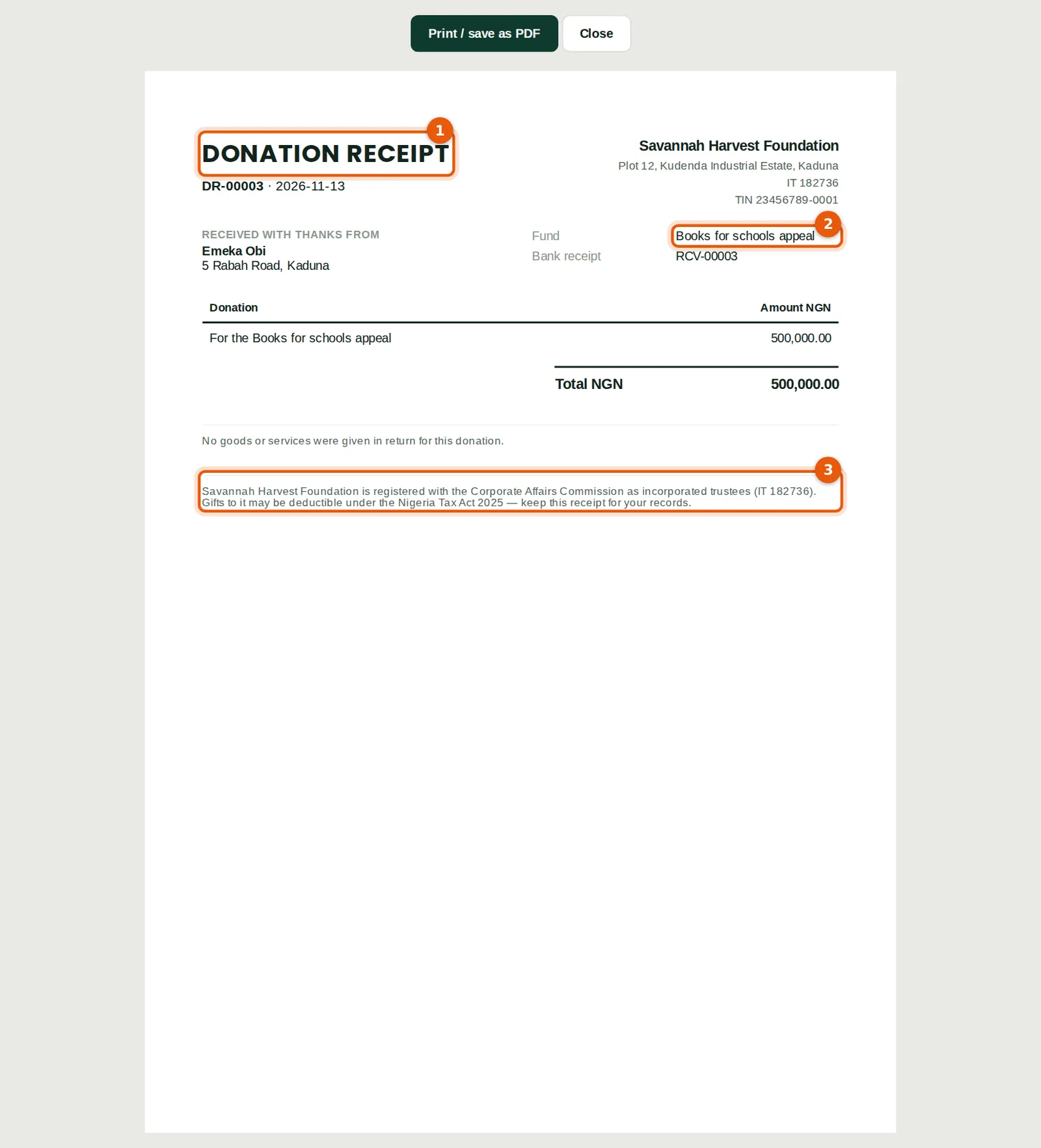
Why
The receipt (1) carries the company's logo and details, the donor, the fund (2), what was given, and the note from Settings (3). It states that no goods or services were given in return. Print it or save it as a PDF; cancelling a donation cancels its receipt.
Who
NGO finance officer.
What to do
- The receipt opens when a donation is recorded. Open a donation and click Print the receipt to print it again.
32.16 A gift in kind
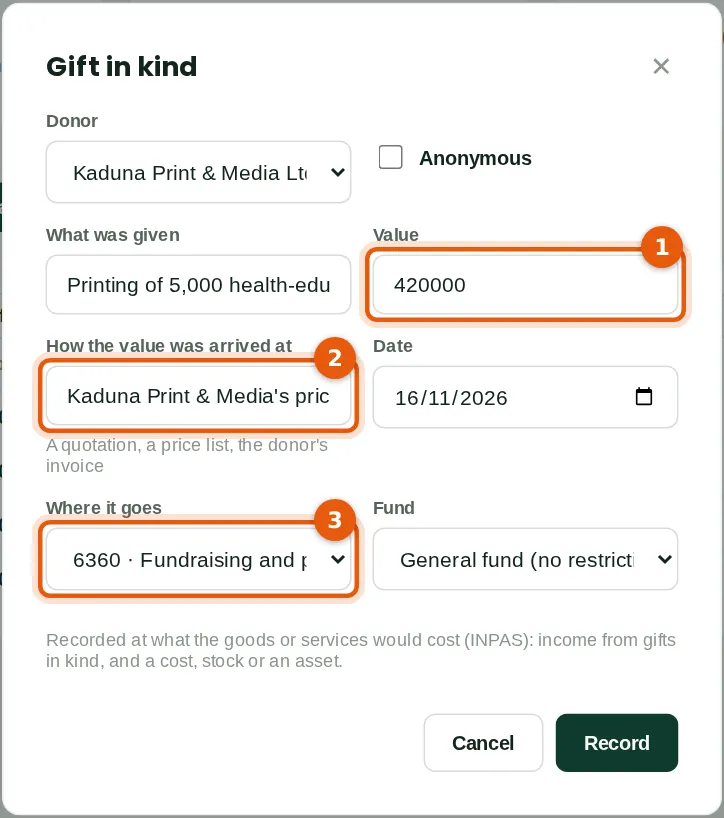
Why
Kaduna Print & Media printed 5,000 health-education leaflets for nothing. The gift is recorded at what the job would cost, ₦420,000 (1), with how the value was arrived at (2): their price list for the same job. It is income in Gifts in kind and, as the leaflets were used for publicity, a cost in Fundraising and publicity (3); goods kept go to stock or an asset instead. A gift in kind cannot go to a grant's fund.
Who
NGO finance officer.
What to do
- Click Gift in kind. Choose the donor, describe the gift, type its value (1) and how it was valued (2), choose where it goes (3) and the fund, and click Record.
32.17 Pledges
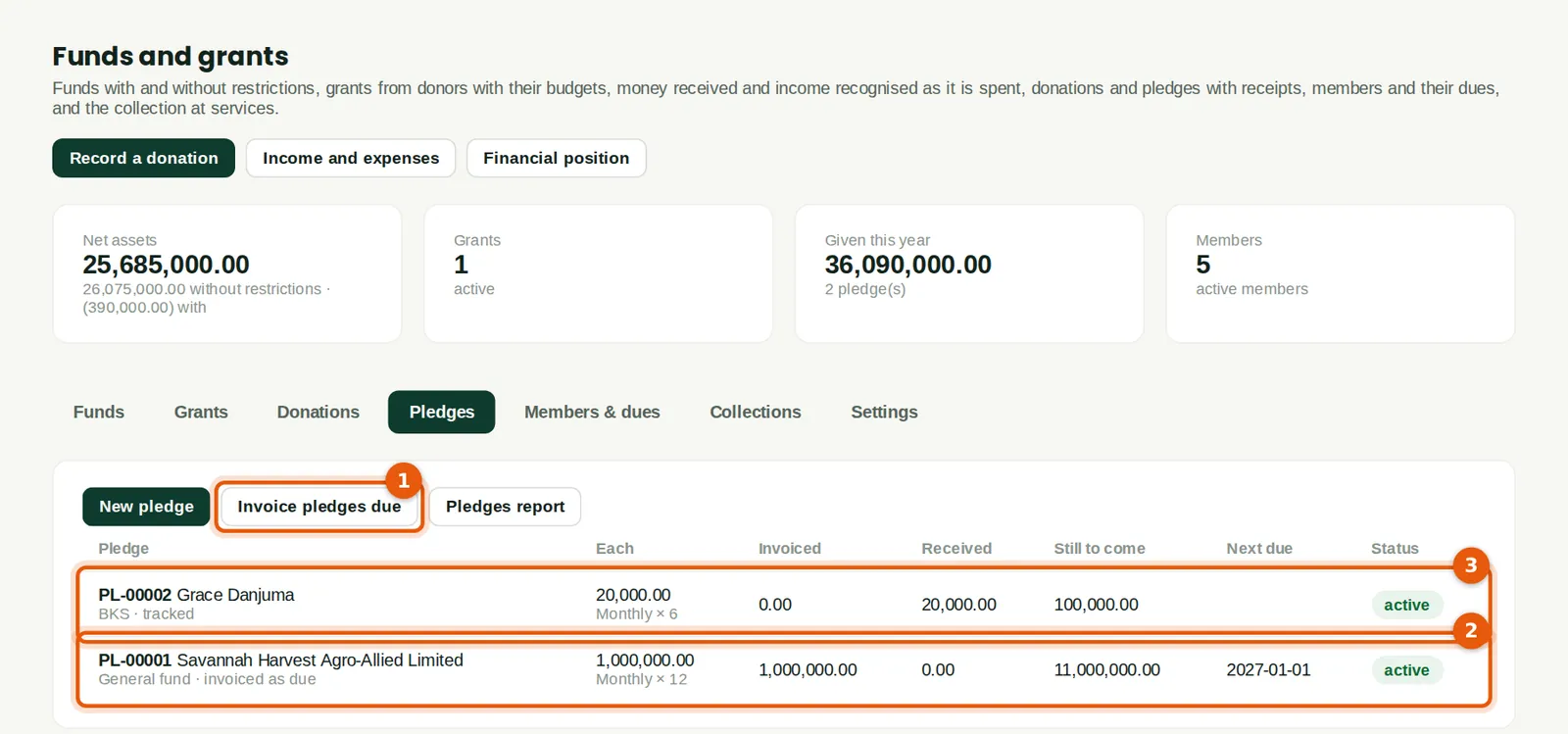
Why
Savannah Harvest Agro-Allied pledged ₦1,000,000 a month for a year from December (2), invoiced as each instalment falls due. Invoice pledges due (1) invoiced December's instalment on 24 November, seven days ahead (the setting); the hourly job does it too. Grace Danjuma pledged ₦20,000 a month for six months to the books appeal (3), paid by standing order: her pledge is tracked, not invoiced, and her first gift on 16 November was recorded towards it.
Who
NGO finance officer.
What to do
- Open Pledges and click New pledge: the donor, the amount, how often, how many times and whether it is invoiced or tracked. Click Invoice pledges due to invoice what falls due now.
32.18 Bill dues or a levy
Why
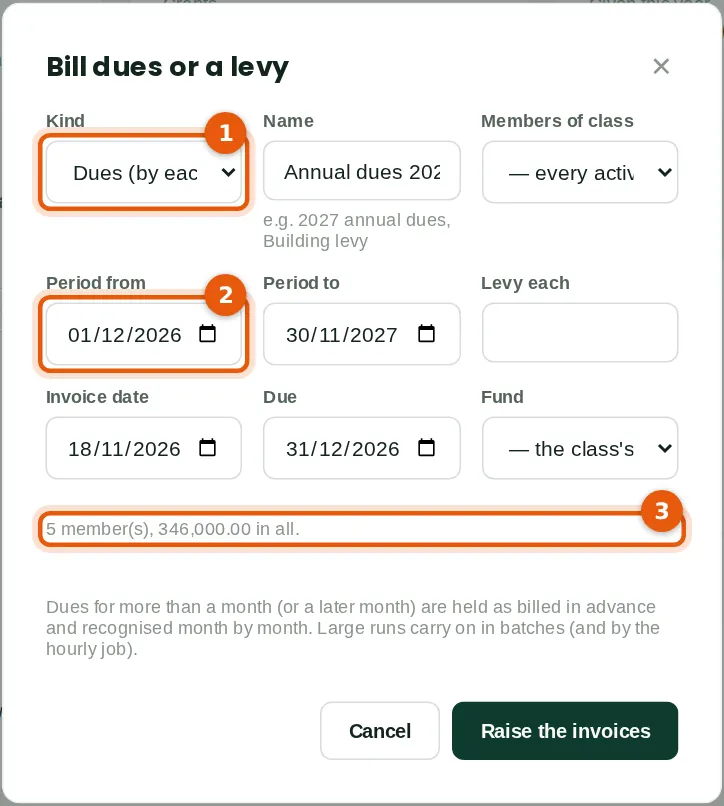
The Friends of the Foundation pay yearly dues: ₦24,000 for a Friend, ₦250,000 for a Patron. The five members were added (Fatima Yusuf, Emeka Obi, Grace Danjuma, Musa Abdullahi, Ifeoma Nwachukwu), then the run (1) bills each active member their class's dues for December 2026 to November 2027 (2): the preview (3) shows 5 members, ₦346,000. A levy charges every member the same amount (a building levy, say). Dues for a later period are held as Dues billed in advance and recognised month by month by the month-end schedules run (chapter 10). Emeka and Fatima paid the next day.
Who
NGO finance officer.
What to do
- Open Members & dues and click Bill dues or a levy. Choose dues or a levy (1), the class (or all), the period (2) and the dates, check the preview (3) and click Raise the invoices. A large run carries on in batches: click Carry on, or leave it to the hourly job.
32.19 Members and their standing
Why
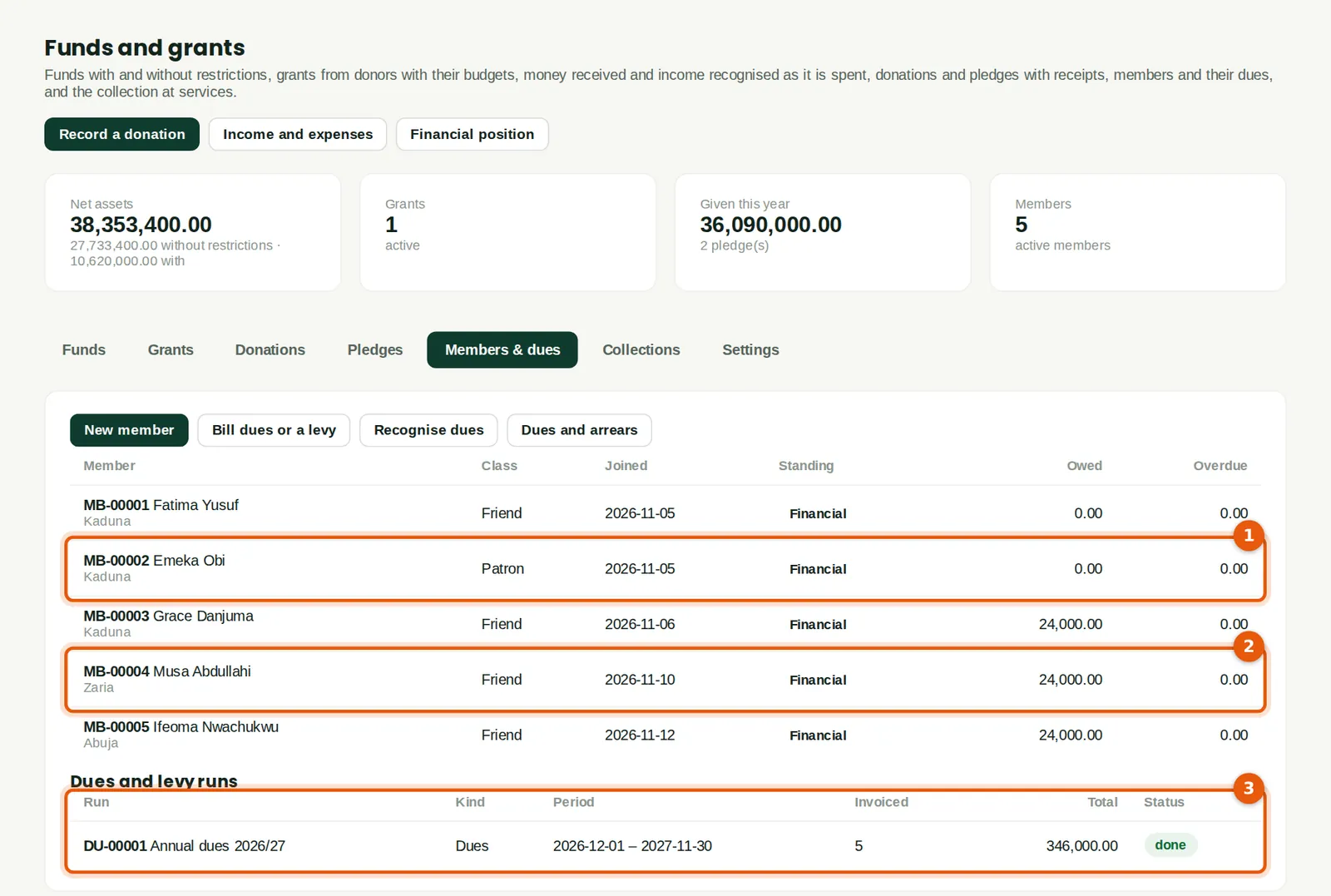
Each member shows their class, when they joined, what they owe and what is overdue. A member is financial while nothing is overdue: Emeka Obi has paid (1); Musa Abdullahi owes ₦24,000 (2), not yet due. The dues runs (3) are below. Cancelling a member's dues from their invoice credits what is not yet recognised.
Who
Everyone with NGO and fund accounting.
What to do
- Open Members & dues. Click a member to change their class or end their membership; Dues and arrears is the report.
32.20 Count a collection
Why
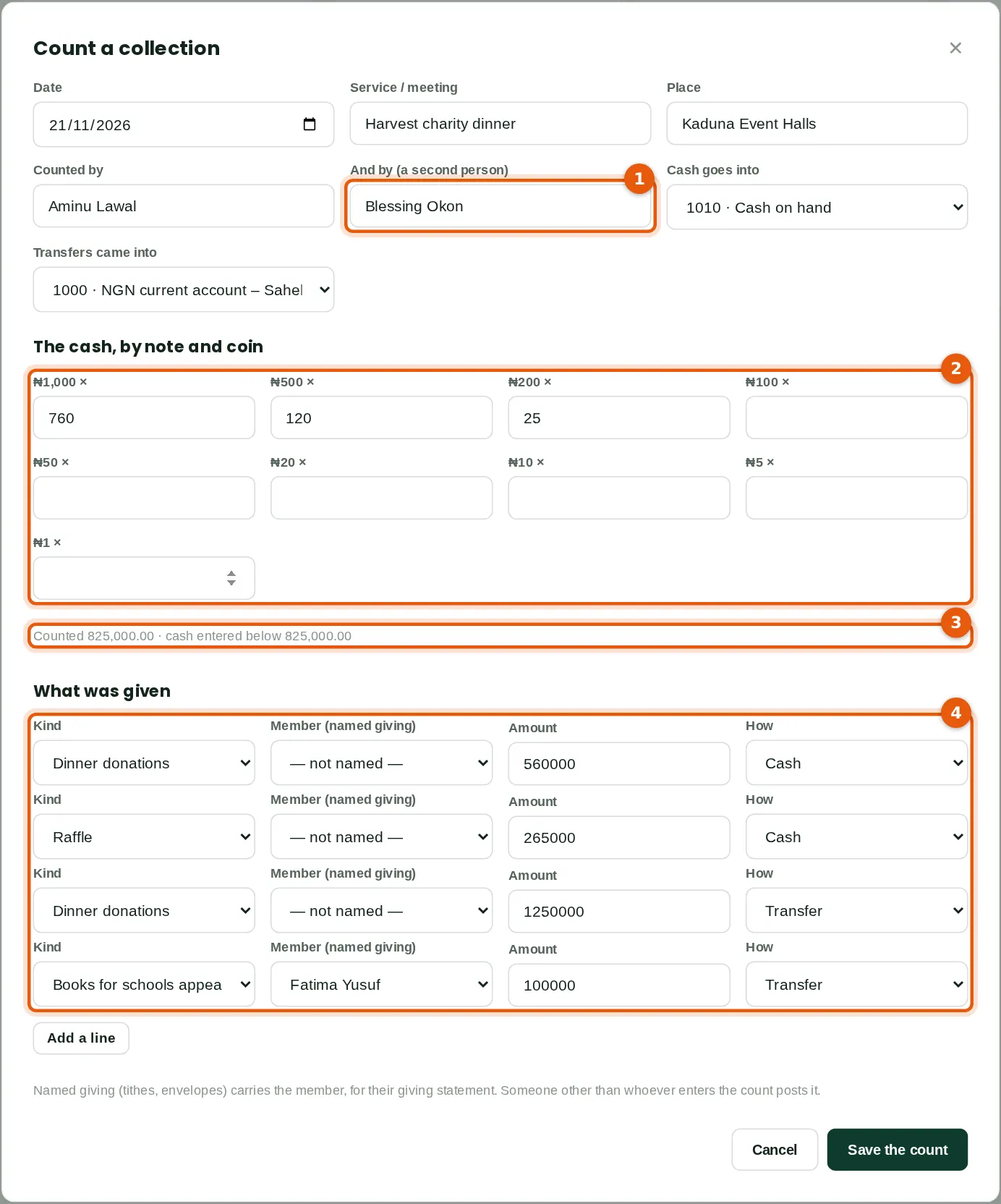
At the charity dinner on Saturday 21 November the cash was counted by Aminu Lawal and Blessing Okon (1). On Monday Hauwa enters their count note by note (2): 760 × ₦1,000, 120 × ₦500 and 25 × ₦200, ₦825,000. The cash lines below must agree with it (3), or the form says to count again. What was given is entered by kind (4): dinner donations and the raffle in cash, ₦1,250,000 of dinner donations by transfer and Fatima Yusuf's ₦100,000 for the books appeal, named so it appears on her giving statement. A church sets up its kinds once (tithes, offerings, thanksgiving), each with its income account, fund and any share sent to headquarters.
Who
NGO finance officer (or whoever counts).
What to do
- Open Collections and click Count a collection. Type the date, the event, the two counters (1), the cash and bank accounts, the count (2) and what was given (4), and click Save the count.
32.21 A second person posts the collection
Why
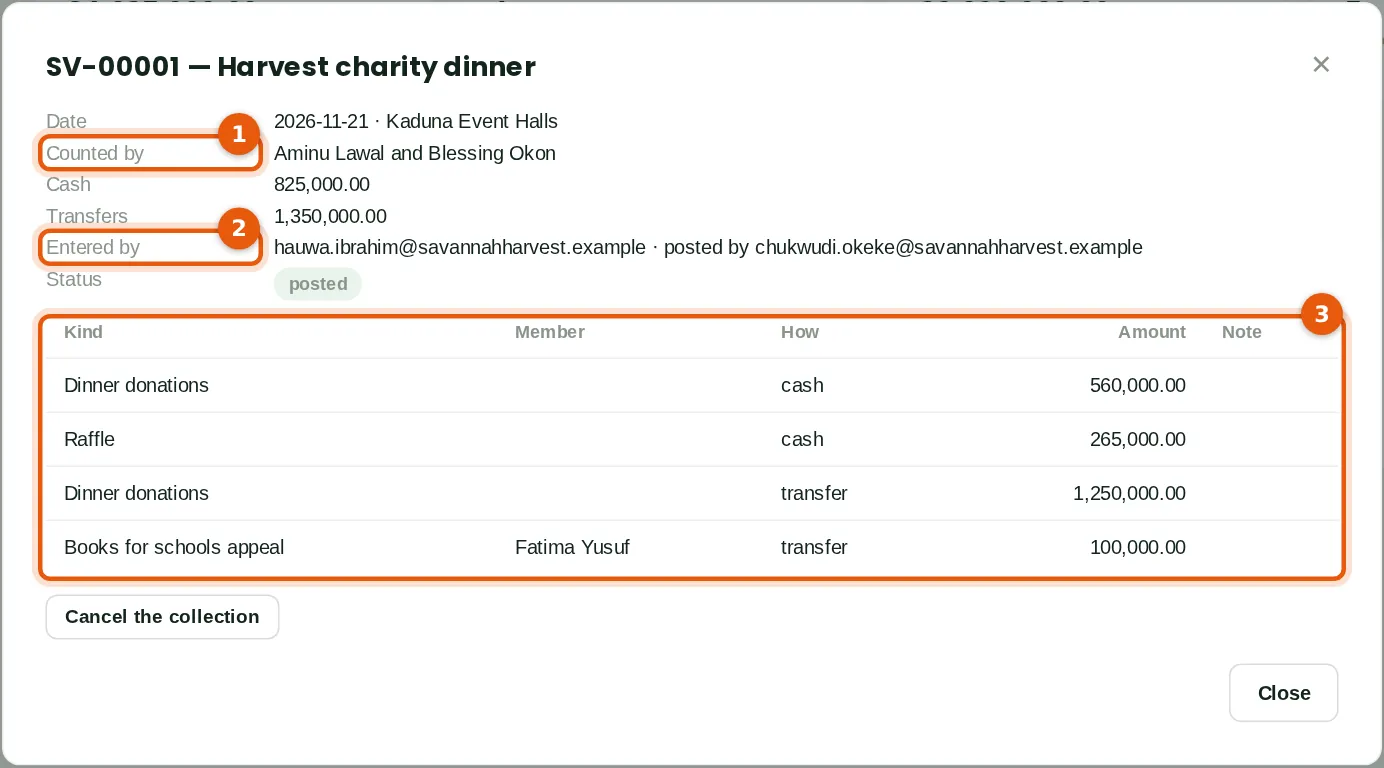
Chukwudi checks the count against the counting sheet and posts it. The collection shows who counted it (1) and who entered and posted it (2), and the lines (3). Journal JV-00022 took ₦825,000 to Cash on hand and ₦1,350,000 to the bank, with ₦2,075,000 to Collections and offerings and ₦100,000 to the books appeal's fund. Nobody can post a count they entered or changed.
Who
NGO and fund accounting at Prepare level: not the person who entered or changed the count.
What to do
- Open Collections, click the collection, check it, click Check and post and confirm.
32.22 The funds
Why
The cards (1) show the net assets, ₦38,353,400 (₦27,733,400 without restrictions and ₦10,620,000 with), the active grants, what was given this year and the members. The general fund (2) holds ₦24,733,400. The endowment keeps its capital (3). The transfers between funds (4) are below. A fund in deficit is flagged by Book health.
Who
Everyone with NGO and fund accounting.
What to do
- Open Funds. Click a fund to see or change it; Changes in net assets is the report of each fund's movements.
32.23 Statement of income and expenses
Why
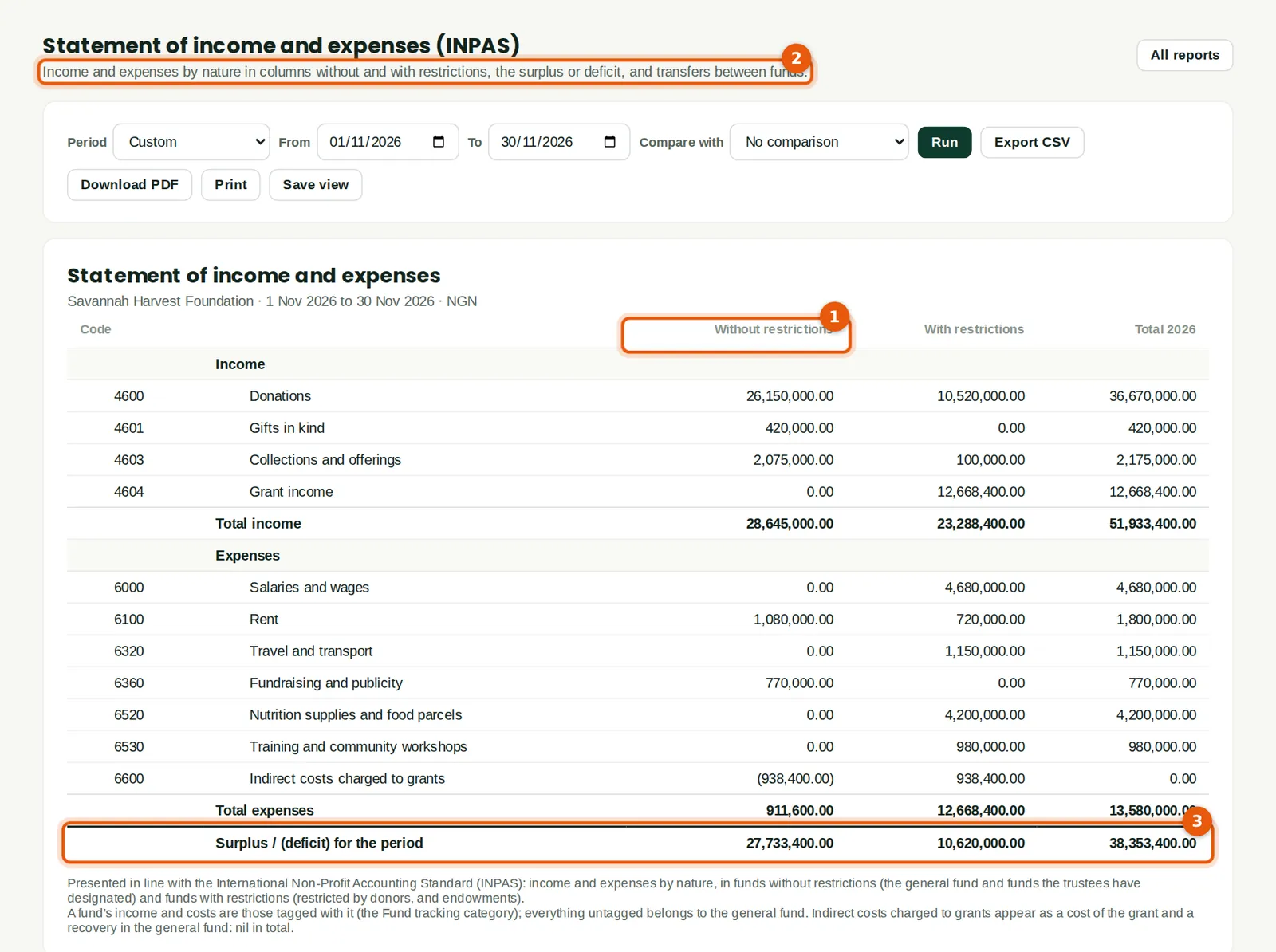
Income and expenses without restrictions (1) and with restrictions (2), with the total. November's income was ₦51,933,400: donations ₦36,670,000, the gift in kind ₦420,000, collections ₦2,175,000 and grant income ₦12,668,400. Expenses were ₦13,580,000. The indirect costs charged to the grant, ₦938,400, are a cost of the restricted column and a recovery in the unrestricted one. The surplus for the month (3) is ₦38,353,400, ₦10,620,000 of it with restrictions.
Who
Reports users.
What to do
- Open Reports → NGO → Statement of income and expenses, choose the period and click Run. Compare with the previous period if you wish.
32.24 Statement of financial position
Why
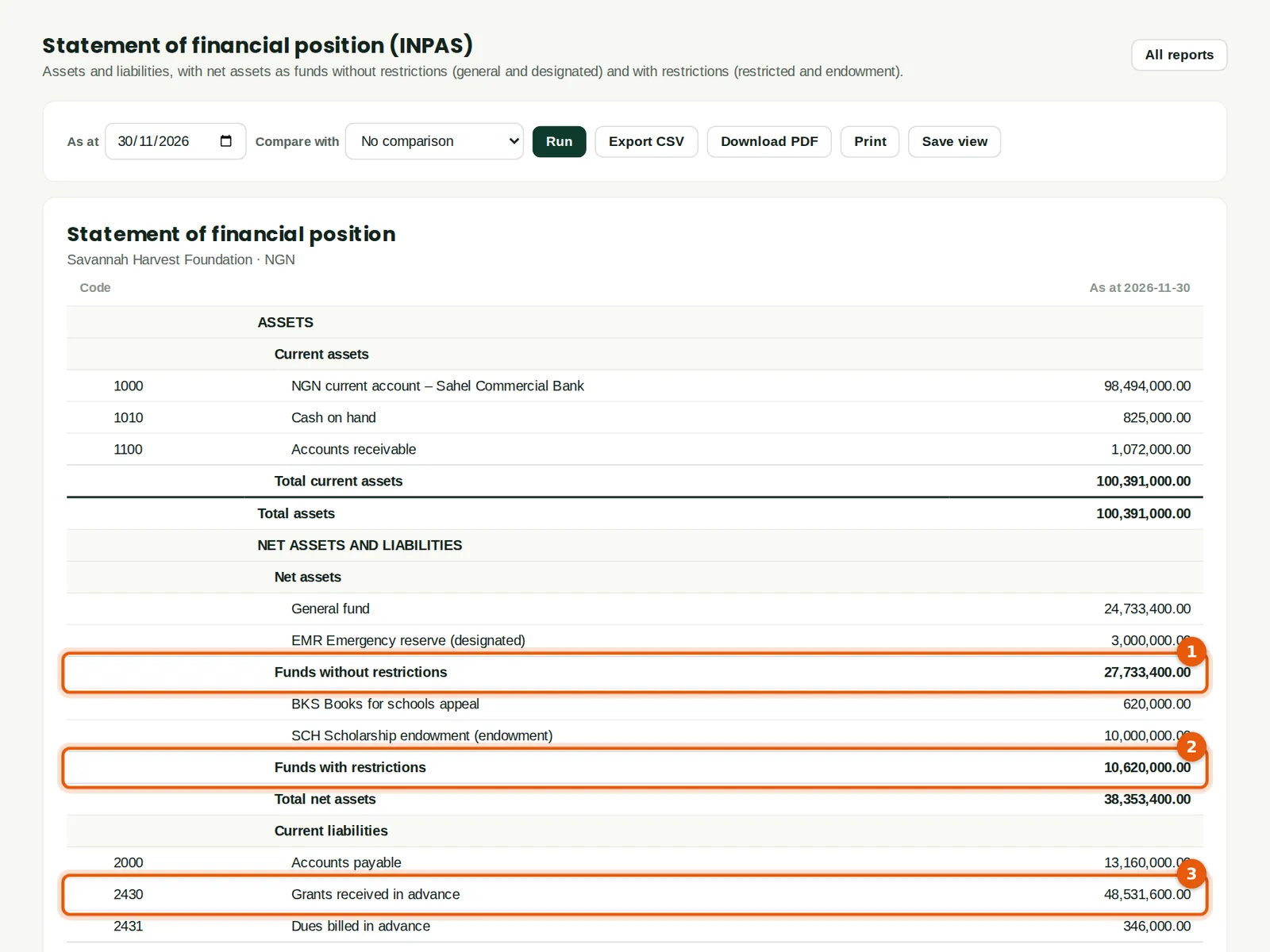
Assets of ₦100,391,000 (the bank ₦98,494,000, cash on hand ₦825,000 and receivables ₦1,072,000) against net assets and liabilities. Net assets are shown by fund: without restrictions, the general fund and the Emergency reserve, ₦27,733,400 (1); with restrictions, the books appeal and the endowment, ₦10,620,000 (2). Liabilities include the grant money not yet spent, ₦48,531,600 (3), and the dues billed in advance, ₦346,000.
Who
Reports users.
What to do
- Open Reports → NGO → Statement of financial position, choose the date and click Run.
32.25 Expenses by function
Why
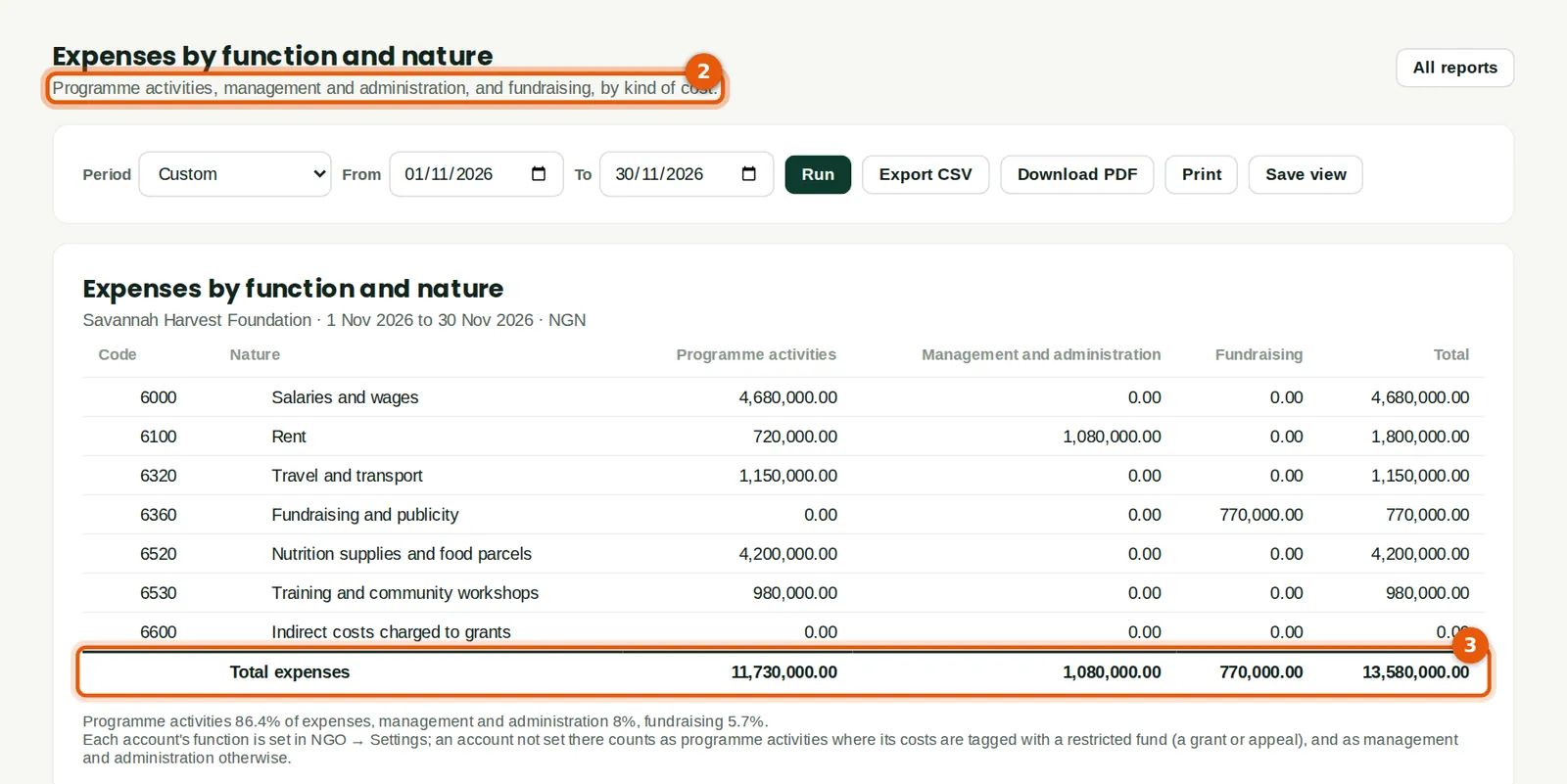
Each expense account split between programme activities (1), management and administration, and fundraising (2), with the totals (3): programme ₦11,730,000 (86.4%), management ₦1,080,000 (8%) and fundraising ₦770,000 (5.7%). Donors and regulators often ask for this. An account not given a function in Settings counts as programme activities where its costs are tagged with a restricted fund, and as management and administration otherwise.
Who
Reports users.
What to do
- Open Reports → NGO → Expenses by function and nature, choose the period and click Run.
32.26 On a phone
Why
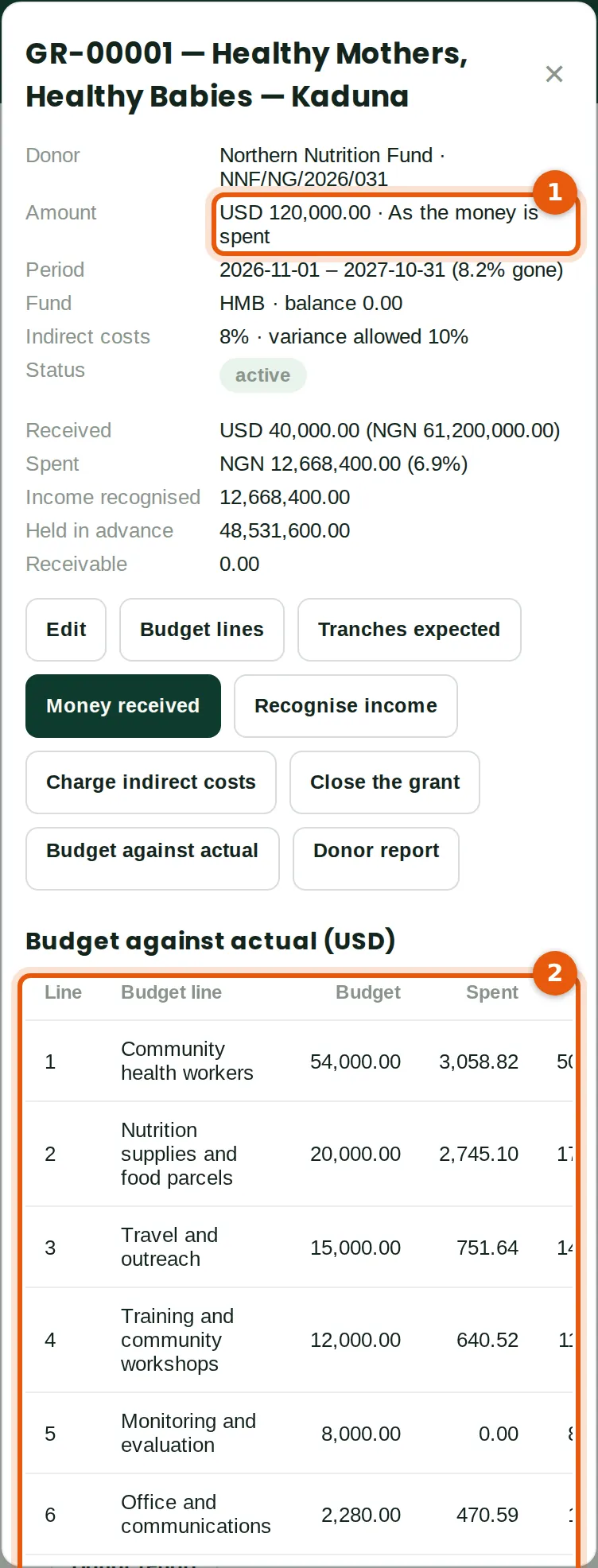
Hauwa checks the grant from her phone: its amount and basis (1), what has been received, spent and recognised, with 8.2% of the time gone and 6.9% spent, and the budget against actual (2). Wide tables scroll sideways. Every screen of Funds and grants works on a phone, including counting a collection.
Who
NGO finance officer.
What to do
- Open Funds and grants on the phone and tap a grant.