Steps in this chapter (20)
Property management keeps the books of property that is let: the properties and their units, the tenancies and short lets, the rent and service charge billed on time, deposits, the costs of running the buildings and, for property managed for a landlord, the rent collected for them, the management fee and the money paid over. Everything it does is an ordinary invoice, credit note, bill, receipt or journal, so the ledger, aged receivables, VAT and the reports see it all.
It is a paid add-on, available on any plan. It works for a company that owns property and lets it (a landlord), for an estate agent or property manager who lets property for landlords, and for a company that does both.
In the illustration Savannah Harvest owns Harvest Court, a block of six flats and two serviced guest suites beside its Kaduna factory: some flats are let to staff, some to the public, and the suites to visiting buyers by the night. It also manages Barnawa Shopping Plaza for Bawa Family Holdings Ltd, the founding family's company, for a fee of 10% of the rent collected. Chukwudi Okeke (administrator) sets up the properties on Thursday 8 October 2026; Ngozi Okafor, the new property manager (the Property manager role), runs the tenancies, billing, deposits, expenses and the landlord's money to Monday 2 November.
How property management works
| Topic | What happens |
|---|---|
| Where | Business → Property management, with tabs for Tenancies, Properties & units, Billing, Service charge, Expenses, Landlords and Settings. Reports → Property: rent roll, rent arrears, vacant units, lease expiries and rent reviews, tenancy deposits held, and the landlord statement. |
| Add-on | Property management is a paid add-on on any plan, added by the subscription owner on troveuniverse.com. Without it the area and its reports are hidden. |
| Who | A new area, Property management, in each role. View: see everything. Prepare: draft and start tenancies, bill, record expenses, change a tenancy's terms (not its amounts). Approve: also change the rent and charges of a running tenancy, end tenancies, settle deposits, recognise rent billed in advance, reconcile the service charge, collect for landlords and pay them. Full: also set up properties, units, service charge budgets and the accounts used. A new ready-made role, Property manager, has Property management at Approve with Sales and Purchases at Prepare; bookkeepers can view it. Property management raises its own invoices and bills: a property manager needs no Sales rights of their own. |
| Owned or managed | A property is owned by the company, or managed for a landlord (a contact) with a fee. On an owned property the rent is the company's income. On a managed property it is the landlord's money: the invoice credits Landlords' rent billed, not yet collected with the landlord named on the line, and no VAT of the company's is charged on it (the landlord accounts for any VAT on their rent). |
| Tenancies | A tenancy lets a unit to a tenant (a customer) from one date to another: a lease, or a short let by the night. One tenancy at a time per unit. It is drafted, then started (activated): the deposit invoice is raised and whatever is due is billed. Each tenancy has charges — rent, service charge and other charges — each with its amount, how often it is billed (monthly, quarterly, half-yearly, yearly, once or per night) and its VAT code. A rent review (every so many months, by a percentage) is applied to the periods that start after it. |
| VAT | Residential rent is exempt from VAT; commercial rent and short lets in serviced apartments carry VAT at 7.5% when the company is registered. These are the defaults for each unit's kind; a charge can take another code. The management fee on a managed property carries VAT when the company is registered. |
| Billing | A period is billed a number of days before it starts (14 unless changed): one invoice per tenancy for everything due. The billing run (Billing tab) and the scheduled job every hour do it, so rent is never forgotten; nothing is billed twice. A part period at the end of a tenancy is charged by the day. |
| Billed in advance | On an owned property, a period of more than a month (a year's rent) or one starting in a later month than the invoice is held in Rent and service charge billed in advance, a liability, and recognised as income month by month over the calendar months it covers. The Billing tab's Recognise, or the month-end schedules run (chapter 10), posts each month's share. |
| Deposits | A deposit has its own invoice, with no VAT, held in Tenant deposits held. When the tenant leaves, it is settled: part applied to what the tenant still owes, part kept with the reason (income on an owned property, the landlord's money on a managed one) and the rest paid back. A renewal keeps the deposit. |
| Landlords | Collecting for a landlord moves what the tenants have paid to Landlords' funds held (client money) and takes the management fee (with its VAT) from it. Withholding tax a tenant deducted is the landlord's: the credit note goes to them. Expenses of a managed property are paid out of the landlord's funds. Paying the landlord comes out of the funds, never more than is held. |
| Tracking | Each property is an option of a Property tracking category, so its income and costs show in the profit and loss by property (chapter 12). |
| Checks | The month-end checklist checks that every tenancy is billed for the month. Book health flags a tenancy that could not be billed, tenants holding over after their lease ended, and deposits not settled a month after a tenancy ended. |
31.2 A property and its units
Why
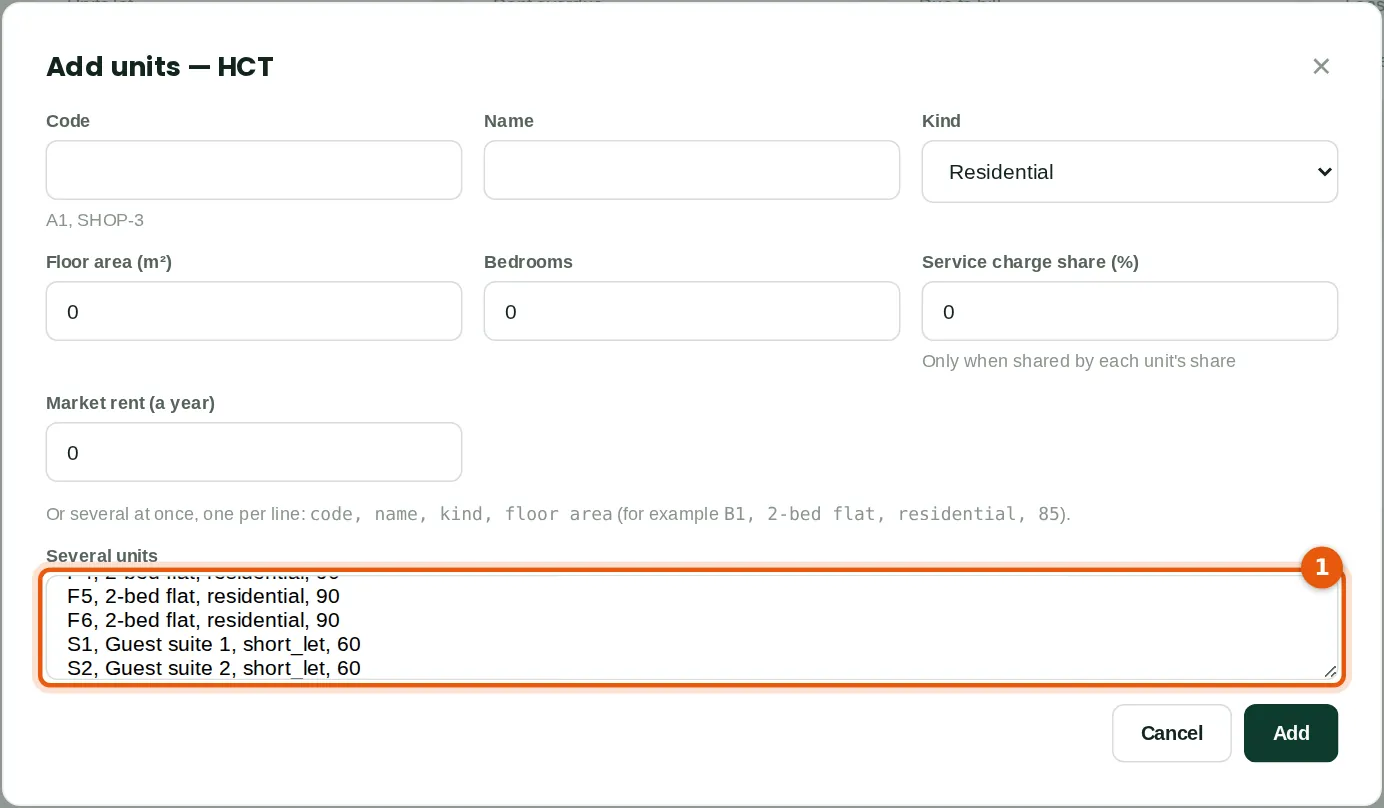
Chukwudi adds Harvest Court (HCT), a residential property owned by the company, then its units in one go (1): one line each, with the code, the name, the kind and the floor area — six flats (F1 to F6, 120 m² or 90 m²) and two guest suites let by the night (S1 and S2, short-let apartments, 60 m²). The floor area shares the service charge (step 31.18). A unit can also carry its number of bedrooms and its market rent. Each property becomes an option of the Property tracking category.
Who
Owner or administrator (Property management at Full level). Chukwudi Okeke.
What to do
- Open Property management and click New property. Type the code, the name and the kind, and click Save.
- In the property, click Add units. Fill in one unit, or type several, one per line (1), and click Add.
31.3 A property managed for a landlord
Why
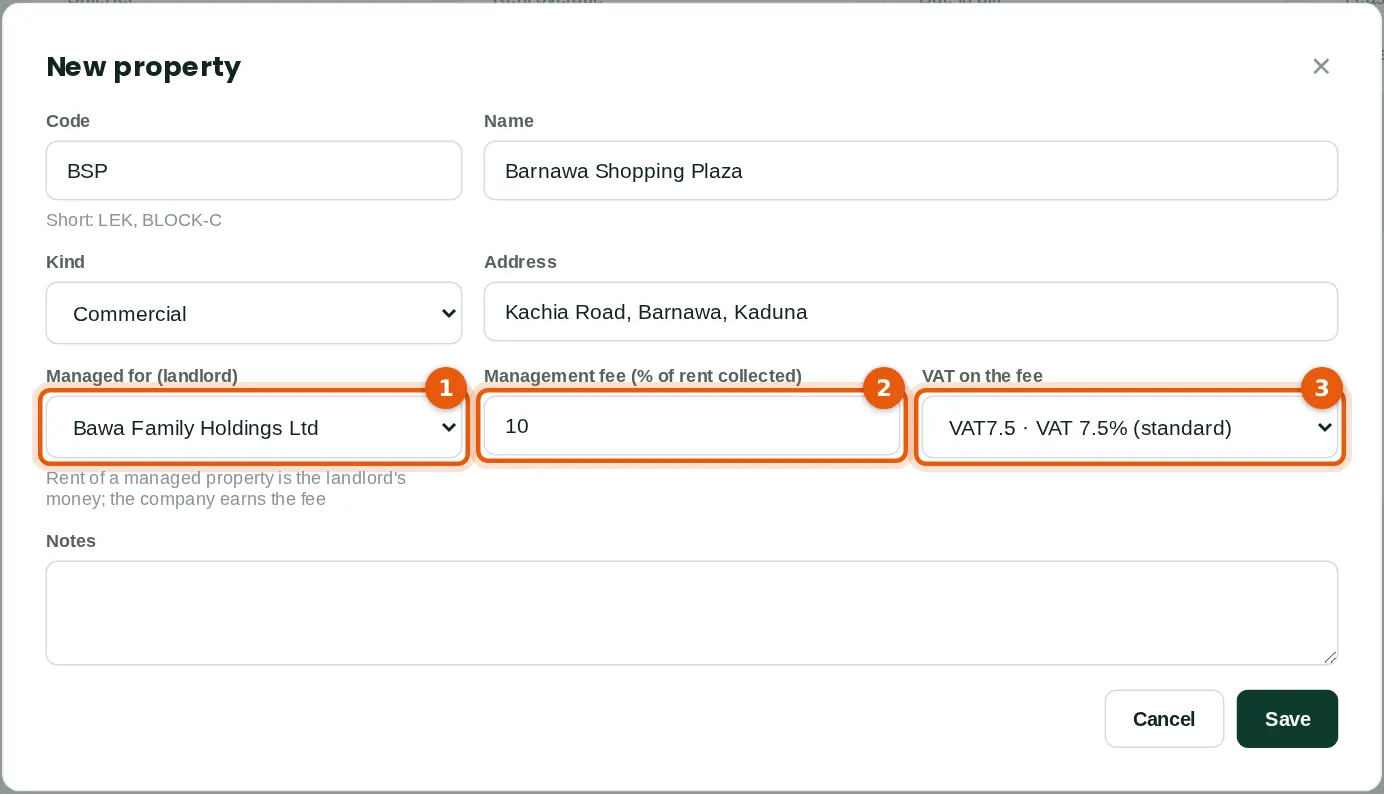
Barnawa Shopping Plaza (BSP) belongs to Bawa Family Holdings Ltd, which Savannah Harvest manages it for (1). The fee is 10% of the rent collected (2), with VAT at 7.5% (3). The plaza's units are three ground-floor shops and a first-floor office, all commercial. Whether a property is owned or managed, and for whom, cannot change once rent has been billed on it.
Who
Owner or administrator.
What to do
- Click New property. Choose the landlord (1), the fee (2) and its VAT (3), and click Save. Then add the units.
31.4 A new tenancy
Why
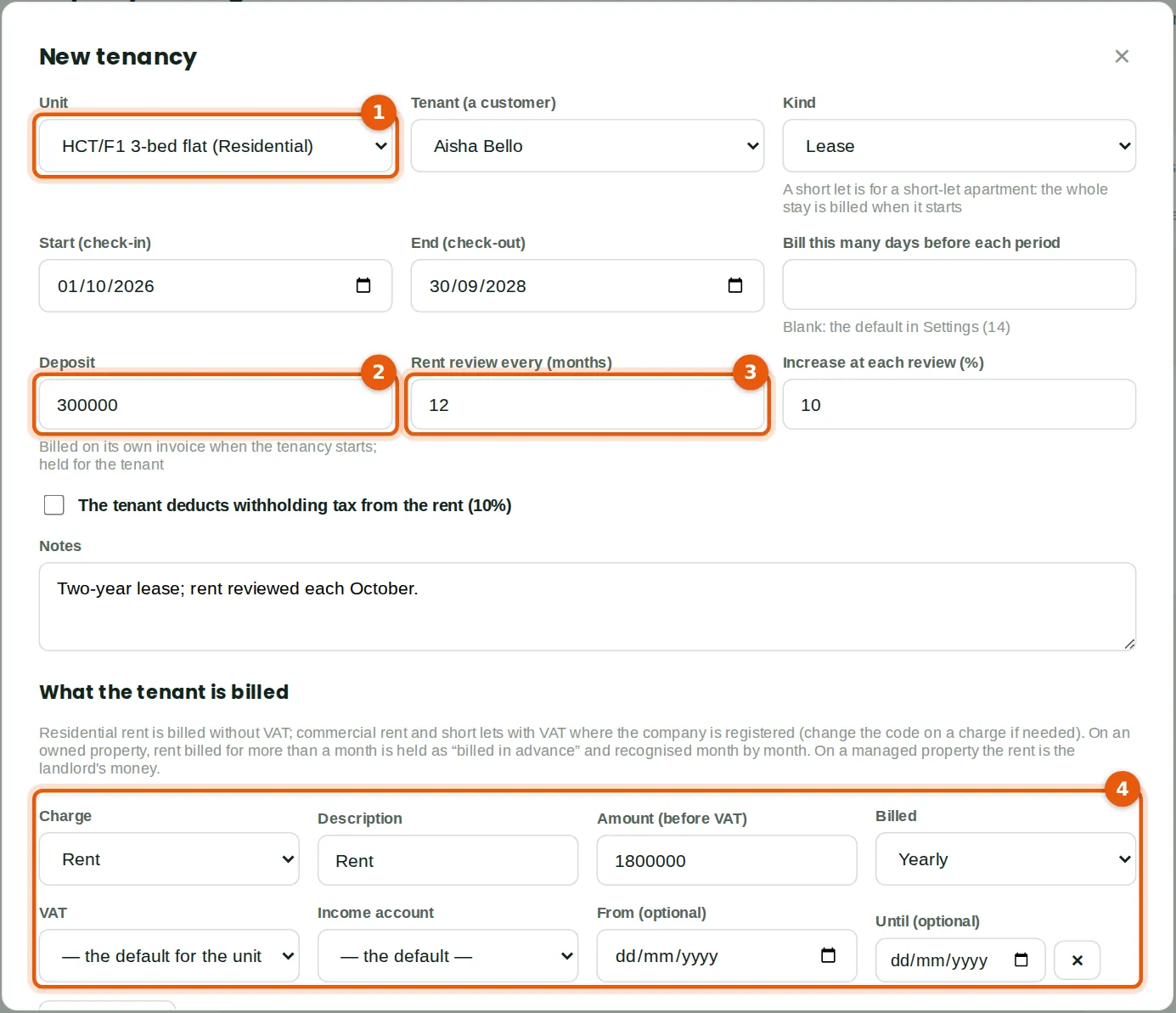
Aisha Bello rents flat F1 (1) for two years from 1 October 2026, paying a year's rent in advance, ₦1,800,000, with a deposit of ₦300,000 (2). The rent goes up 10% every 12 months (3): the next year is billed at ₦1,980,000. The charges (4) are what she is billed: here the rent, yearly; a service charge or other charges (a car-park fee, a one-off agency fee) are added with Add a charge. The VAT code is left to the default (residential rent is exempt). A tenant who deducts withholding tax from the rent is ticked so (it is set for Kaduna Pharmacy, step 31.21).
Who
Property manager (Property management at Prepare level or above). Ngozi Okafor.
What to do
- Click New tenancy. Choose the unit (1) and the tenant, and type the dates.
- Type the deposit (2) and any rent review (3).
- For each charge, choose rent, service charge or other, type the amount before VAT and how often it is billed (4). Click Save draft.
31.5 The tenancy, started
Why
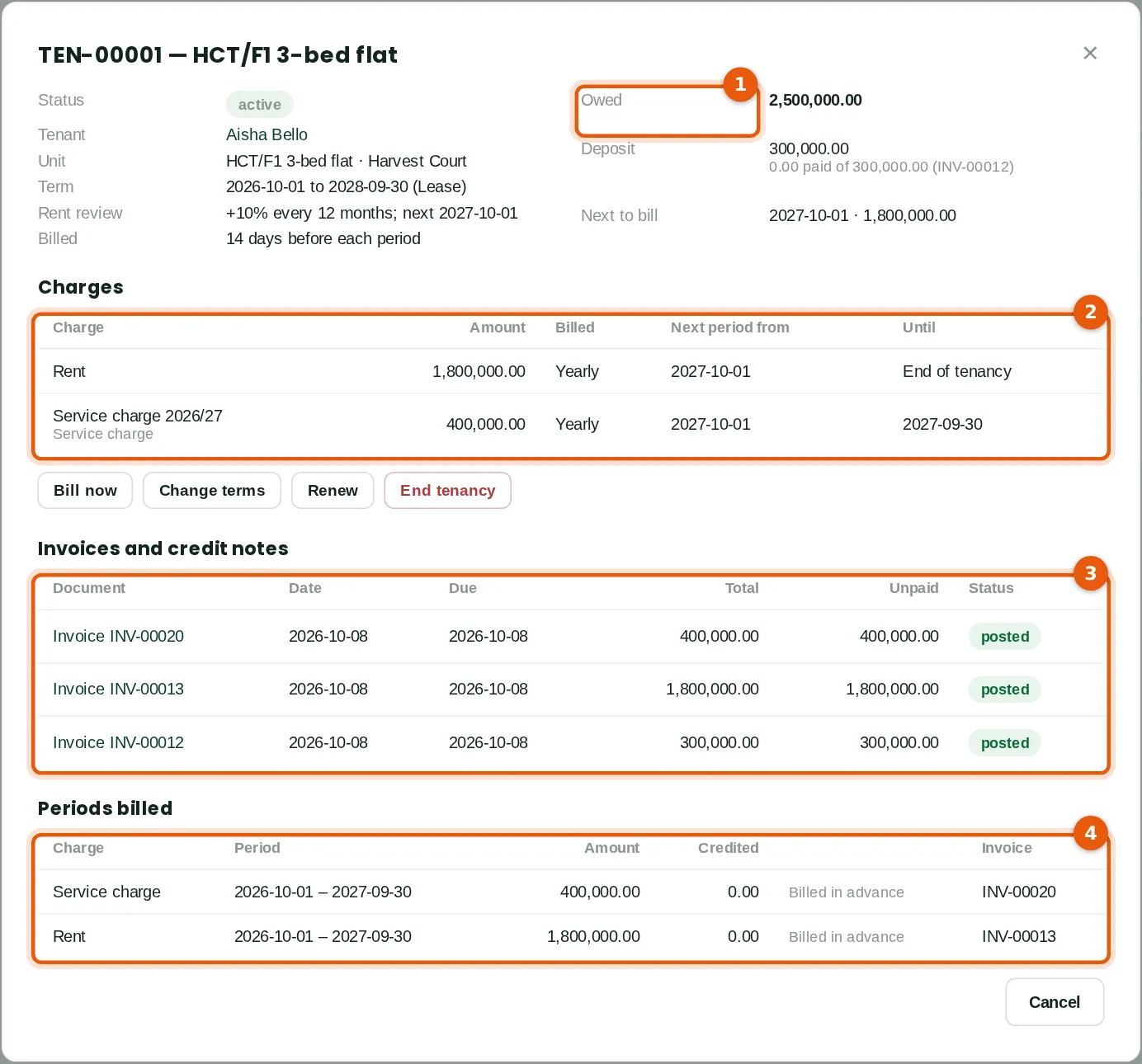
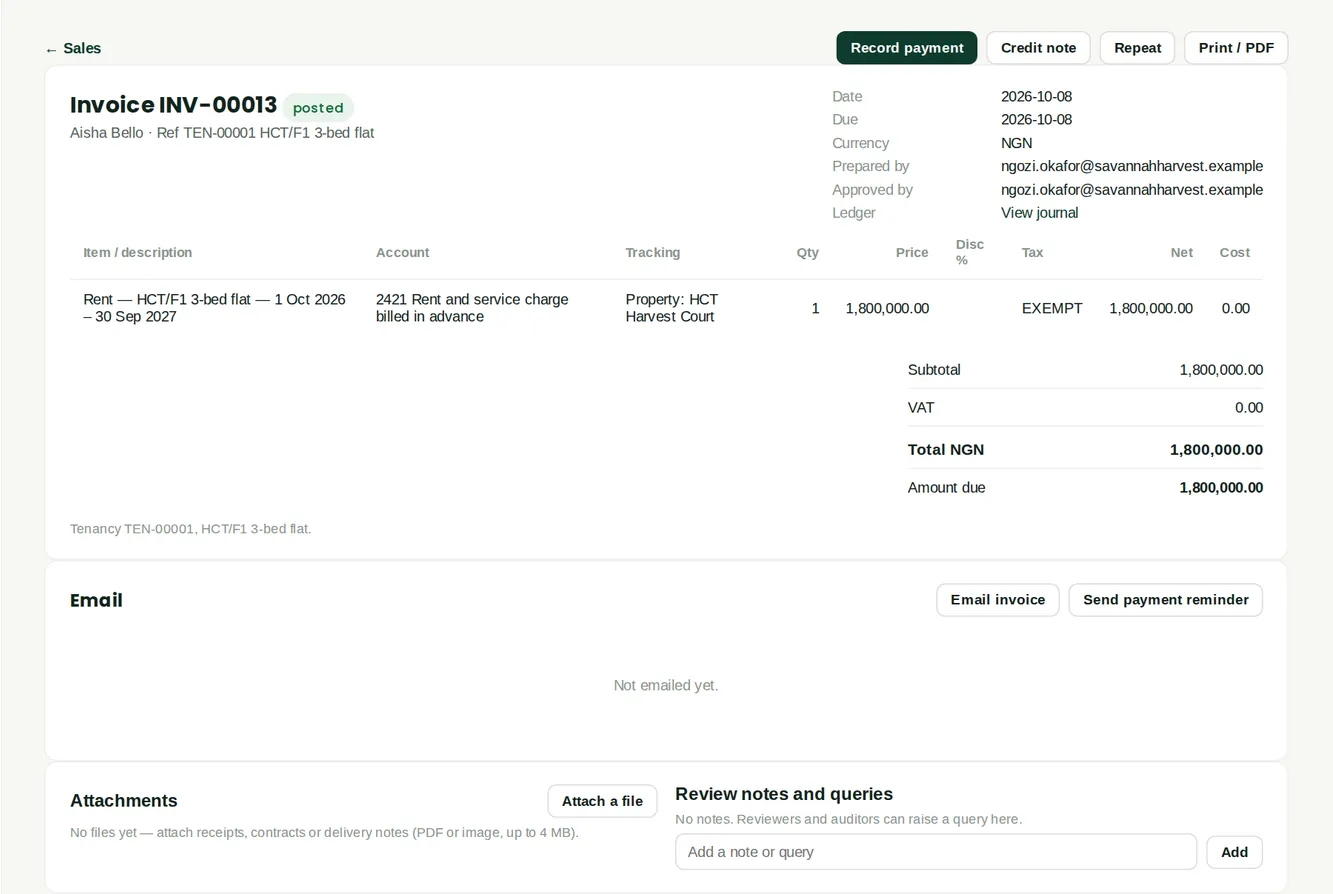
Ngozi clicked Activate. BookTrove raised the deposit invoice, INV-00012 for ₦300,000, and billed the first year's rent, INV-00013 for ₦1,800,000; later that morning the service charge budget (step 31.18) added a yearly service charge of ₦400,000, billed by the billing run as INV-00020. Aisha owes ₦2,500,000 (1). The charges (2) show the next period of each; the invoices (3) and the periods billed (4) show each period once, with Billed in advance where it is held as a liability and recognised month by month. Maryam Garba (flat F2, ₦1,500,000 a year, deposit ₦250,000) and Daniel Ayuba (flat F3, ₦150,000 a month, deposit ₦150,000) were started the same way, and the plaza's two shops: Kaduna Pharmacy Ltd (₦2,400,000 a year, which deducts withholding tax) and Zainab Musa (Zainab Fabrics, ₦450,000 a quarter).
Who
Property manager.
What to do
- Open the tenancy and click Activate. Bill now bills anything due at once; Change terms changes the billing days, the review or (with Approve level) the charges.
31.6 The rent invoice
Why
The invoice is an ordinary sales invoice: it is emailed, paid, chased and appears in aged receivables like any other, with the company's logo (chapter 7). Its line names the unit and the period. As a year's rent on an owned property, it goes to 2421 Rent and service charge billed in advance, VAT exempt, tagged with Harvest Court in the Property tracking category. Aisha paid all three invoices by transfer on 9 October.
Who
Property manager, sales users.
What to do
- Click an invoice on the tenancy to open it.
31.7 A short let
Why
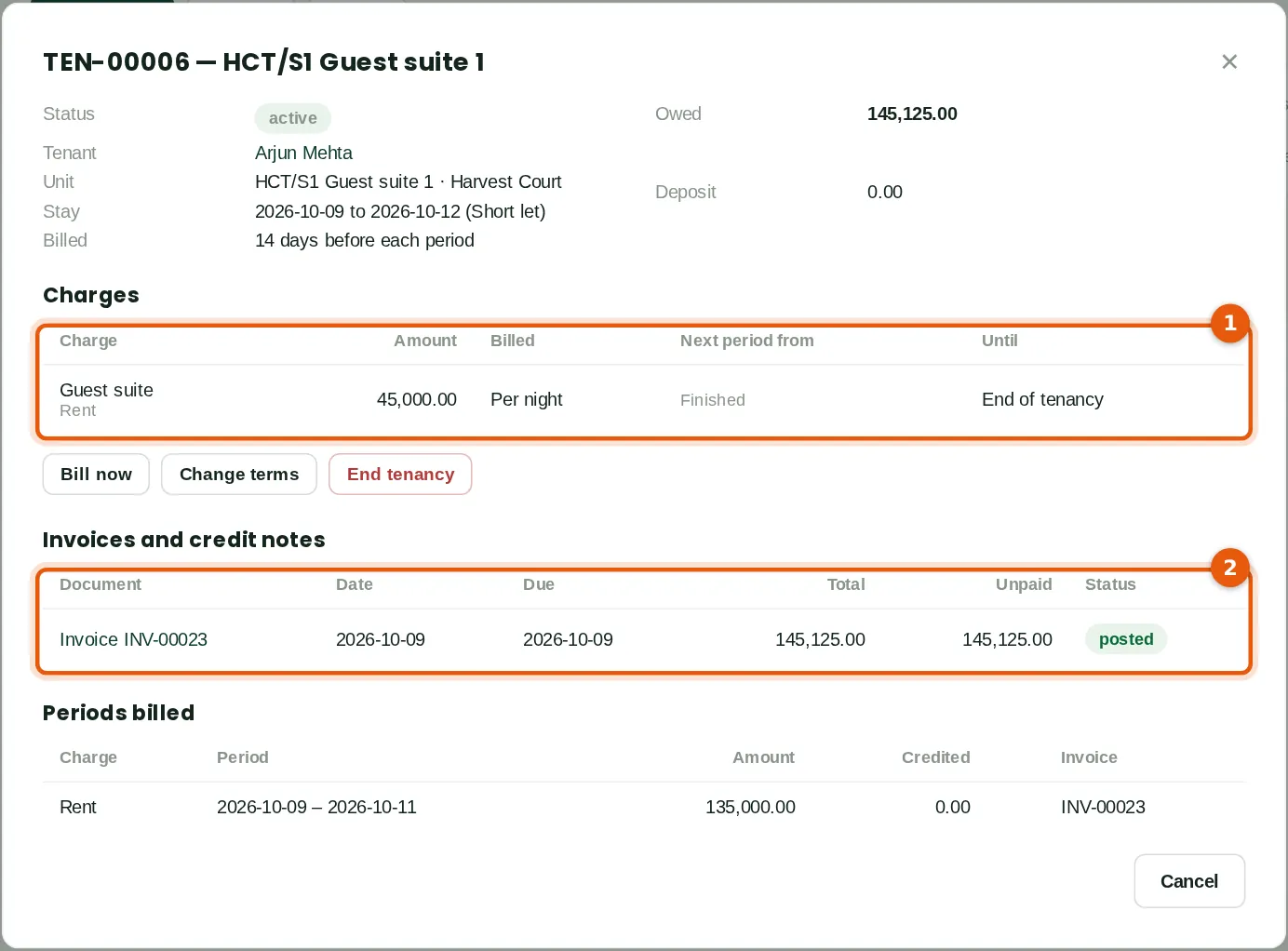
Arjun Mehta, a buyer from Mumbai Spice Importers, stays in guest suite S1 from 9 to 12 October. A short let has a nightly rate (1): 3 nights at ₦45,000 is ₦135,000, plus VAT at 7.5% (a serviced apartment is a business), ₦145,125 on INV-00023 (2), billed in full when the stay starts and paid by card the same day. It goes straight to rental income. After check-out the short let ends on its own.
Who
Property manager.
What to do
- Click New tenancy, choose a short-let unit and Short let, type the check-in and check-out dates and the nightly rate, then Activate.
31.8 A property expense
Why
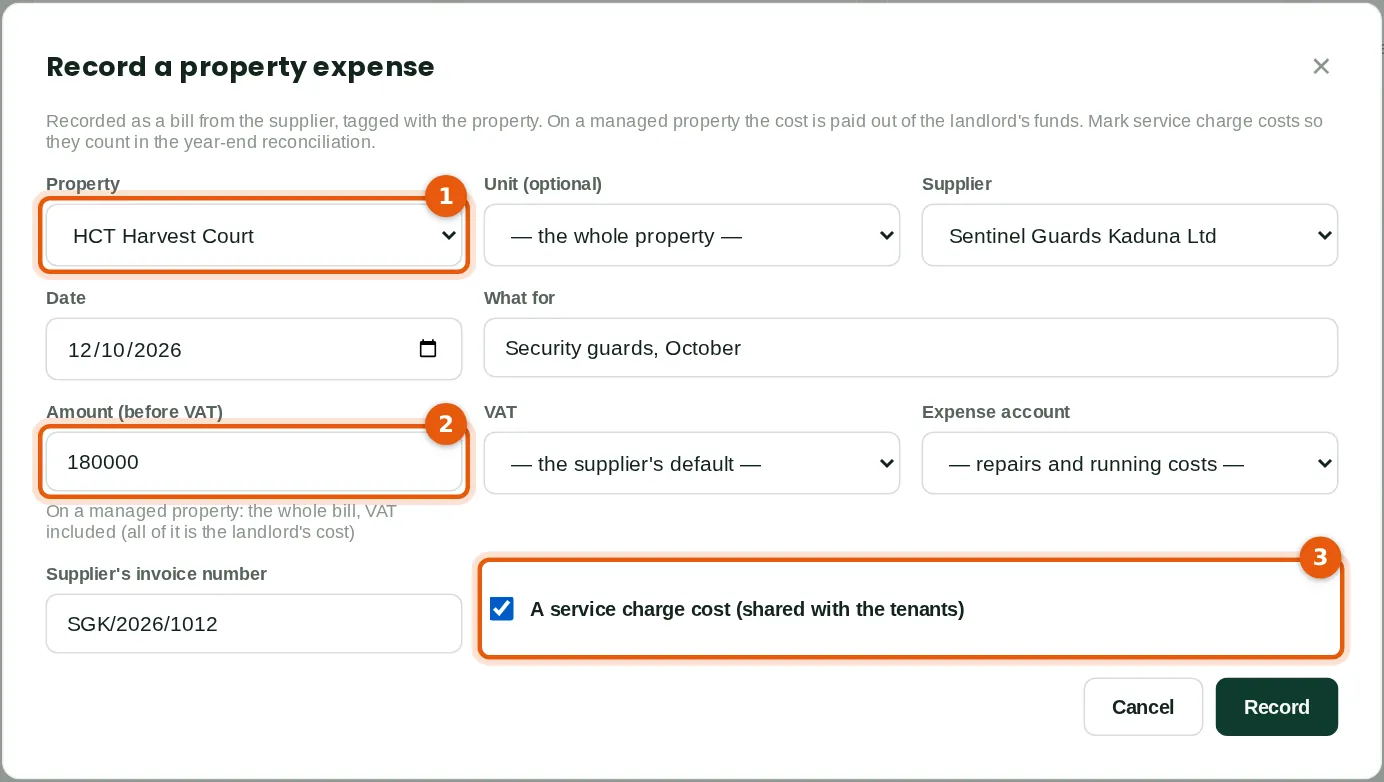
Sentinel Guards' October invoice for Harvest Court's security (1), ₦180,000 (2), is a service charge cost (3): it is shared with the tenants at the year end. It is recorded as a bill from the supplier, to Property service charge costs (6500), tagged with the property, and paid like any bill. Estate cleaning, ₦60,000, was recorded the same way. A repair to Shop 1's generator at Barnawa Shopping Plaza, ₦85,000 from Kaduna Power Services, is the landlord's cost: on a managed property the bill is paid out of the landlord's funds.
Who
Property manager.
What to do
- Open Expenses and click Record an expense. Choose the property (1) and, if it is for one unit, the unit; the supplier; type the amount (2); tick a service charge cost (3). Click Record.
31.9 Billing
Why
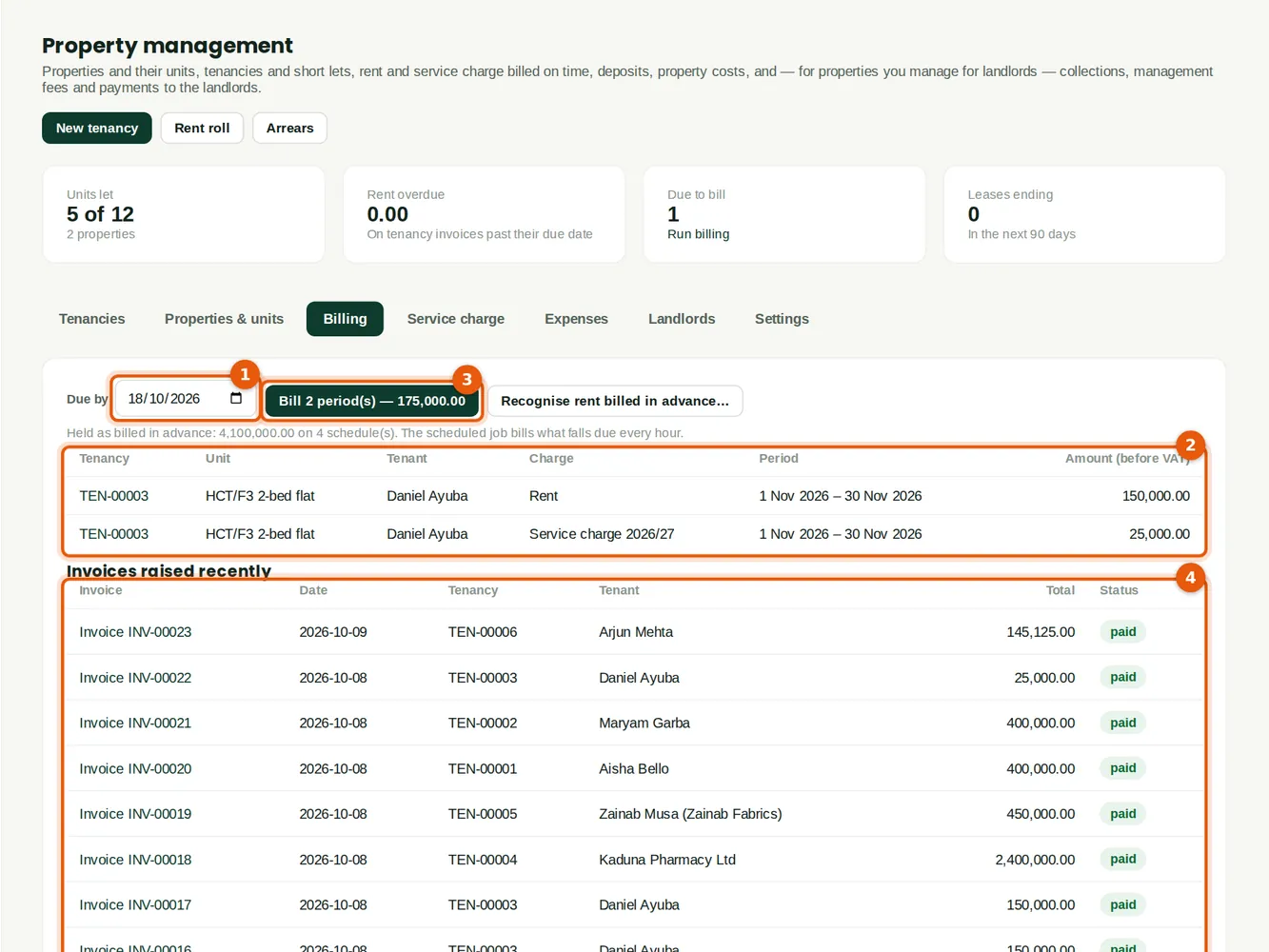
On 18 October Daniel Ayuba's November rent and service charge, ₦175,000, fall due: 14 days before 1 November. The Billing tab lists what is due by a date (1, 2) and Bill (3) raises the invoices; the scheduled job does the same every hour, so this is for billing early or checking. Recent invoices (4) are below. ₦4,100,000 is held as billed in advance on four schedules (the flats' year of rent and service charge).
Who
Property manager.
What to do
- Open Billing. Change the date (1) to see what falls due by then, and click Bill (3).
31.10 Recognise rent billed in advance
Why
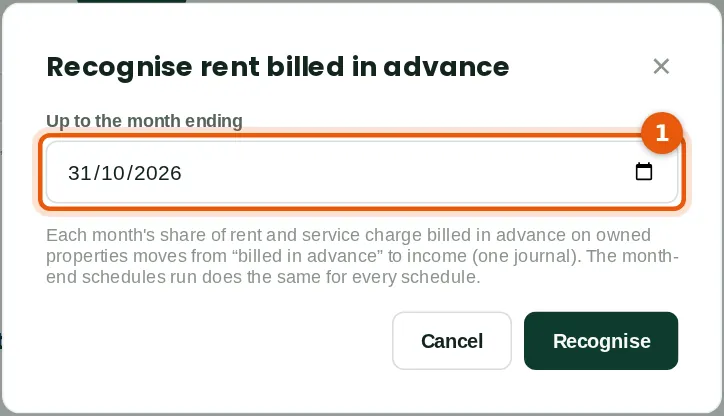
At the end of October Ngozi recognises a month of the rent and service charge billed in advance (1): ₦150,000 of Aisha Bello's rent, ₦125,000 of Maryam Garba's and ₦33,333.33 of each one's service charge, ₦341,666.66 in one journal (Dr 2421, Cr Rental income 4400 and Property service charge income 4401, tagged by property). Daniel Ayuba's November rent, billed in October, waits for November. The month-end schedules run (chapter 10) posts it too.
Who
Property manager (Approve level), or an accountant.
What to do
- Click Recognise rent billed in advance, choose the month end (1) and click Recognise.
31.11 Collect for a landlord
Why
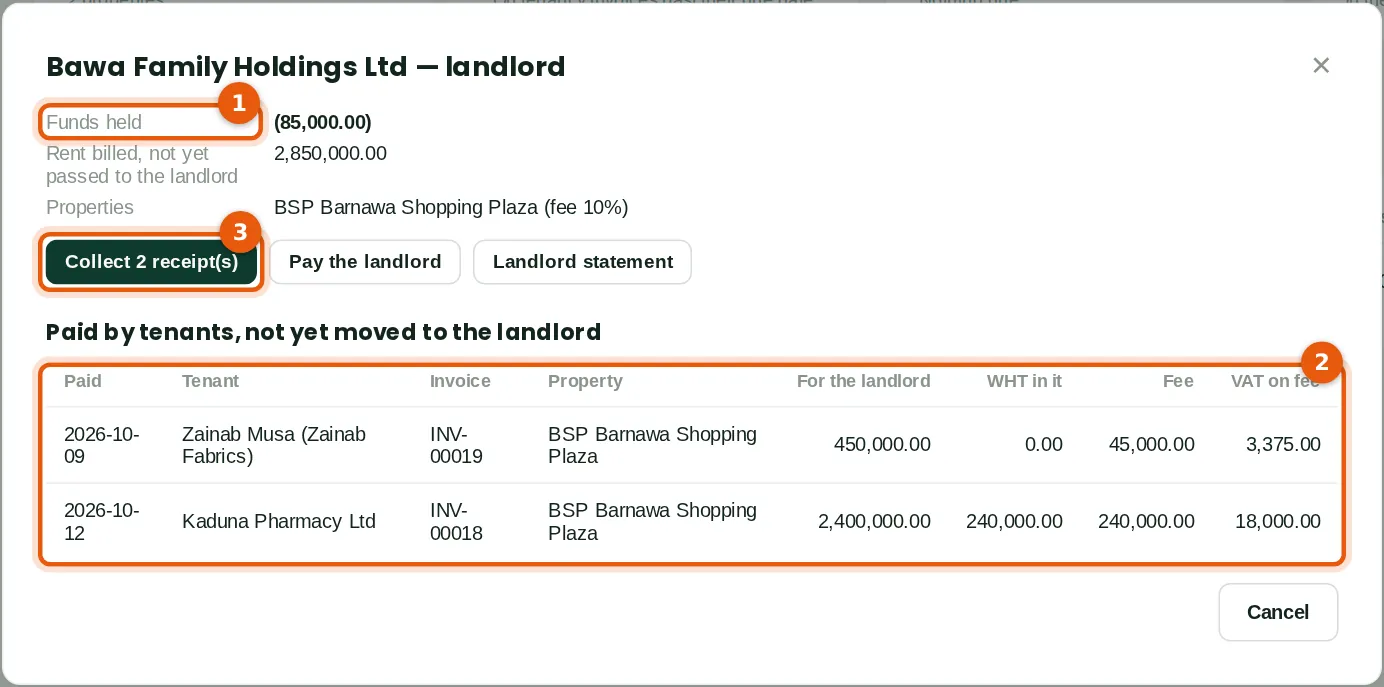
The funds held for Bawa Family Holdings (1) are ₦85,000 short: the generator repair was paid for them before any rent came in. The plaza's tenants have paid (2): Zainab Fabrics ₦450,000, and Kaduna Pharmacy ₦2,400,000, of which it paid ₦2,160,000 and deducted ₦240,000 of withholding tax (10%). The fee is 10% of the rent: ₦45,000 and ₦240,000, each with VAT at 7.5%. Collect (3) moves it all in one journal.
Who
Property manager (Approve level).
What to do
- Open Landlords and click the landlord. Check what the tenants have paid (2) and click Collect (3).
31.12 Collected, and paid to the landlord
Why
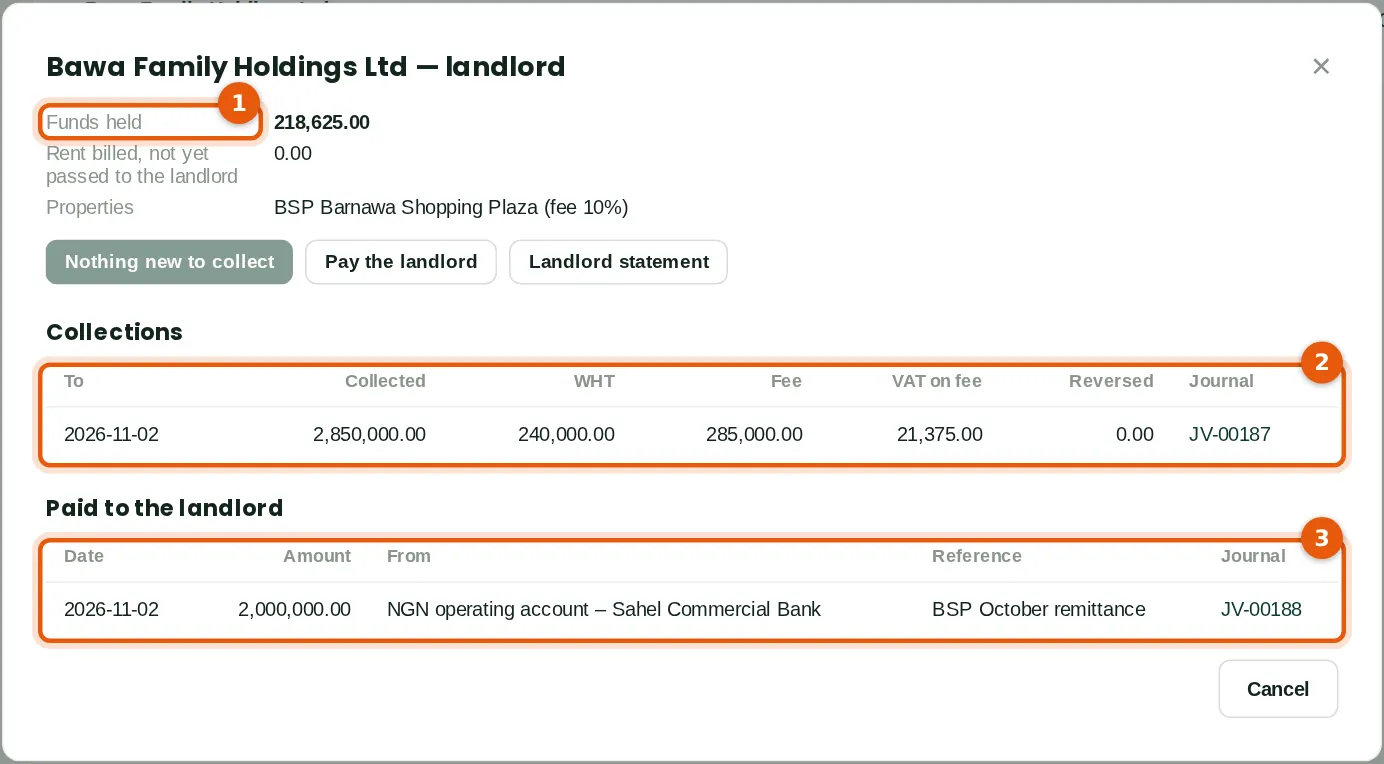
Journal JV-00187 (2) moved ₦2,850,000 from Landlords' rent billed, not yet collected (2422) to the landlord: ₦2,610,000 received into their funds held (2423), and the ₦240,000 of withholding tax credited back to WHT receivable — the tax credit note is the landlord's, passed on to them. It took the fee, ₦285,000, to Property management fees (4402), and its VAT, ₦21,375, to output VAT. Ngozi then paid the landlord ₦2,000,000 from the naira operating account (3, JV-00188), leaving ₦218,625 held (1). A payment can never be more than the funds held. A receipt voided after it was collected is reversed by the next collection.
Who
Property manager (Approve level).
What to do
- Click Pay the landlord, type the amount and choose the bank account, and click Record the payment. Make the transfer at the bank.
31.13 The landlord statement
Why
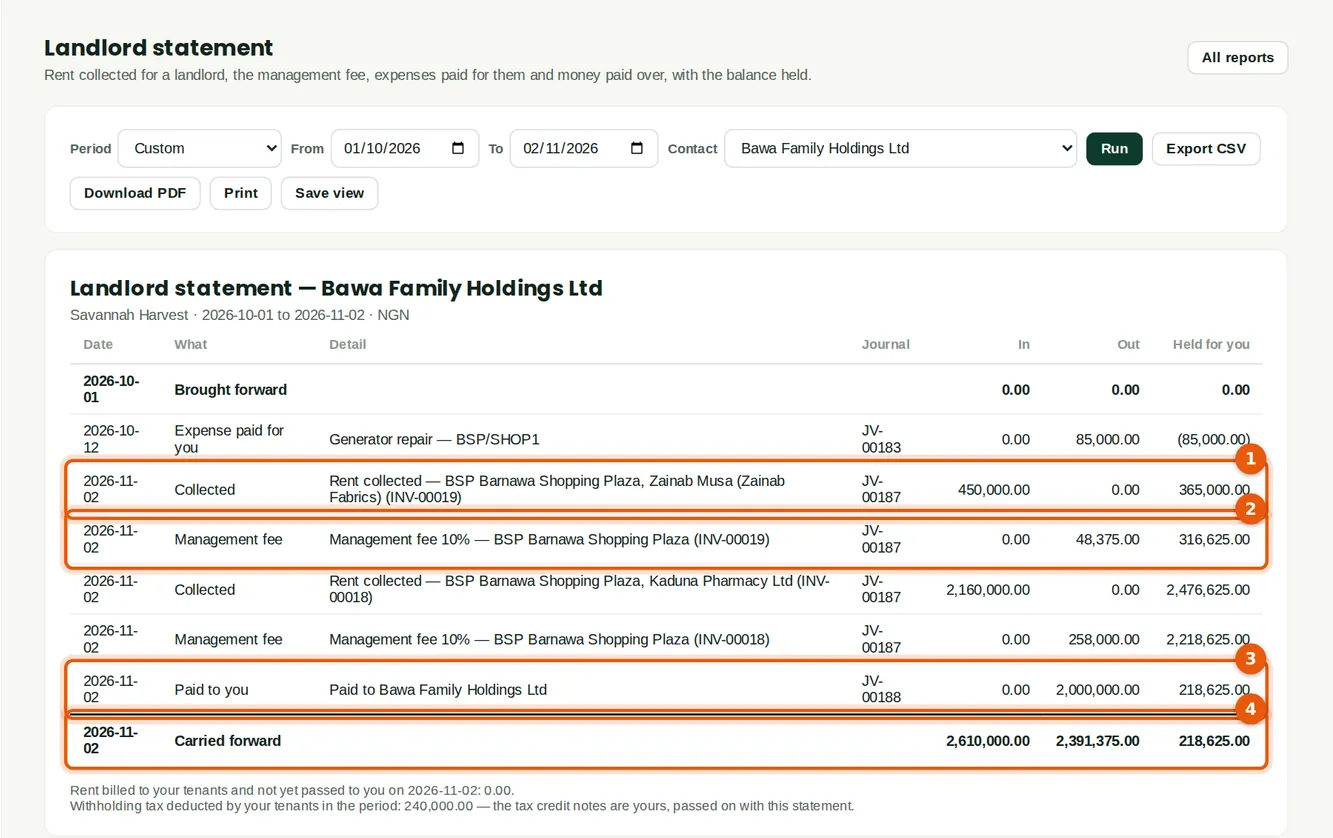
The statement for Bawa Family Holdings shows each receipt collected (1), the fee with its VAT (2), the expense paid for them, the payment to them (3) and the balance held, ₦218,625 (4). The notes give the rent billed and not yet passed on, and the withholding tax deducted by the tenants, ₦240,000, whose credit notes go to the landlord with the statement. Download it as a PDF to send.
Who
Property manager, reports users.
What to do
- Open Reports → Property → Landlord statement, choose the period and the landlord, and click Run.
31.14 End a tenancy early
Why
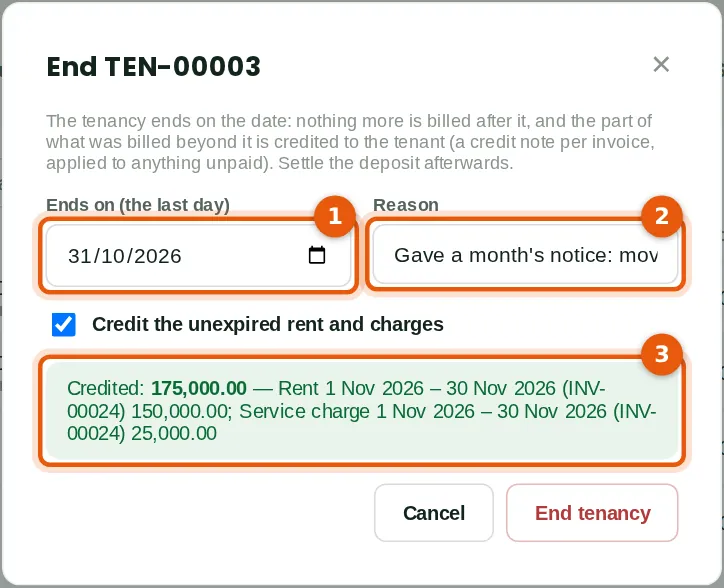
Daniel Ayuba gave a month's notice and left on 31 October (1, 2). His November rent and service charge had been billed on 18 October; the preview (3) shows they are credited, ₦175,000. Ending posts credit note CN-00002, applied to the November invoice, stops the charges and ends the tenancy. For a year's rent paid in advance, the unexpired days are credited and the deferral is put right. A lease that simply reaches its end date stays active (the tenant holding over) until it is renewed or ended; Renew drafts the next tenancy with the rent changed by a percentage.
Who
Property manager (Approve level).
What to do
- Open the tenancy, click End tenancy, type the last day (1) and the reason (2), check the preview (3) and click End tenancy.
31.15 Settle the deposit
Why
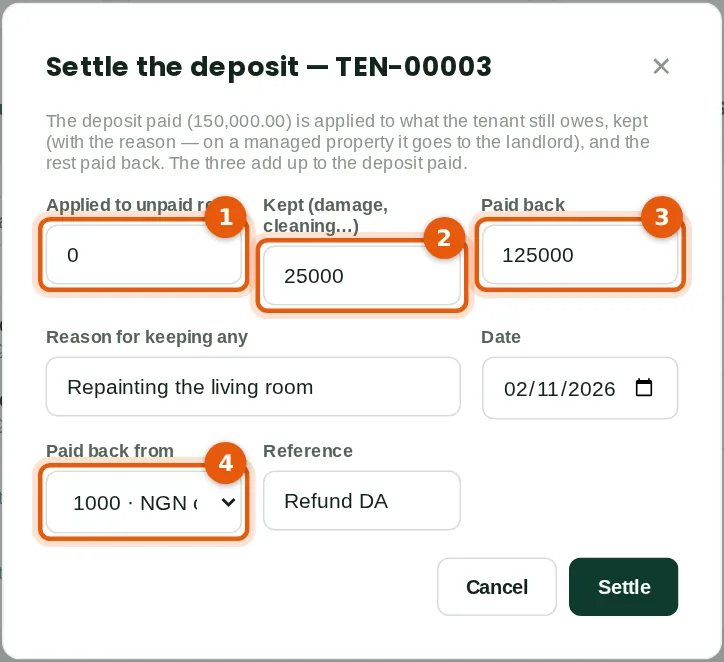
Daniel's ₦150,000 deposit was paid with his first invoices. He owes nothing (1). Ngozi keeps ₦25,000 for repainting the living room (2), with the reason, as income in Tenant deposits kept (4403), and pays back ₦125,000 (3) from the naira operating account (4). Applied, kept and paid back must add up to the deposit paid. On a managed property, what is kept goes to the landlord's funds.
Who
Property manager (Approve level).
What to do
- On the ended tenancy, click Settle deposit. Type what is applied to unpaid rent (1) and kept (2), with the reason; the rest is paid back (3). Choose the bank account (4) and click Settle.
31.16 The tenancies
Why
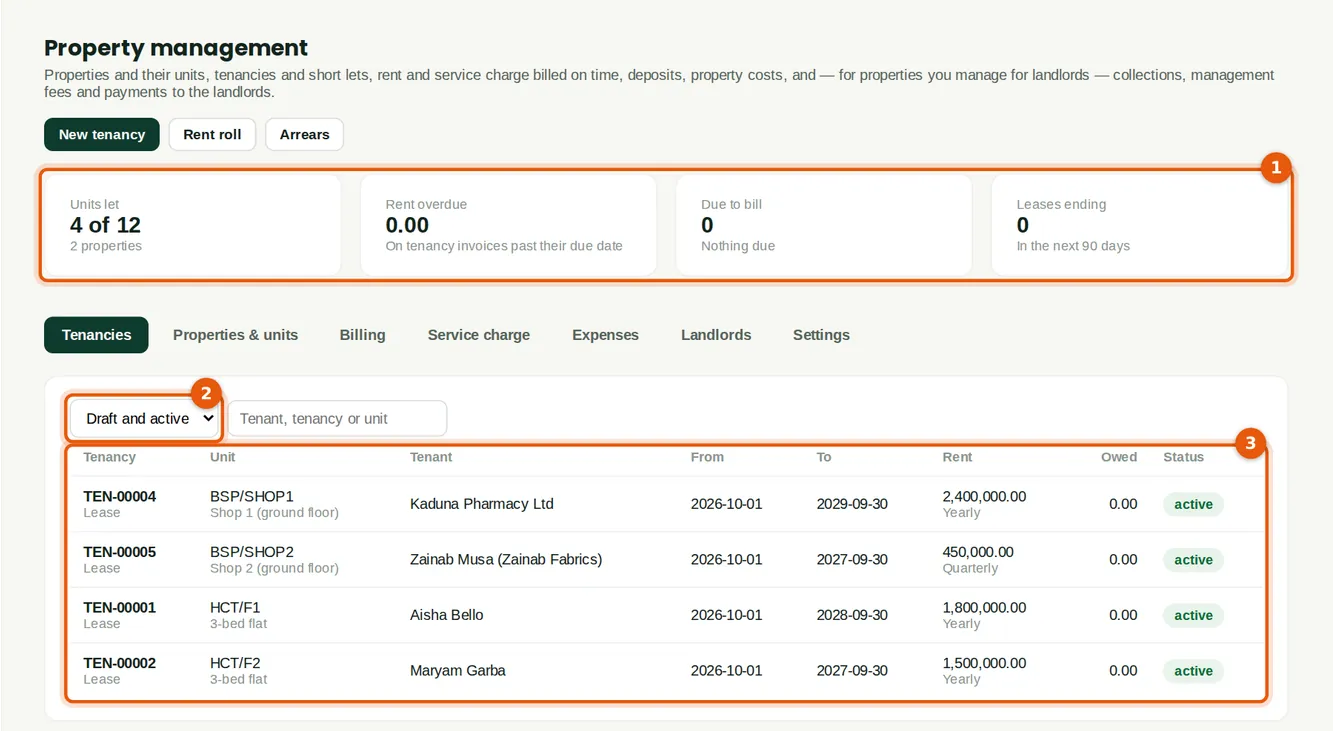
The cards (1) show the units let (4 of 12), rent overdue, tenancies due to bill and leases ending within 90 days, with any tenants holding over. The list (2, 3) shows drafts and active tenancies with each one's rent and what is owed; choose Ended or Cancelled to see the others, or search by tenant, tenancy or unit.
Who
Everyone with Property management.
What to do
- Open Property management. Click a tenancy to open it.
31.17 A property's units
Why
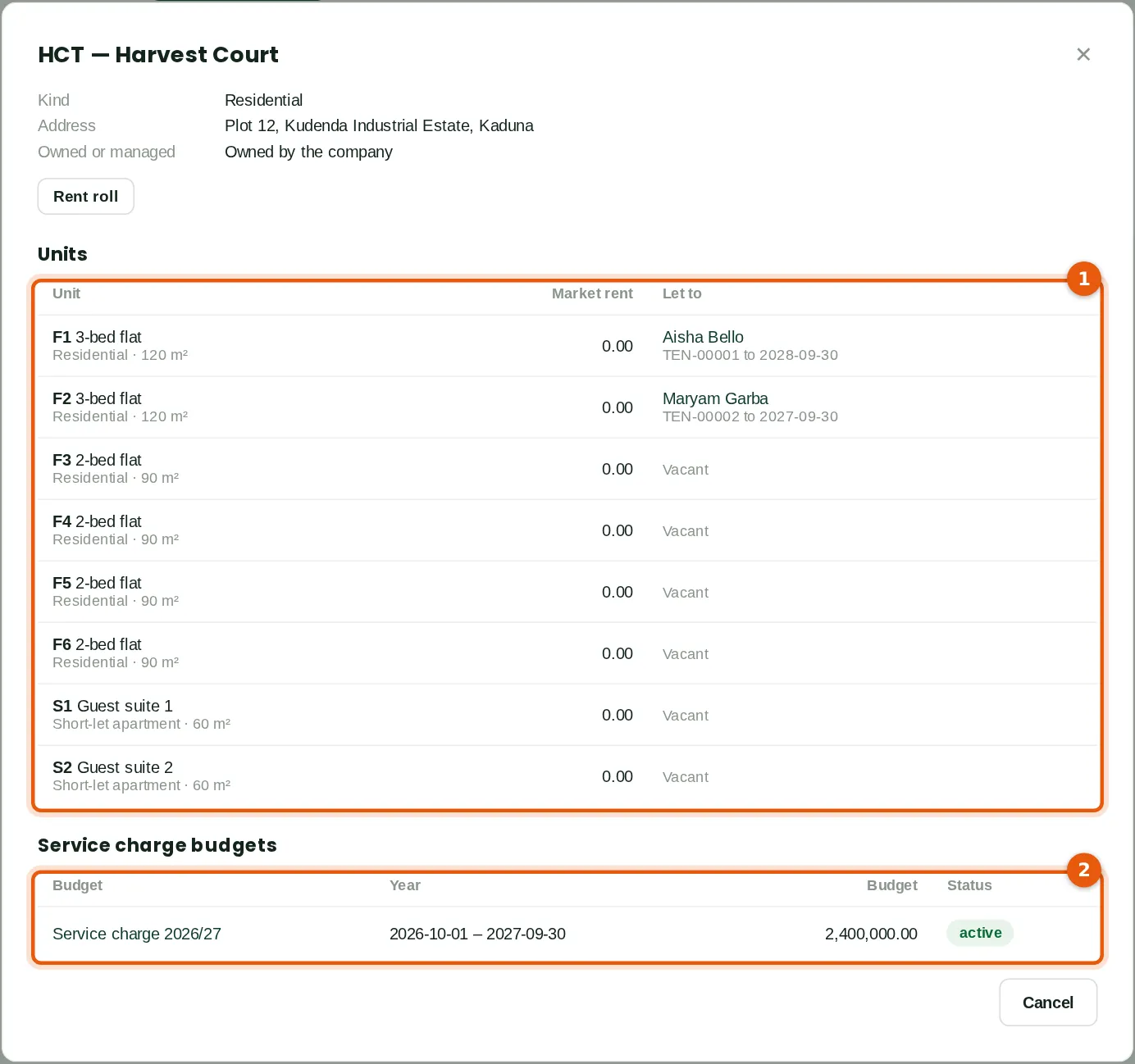
Each unit (1) shows its kind and size and who has it now; Harvest Court has F1 and F2 let, F3 to F6 and the guest suites vacant. The service charge budgets (2) are below. Units are edited or taken out of use here; one with a tenancy cannot be.
Who
Everyone with Property management.
What to do
- Open Properties & units and click a property.
31.18 The service charge budget
Why
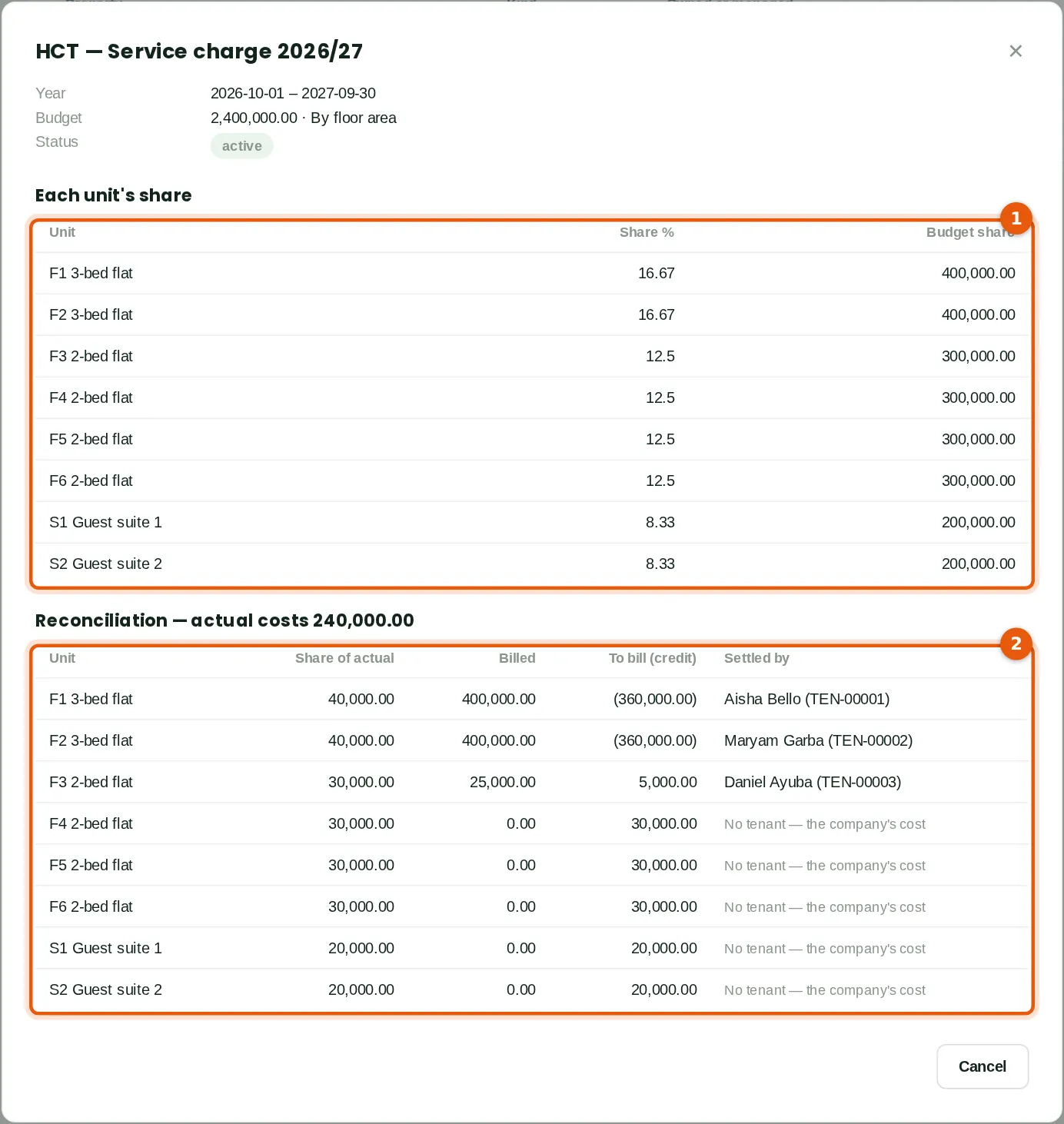
Chukwudi budgeted ₦2,400,000 for Harvest Court's year to 30 September 2027, shared by floor area (1): 16.67% (₦400,000) for each 3-bed flat, 12.5% (₦300,000) for each 2-bed flat and 8.33% (₦200,000) for each suite. Apply to the tenancies made it a service charge on each let unit's tenancy for the year, billed with the rent at the rent's frequency: ₦400,000 a year for Aisha Bello and Maryam Garba, ₦25,000 a month for Daniel Ayuba. Vacant units' shares are the company's cost. The reconciliation (2) shares the actual service charge costs so far, ₦240,000, the same way. After the year end, Reconcile the year invoices each tenant's share of the actual costs above what they were billed, or credits the excess, and closes the budget.
Who
Owner or administrator sets and applies it; the property manager reconciles it.
What to do
- Open Service charge and click New budget: the property, the year, the budget and how it is shared. Then Apply to the tenancies; after the year end, Reconcile the year.
31.19 The rent roll
Why
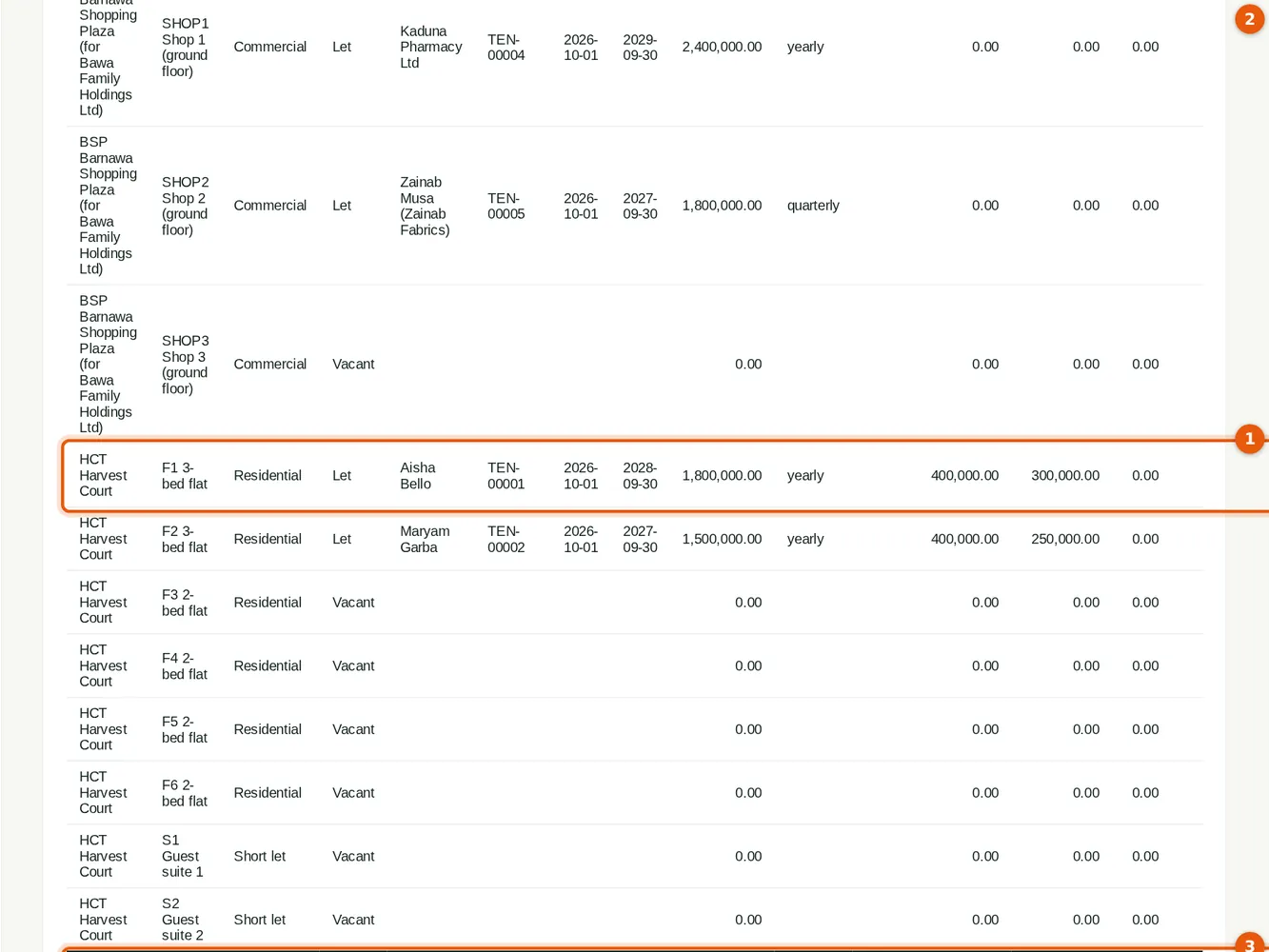
Every unit on the date: who has it (1), the rent and service charge a year, the deposit held, what is owed and when it is next billed; vacant units (2) with their market rent; and the totals (3). The other Property reports are Rent arrears, Vacant units, Lease expiries and rent reviews (tenancies ending in the next 120 days, tenants holding over and reviews due), and Tenancy deposits held.
Who
Everyone with Property management or Reports.
What to do
- Open Reports → Property → Rent roll, choose the date and click Run.
31.20 Settings
Why
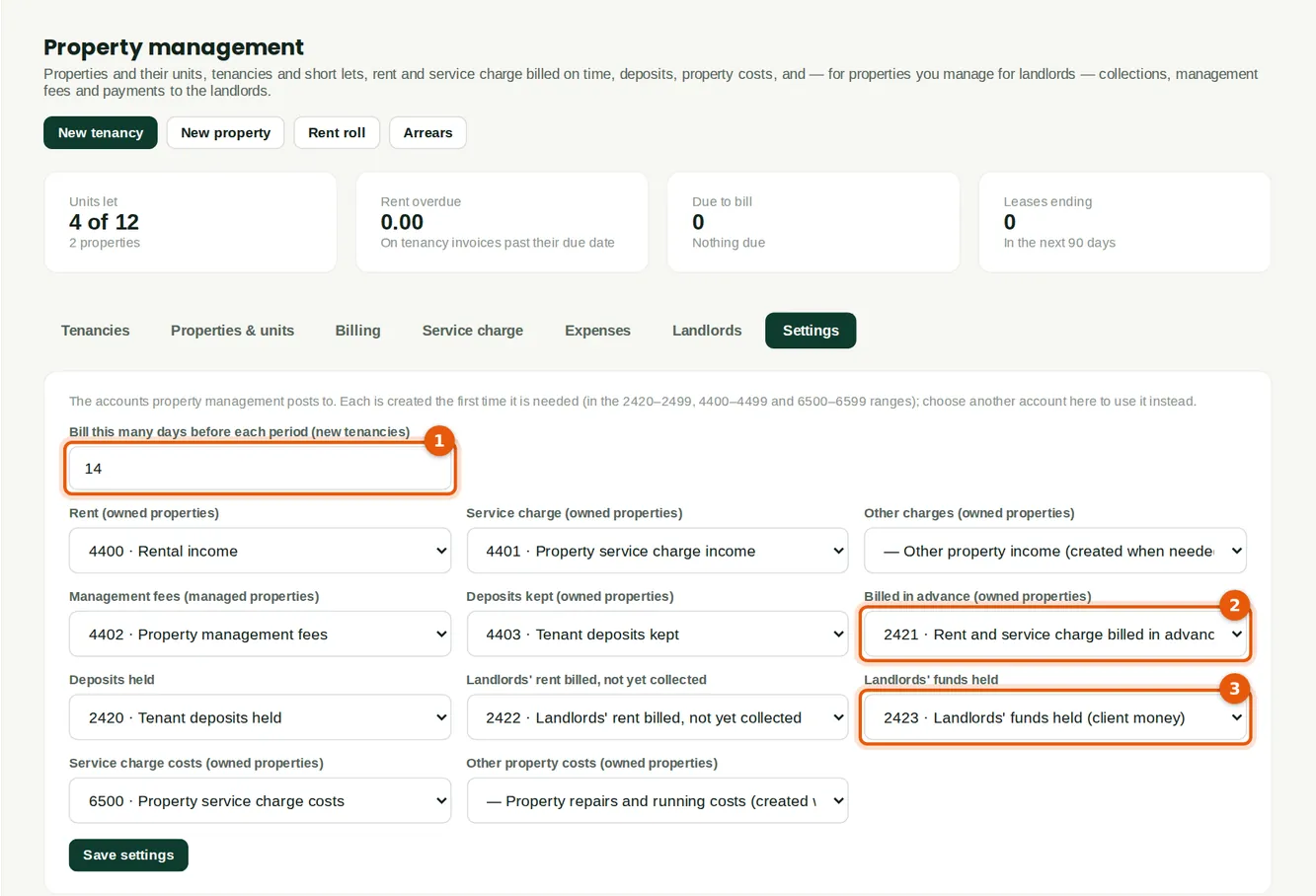
New tenancies are billed 14 days ahead (1). Each account was created the first time it was needed: Rental income 4400, Property service charge income 4401, Property management fees 4402, Tenant deposits kept 4403, Tenant deposits held 2420, Rent and service charge billed in advance 2421 (2), Landlords' rent billed, not yet collected 2422, Landlords' funds held (client money) 2423 (3) and Property service charge costs 6500. Another account of the right type can be chosen instead. Client money is the landlords': many managers keep it in a bank account of its own.
Who
Owner or administrator.
What to do
- Open Settings, choose the accounts and the days, and click Save settings.
31.21 On a phone
Why
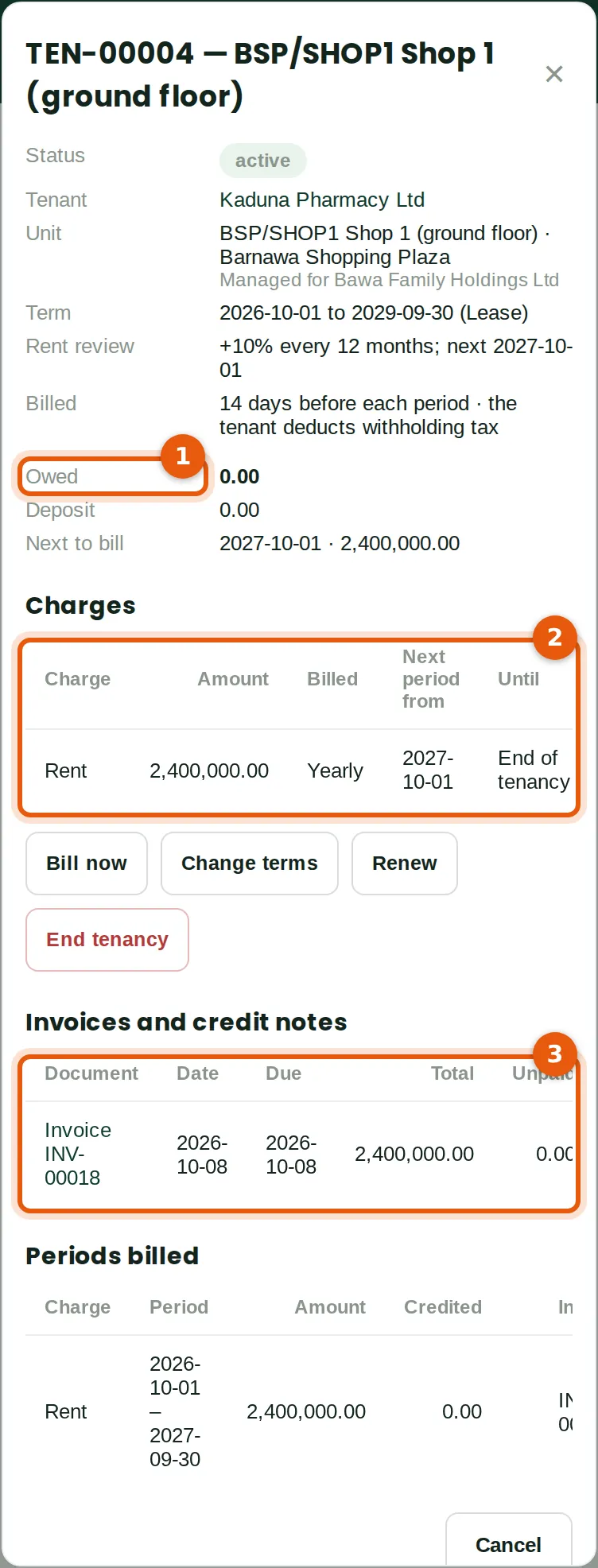
Ngozi checks Kaduna Pharmacy's shop at the plaza from her phone: it owes nothing (1); the rent (2) is next billed on 1 October 2027, when the 10% review takes it to ₦2,640,000; its invoice (3) was paid with withholding tax deducted. Wide tables scroll sideways. Every screen of Property management works on a phone.
Who
Property manager.
What to do
- Open Property management on the phone and tap a tenancy.