Steps in this chapter (7)
Record the Nigeria Tax Act 2025 reliefs beyond pension, NHF and rent — health insurance, life assurance and mortgage interest — with their evidence, and a mid-year joiner's pay from an earlier employer.
Section 30(2)(a) of the Nigeria Tax Act 2025 allows these deductions from employment income: NHF contributions; health insurance (NHIS/NHIA) contributions; the employee's pension contributions; interest on a loan to develop an owner-occupied residential house; annuity or life assurance premiums on the employee's life or their spouse's; and rent relief of 20% of annual rent, capped at ₦500,000. PayTrove works out pension, NHF and rent relief from the employee record. The other three are kept on each employee's Reliefs and earlier employer page, each with its amount, the months it applies to, the insurer or lender, and its evidence. No cap was found in the Act for these three; confirm the treatment of large claims with your adviser.
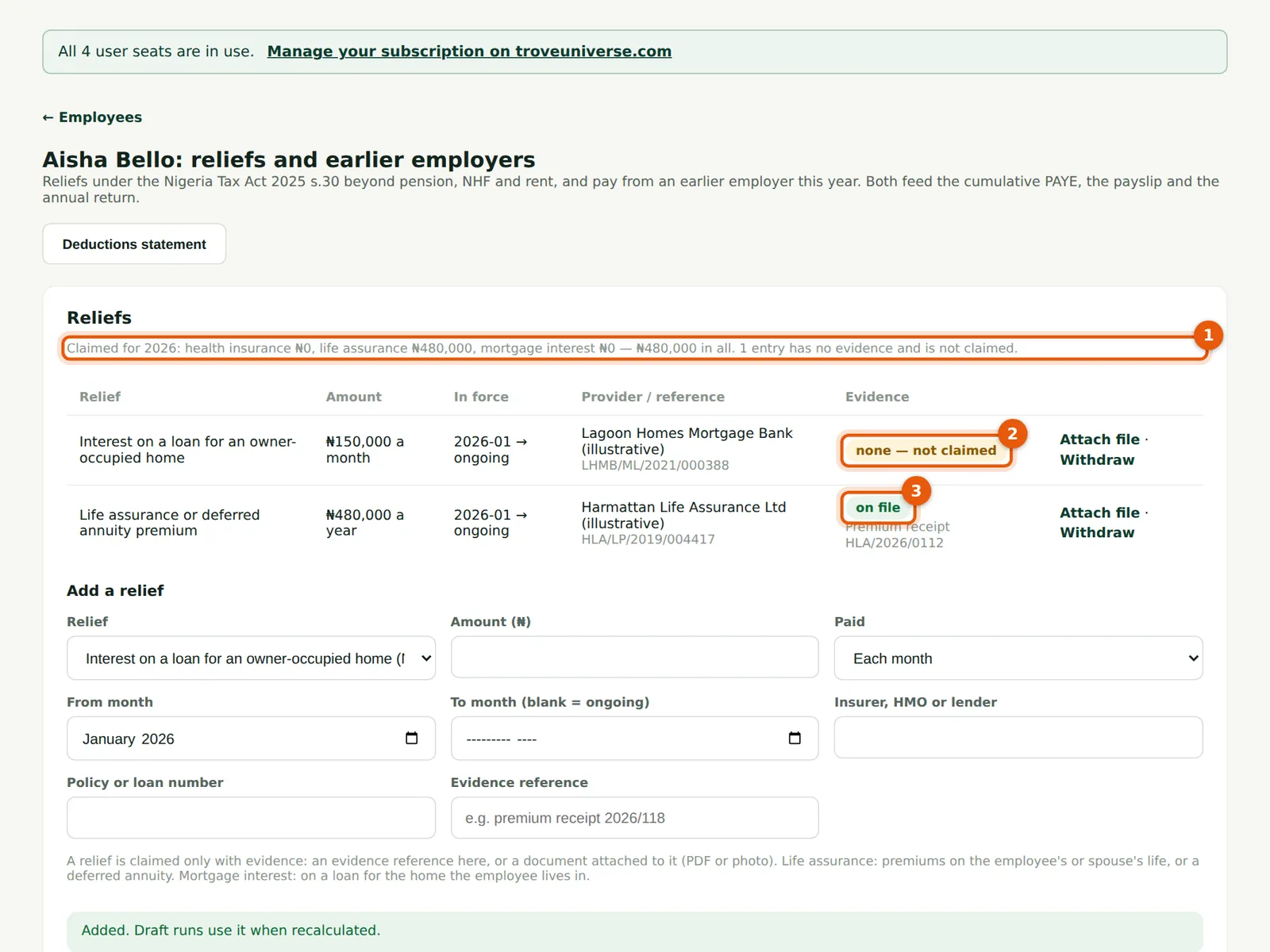
A relief is claimed only with evidence — a reference to the document, or the document itself attached — as for rent relief. A relief without evidence stays on the register but is not claimed, and the run says so. Entries are never deleted: they are withdrawn with a reason, which goes in the audit log.
The same page records pay from an earlier employer this tax year for someone who joins part-way through the year. PayTrove adds it to the year to date, so the tax-free band and the reliefs are given once for the year, not twice; the earlier employer's PAYE counts as already paid but is never refunded by the new employer.
In the illustration, Aisha Bello, the Managing Director in Lagos, pays a life assurance premium of ₦480,000 a year and ₦150,000 a month of interest on the mortgage on her home. Rahila Gwamna joins the Kaduna factory as Maintenance Engineer on 2 March 2026 after two months at Zaria Grain Millers Limited (a fictional company).
12.1 Add a relief
Why
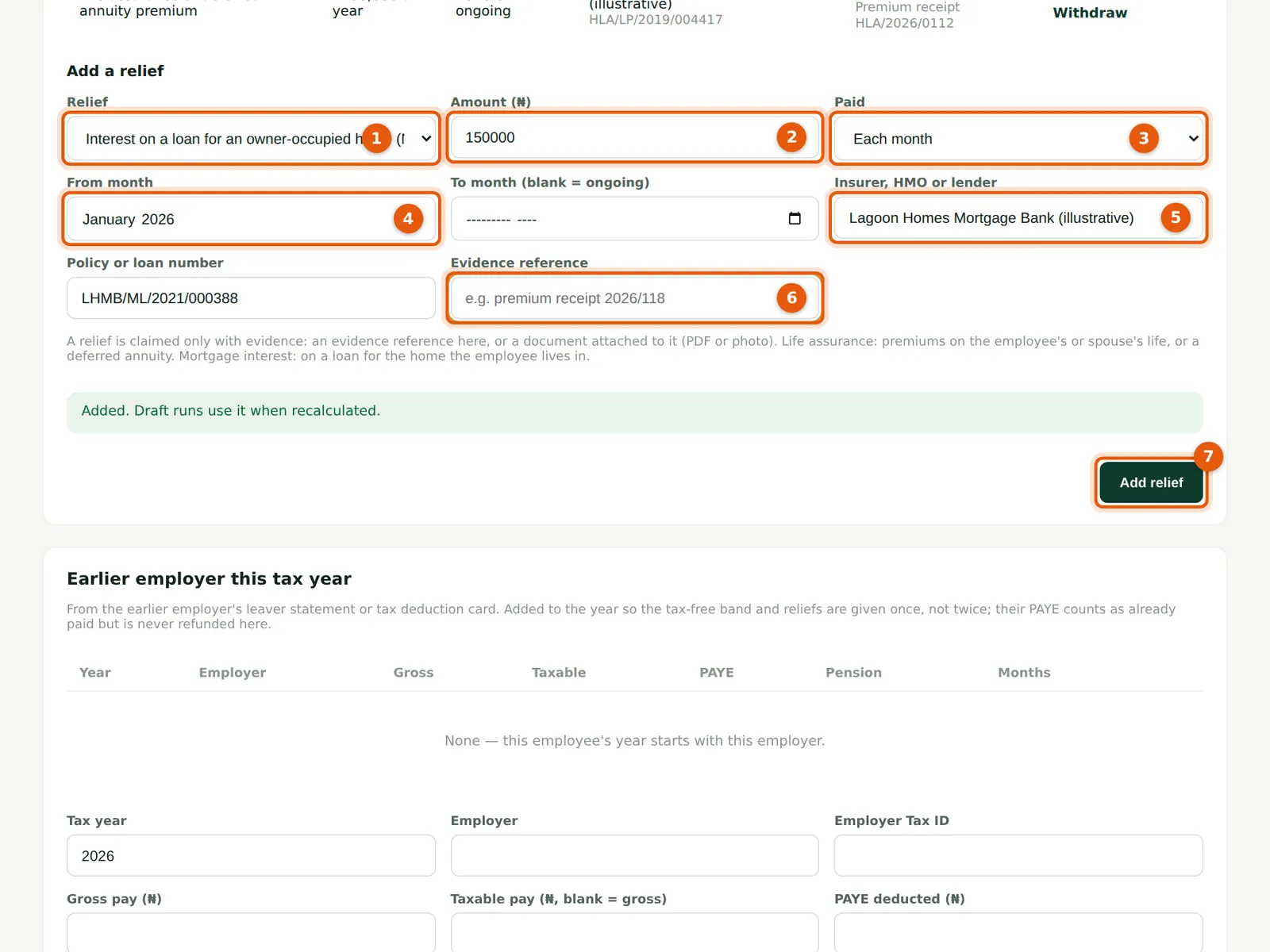
On 6 January Blessing records Aisha's two reliefs. The life assurance premium, ₦480,000 a year from January 2026, goes in with the insurer's receipt number as evidence. The mortgage interest, ₦150,000 a month, goes in without evidence because the lender's interest certificate has not yet come.
Who
Preparer or Admin.
What to do
- Open the employee with Edit and choose Reliefs and earlier employer (step 5.10).
- Choose the relief (1): health insurance (NHIA) contributions, life assurance or deferred annuity premium, or interest on a loan for an owner-occupied home.
- Enter the amount (2), whether it is paid each month or once a year (3), and the first month (4). Leave the last month blank if it is ongoing.
- Enter the insurer, HMO or lender (5) and the policy or loan number.
- Enter the evidence reference (6) if you have the document, then choose Add relief (7).
12.2 A relief without evidence is not claimed
Why
The line at the top (1) shows what is claimed for the year: ₦480,000 of life assurance, and nothing for the mortgage interest, which is marked none — not claimed (2) because it has no evidence. The life assurance is on file (3). The January draft carries a calculation note naming the unclaimed relief (step 6.2), so nobody is surprised when it is missing from Aisha's payslip. For January, with ₦3,336,000 of reliefs in all (pension and life assurance), her PAYE is ₦651,893.33.
Who
Preparer or Admin.
What to do
- Check the summary line (1) after each change.
- Use Attach file on a line to attach the document itself (PDF or photo), or Withdraw, with a reason, if a relief ends or was recorded in error.
12.3 Attach the evidence when it arrives
Why
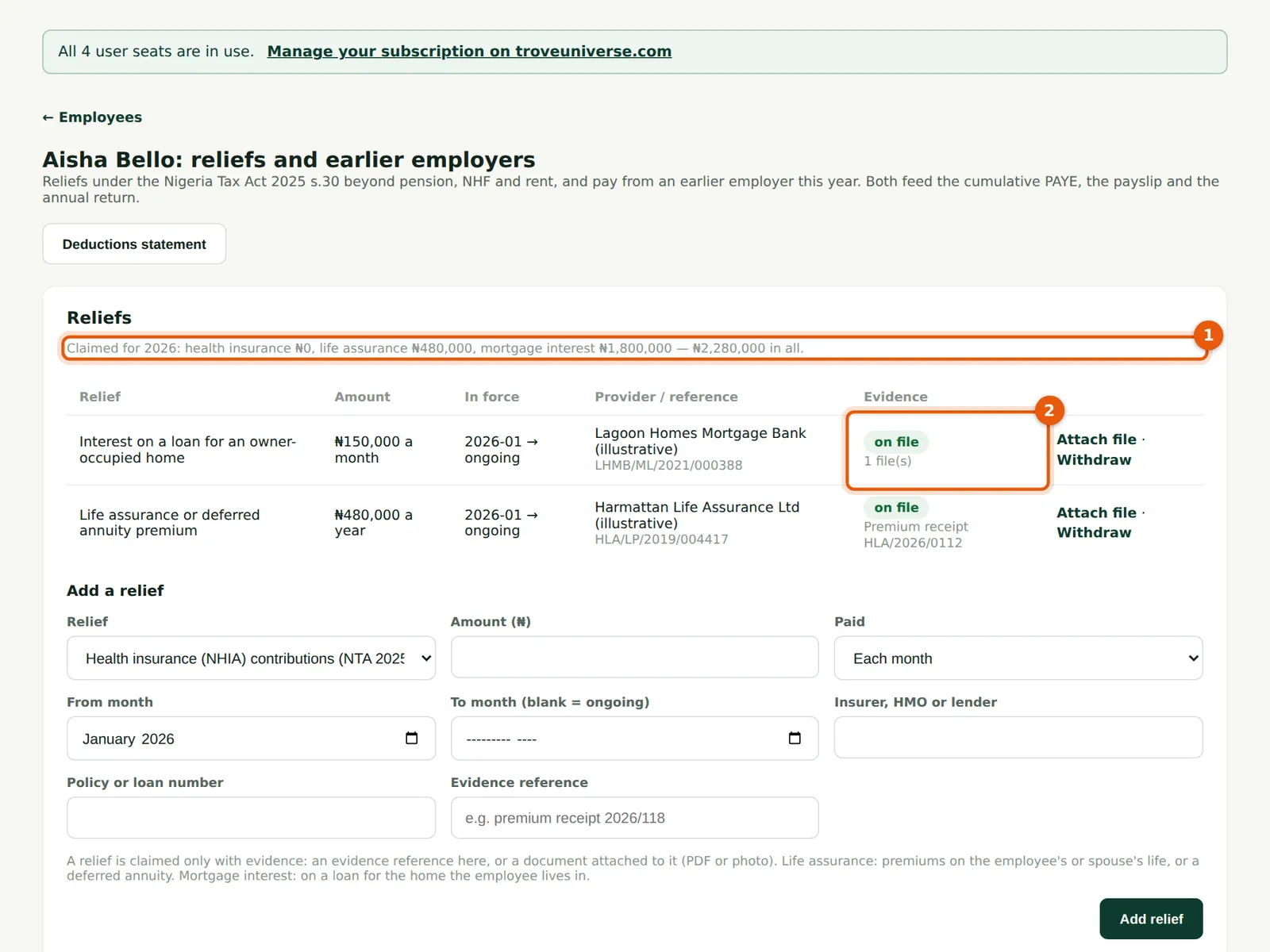
On 11 February Aisha brings the mortgage interest certificate. Blessing chooses Attach file on the mortgage line and picks the scanned certificate: the line shows on file with one file (2) and the year's claim (1) becomes ₦2,280,000 (₦480,000 + ₦1,800,000). Because PAYE is cumulative, February's run gives back the relief missed in January: Aisha's February PAYE is ₦582,893.34, and from March it settles at ₦617,393.33 a month.
Who
Preparer or Admin.
What to do
- Choose Attach file on the line and pick the document. Draft runs pick up the change when recalculated.
12.4 Reliefs on the payslip
Why
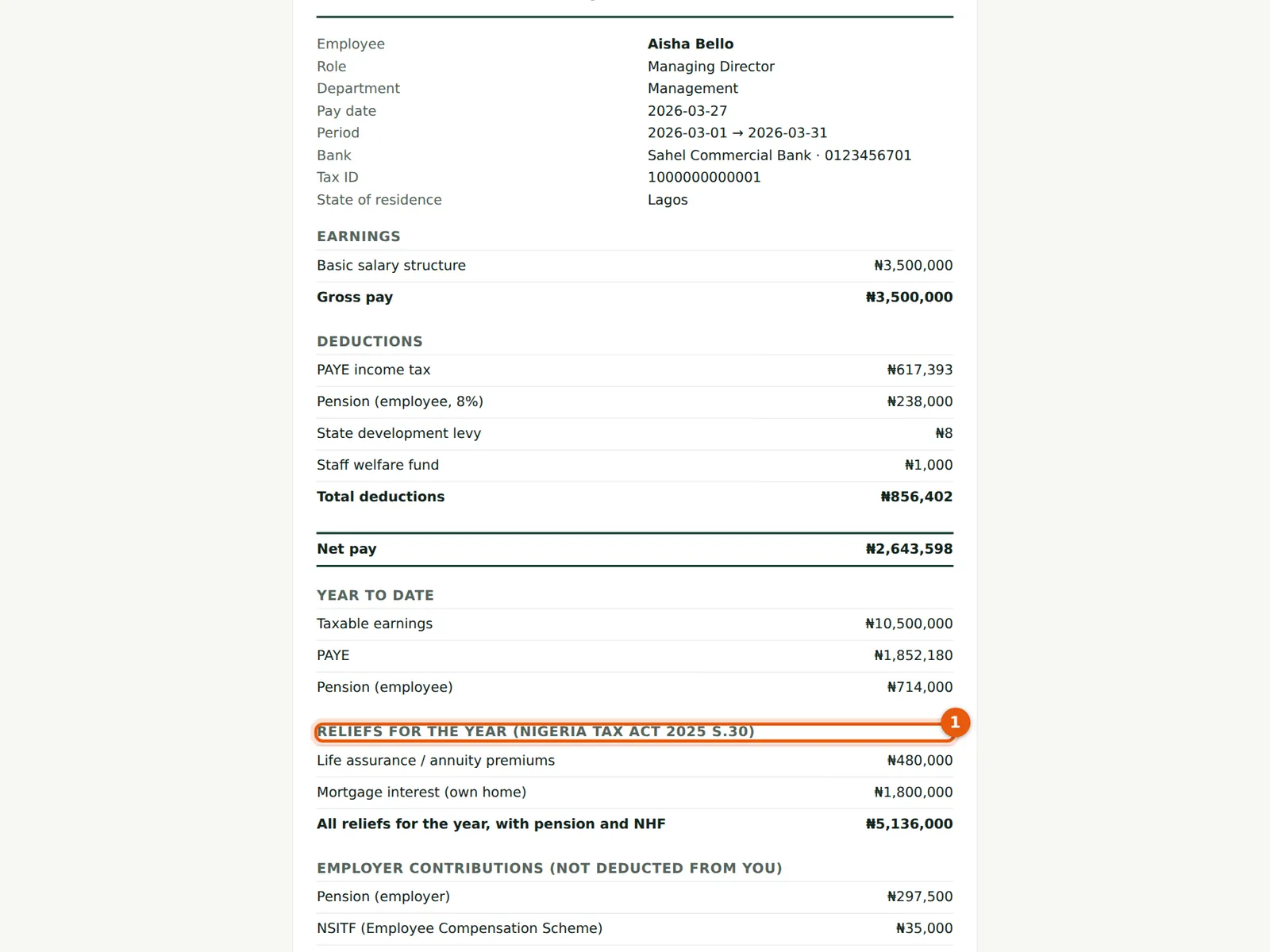
The payslip lists the reliefs for the year (1): life assurance or annuity premiums ₦480,000 and mortgage interest (own home) ₦1,800,000, and the total with pension and NHF. The PDF payslip shows the same. The reliefs also have their own columns on the annual return (step 20.6).
Who
Anyone checking a payslip; the employee on self-service.
What to do
- Check the reliefs against the register if an employee queries their PAYE.
12.5 Record pay from an earlier employer
Why
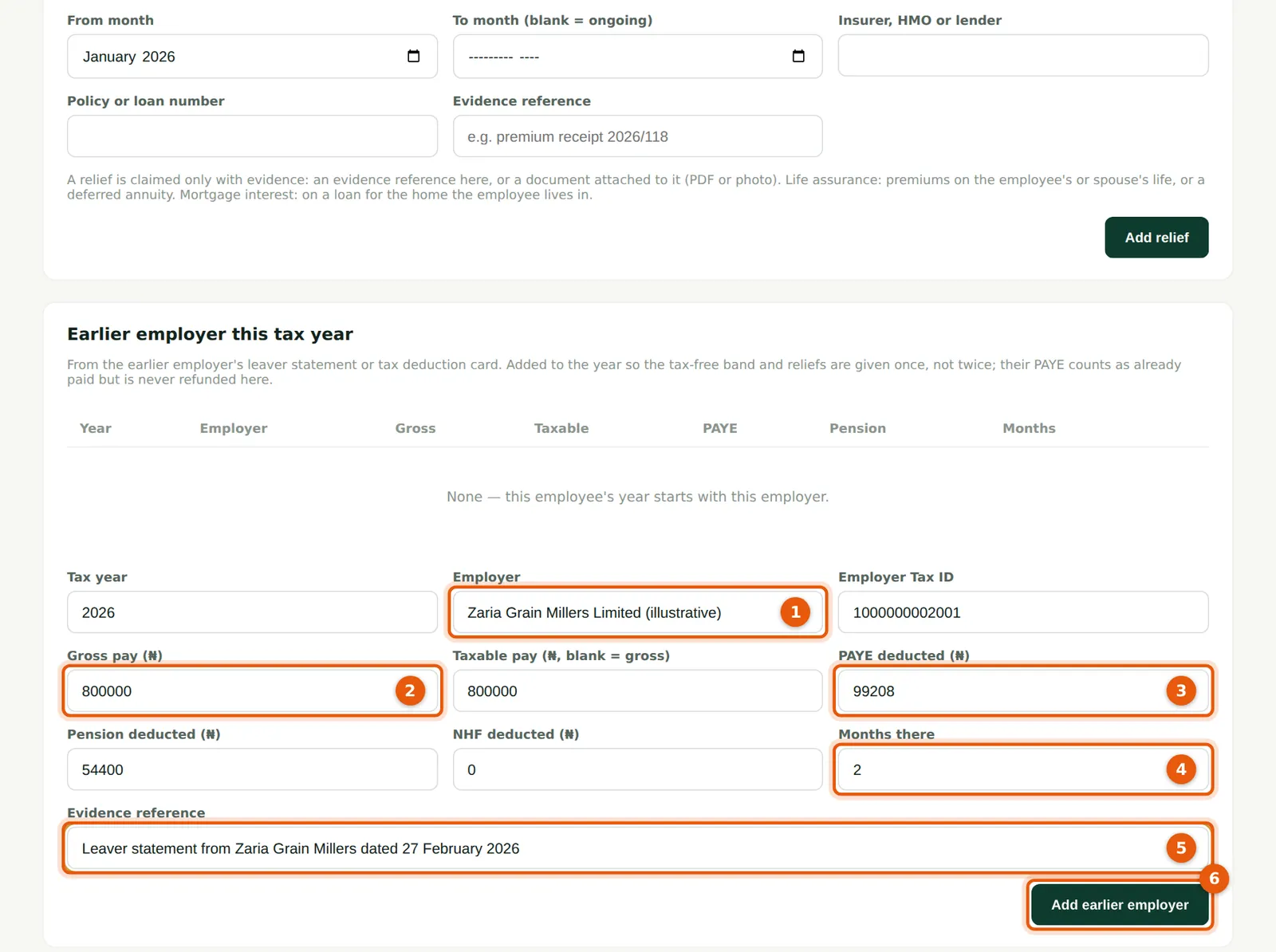
Rahila Gwamna joined on 2 March. Her leaver statement from Zaria Grain Millers shows ₦800,000 gross and taxable pay for January and February, ₦99,208 PAYE and ₦54,400 pension deducted, over 2 months. Without it, PayTrove would give her the tax-free band and reliefs again for the rest of the year and under-deduct. PayTrove checks the months against the start date: someone who joined on 2 March cannot have worked more than two months elsewhere this year.
Who
Preparer or Admin.
What to do
- On the joiner's Reliefs and earlier employer page, enter the tax year, the earlier employer (1) and its Tax ID.
- Enter the gross pay (2), the taxable pay (blank means the same as gross), the PAYE deducted (3), the pension and NHF deducted, and the months there (4).
- Enter the evidence (5) — the leaver statement or tax deduction card — and choose Add earlier employer (6).
12.6 The earlier employer on file
Why
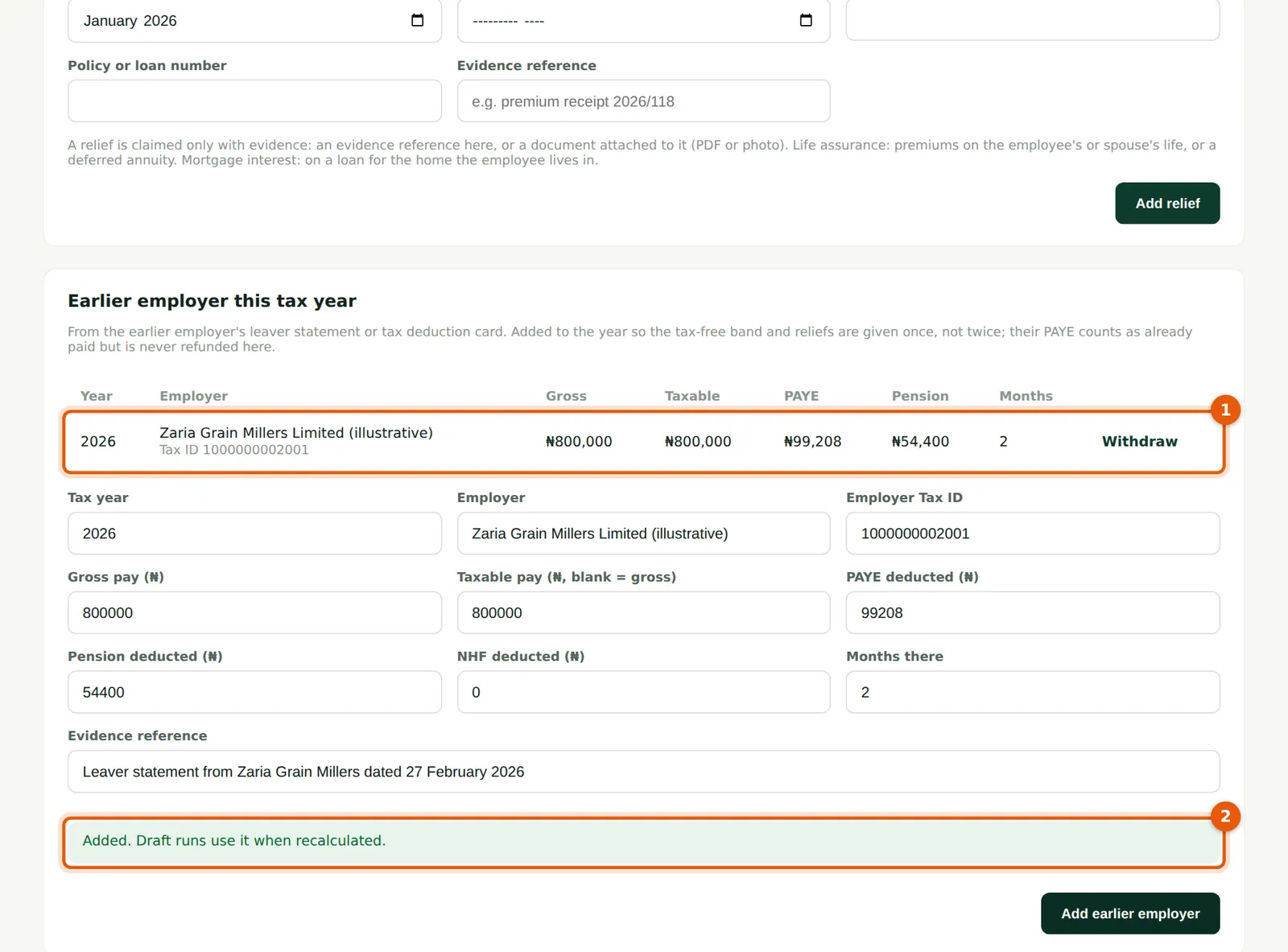
The entry (1) is listed with the employer's Tax ID. The message (2) confirms that draft runs use it when recalculated. Like a relief, an entry is withdrawn with a reason, never deleted.
Who
Preparer or Admin.
What to do
- Create the joiner's first run after recording the earlier employer, or recalculate a draft already created.
12.7 The joiner's PAYE
Why
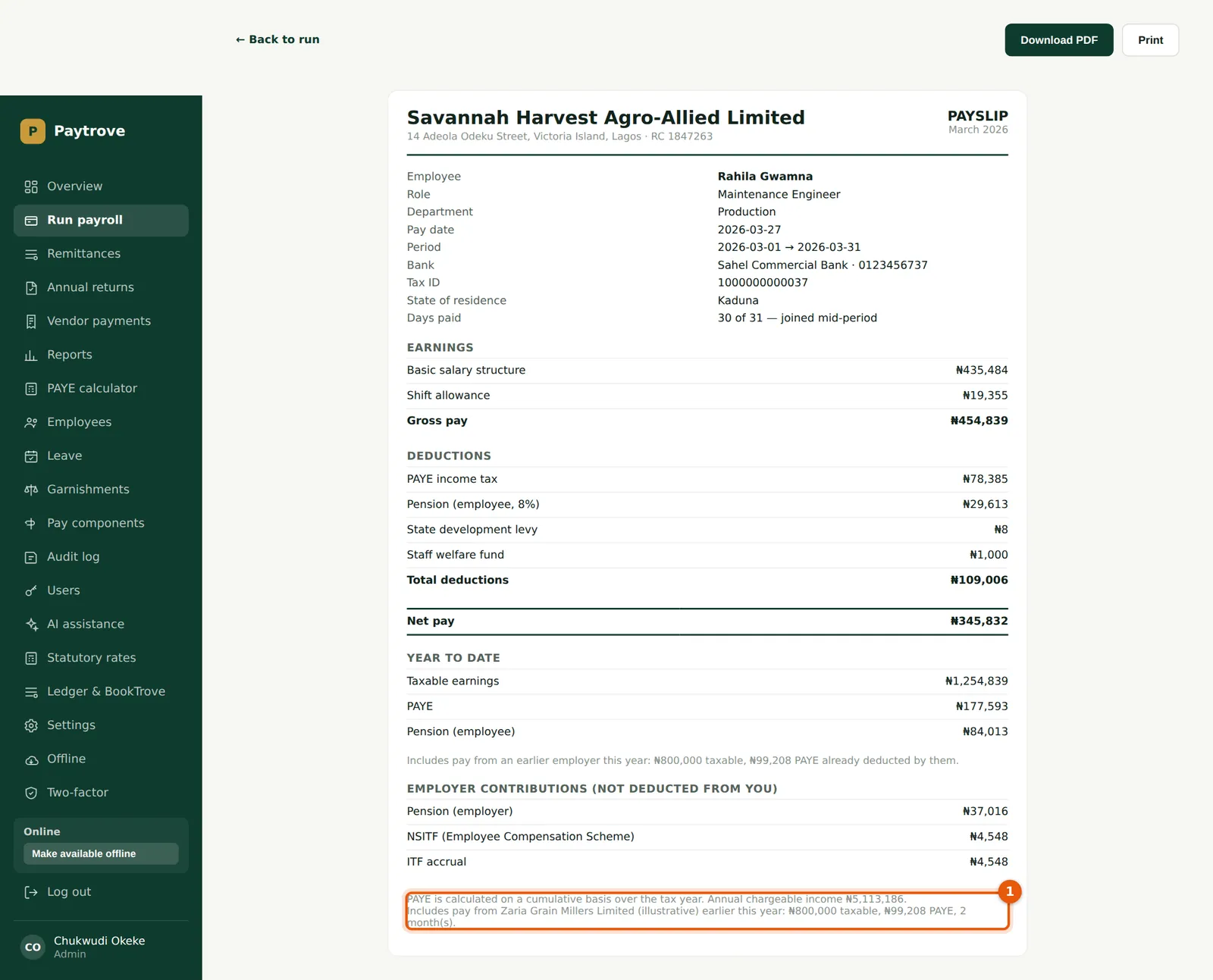
Rahila is paid for 30 of 31 days in March: ₦454,838.71. Her PAYE of ₦78,385.36 is worked out on her whole year: the ₦800,000 from Zaria Grain Millers, this month's pay and her pay projected to December, less her reliefs, gives annual chargeable income of ₦5,113,186. The tax on that, for the three months so far, less the ₦99,208 her earlier employer already deducted, is March's PAYE. The note at the bottom (1) says so. If the earlier employer had over-deducted, Savannah Harvest would not refund it: the refund is capped at what Savannah Harvest itself has deducted.
Who
Anyone checking a payslip.
What to do
- Check the earlier employer's figures in the note against the leaver statement.