Steps in this chapter (10)
The Tax centre brings together VAT returns, withholding tax, the companies income tax computation under the Nigeria Tax Act 2025, capital allowances, stamp duty, official exchange rates and a filing calendar. The figures come from the transactions: every line carries a VAT code and every supplier payment its WHT.
Always check the current rules and rates with your tax adviser: BookTrove's settings can be changed when the law changes.
11.1 The monthly VAT return
Why
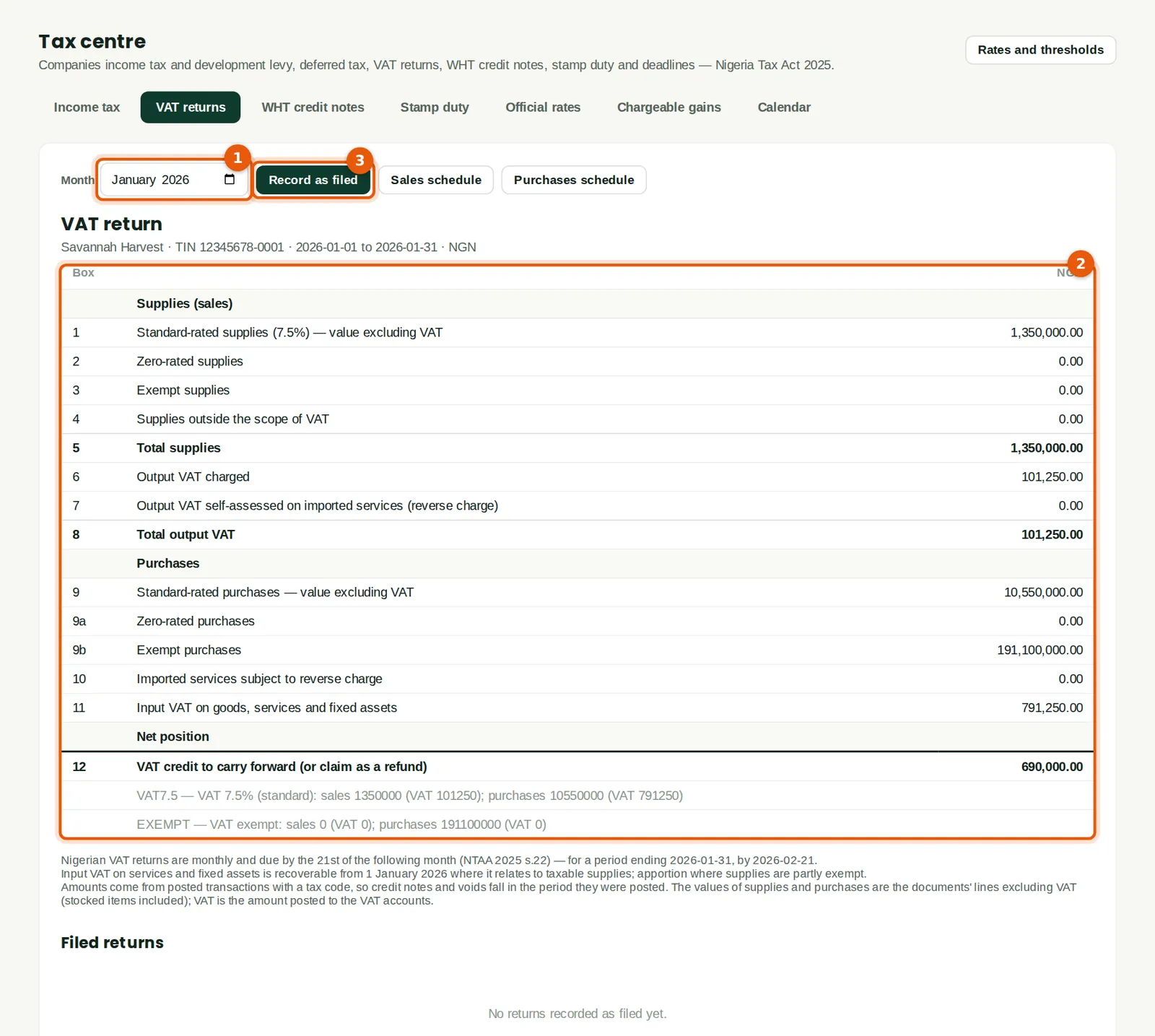
The return (2) shows the boxes for the NRS return: standard-rated, zero-rated, exempt and out-of-scope supplies, output VAT and reverse-charge VAT; then purchases at the standard rate (box 9), zero-rated purchases (9a), exempt purchases (9b), imported services and input VAT; and the net position. The values come from the lines of posted invoices, bills and other documents, excluding VAT, including bills for stock items; the VAT comes from the VAT accounts. In January Savannah Harvest charged ₦101,250 of output VAT on ₦1,350,000 of shells sold locally. It bought ₦10,550,000 of standard-rated goods and services — packaging, haulage and other services — with input VAT of ₦791,250 (box 9 × 7.5% = box 11), and ₦191,100,000 of exempt purchases, mainly raw produce from farmers (box 9b). So it has a VAT credit of ₦690,000 to carry forward. Exports invoiced in January would appear as zero-rated supplies. Returns are due by the 21st of the following month.
Who
Accountant (tax Approve level).
What to do
- Open Tax centre → VAT returns and choose the month (1). Check the boxes against the Sales and Purchases schedules.
- When the return has been filed on the NRS portal, click Record as filed (3).
11.2 Record the return as filed
Why
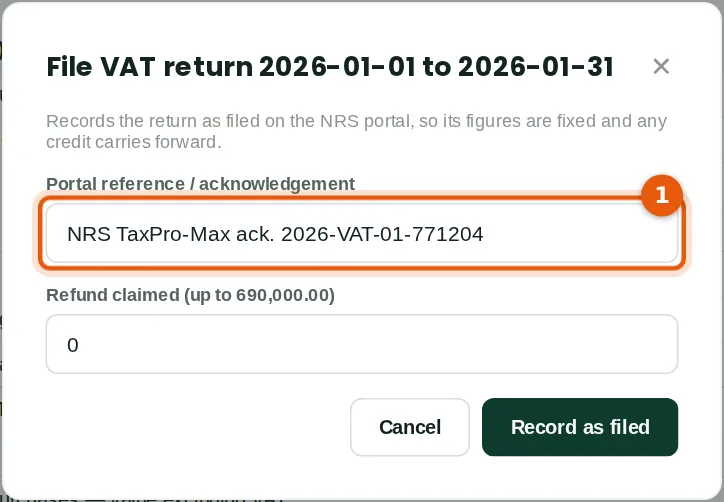
Recording the return fixes its figures and carries any credit forward to the next month. Type the acknowledgement from the portal (1). If some supplies are exempt, BookTrove also offers to post the input VAT apportionment.
Who
Accountant.
What to do
- Type the portal reference, enter any refund claimed and click Record as filed.
11.3 The VAT schedule for the portal
Why
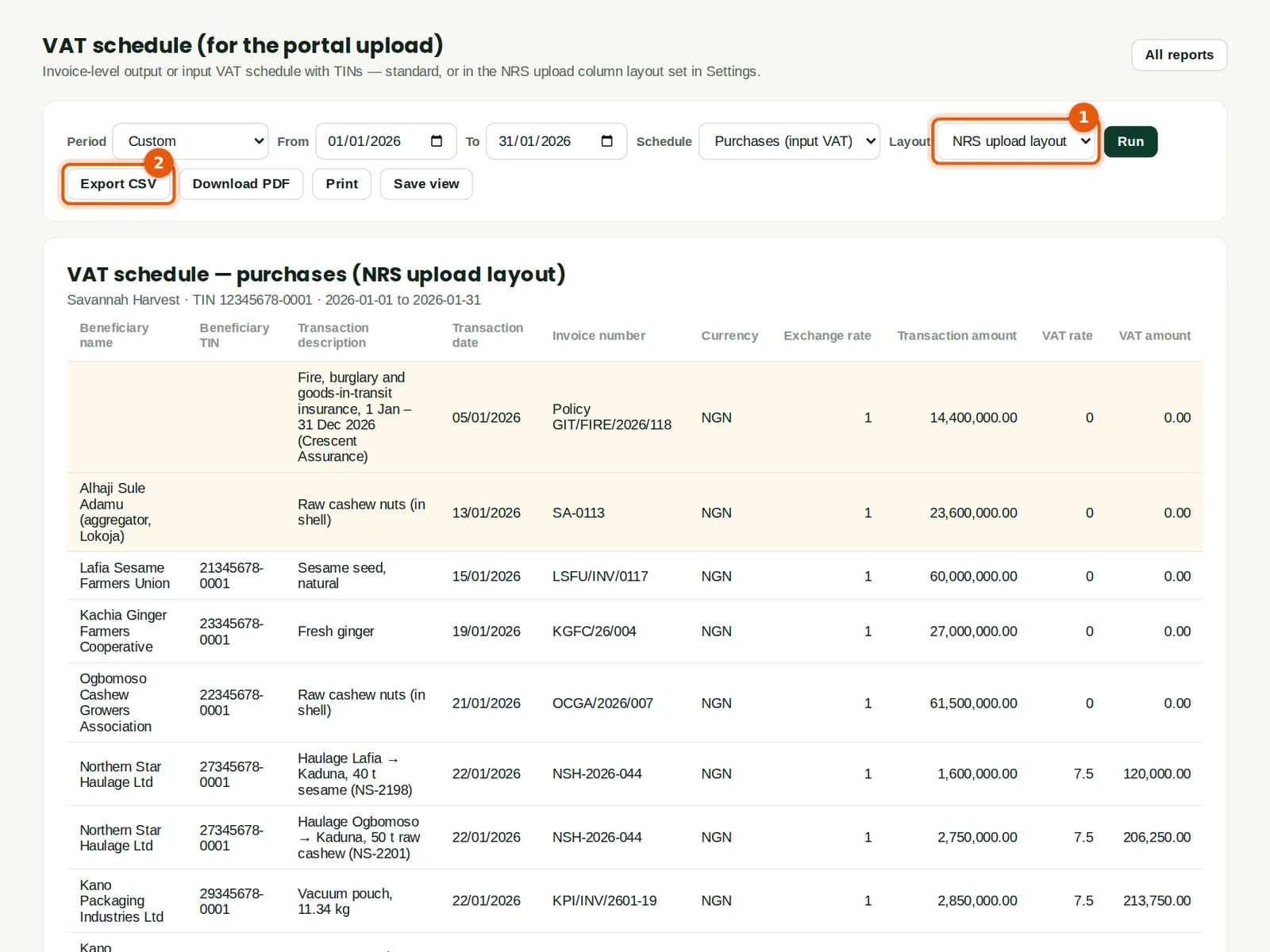
The invoice-by-invoice schedule of output or input VAT with the customers' and suppliers' TINs, in the NRS upload column layout (1). Export it to CSV (2) and upload it with the return. The columns can be changed in Settings → VAT schedule layout.
Who
Accountant.
11.4 WHT deducted: the monthly remittance schedule
Why
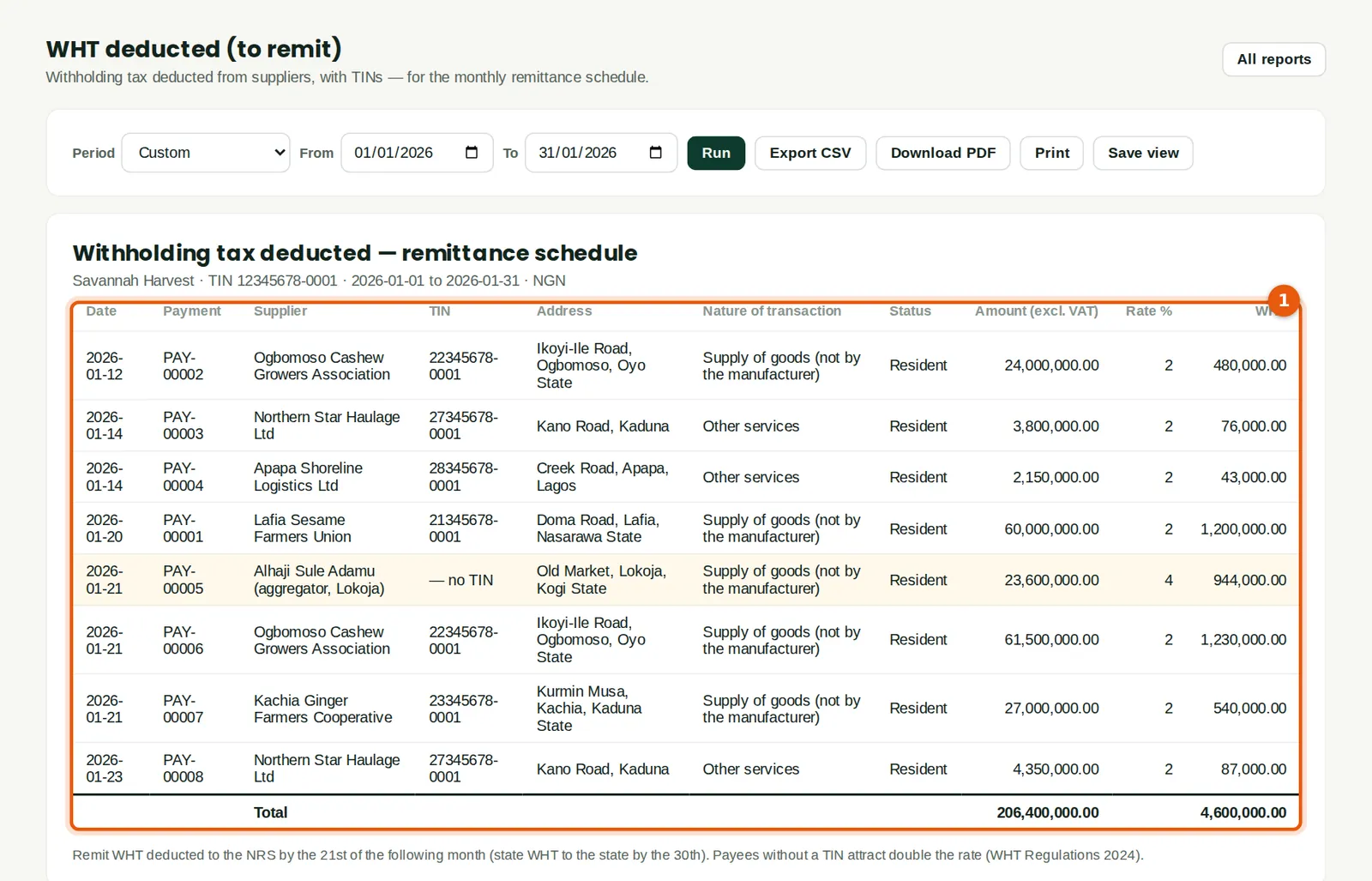
Every WHT deduction from supplier payments in the month, with the supplier's TIN, address, the nature of the transaction, the amount before VAT and the rate (1). The aggregator without a TIN was deducted at 4%. Remit the total to the tax authority by the 21st (state WHT by the 30th) and file this schedule.
Who
Accountant.
What to do
- Run the report for the month and export it to CSV for the remittance.
- Record the remittance as Spend money coded to 2150 Withholding tax payable.
- WHT deducted by customers from payments to the company is tracked under Tax centre → WHT credit notes until the credit note arrives.
11.5 Companies income tax computation
Why
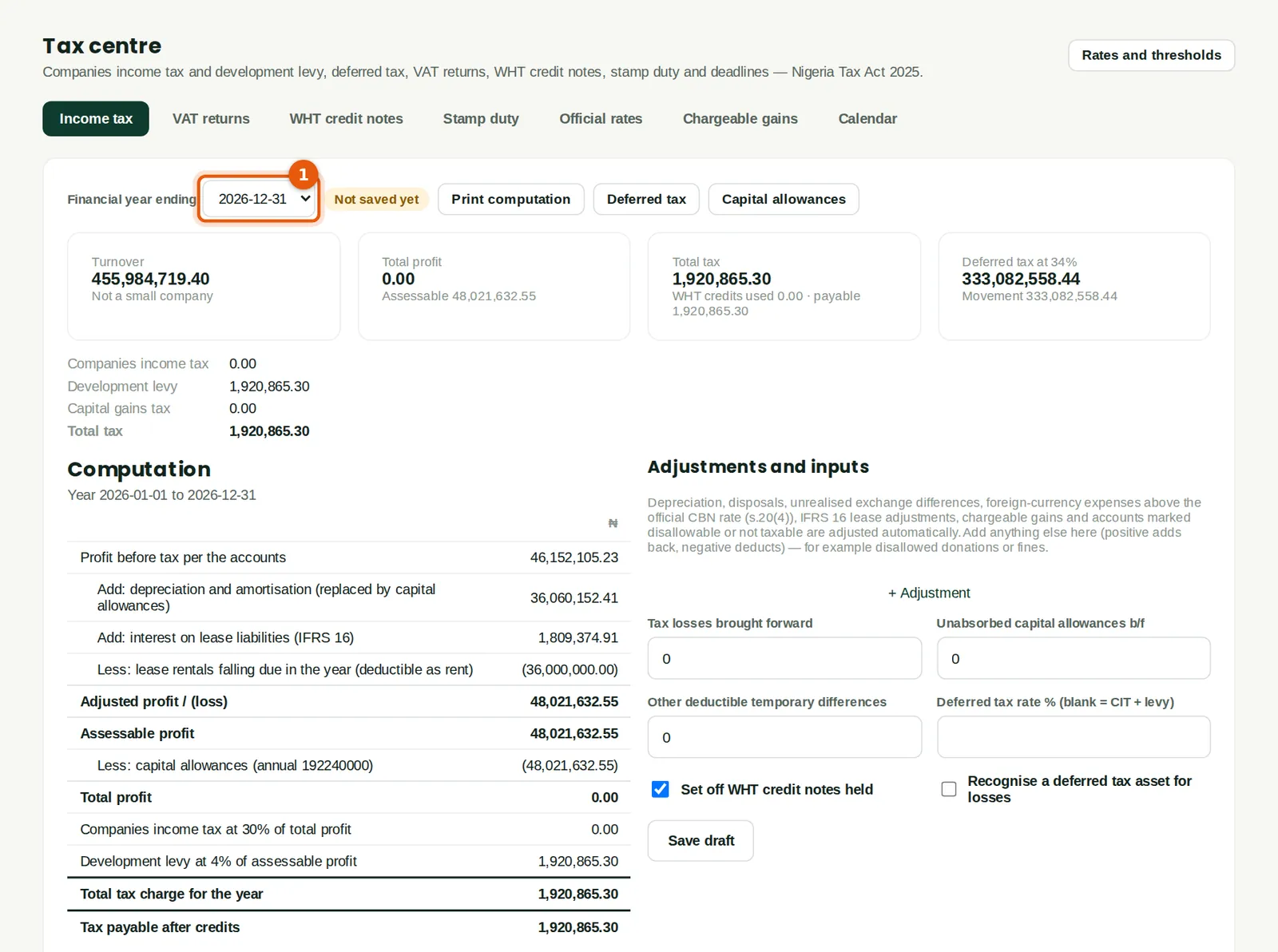
The computation starts from the profit in the ledger, adds back disallowable expenses and the section 20(4) excess on foreign-currency expenses, deducts non-taxable income and capital allowances, and applies the Nigeria Tax Act 2025: 30% companies income tax (0% for a small company), the 4% development levy and the 15% minimum effective rate for large and multinational groups. WHT credit notes held are set off. During the year it shows the year to date; after the year end, finalise it to post the provision.
Who
Accountant or tax adviser.
What to do
- Choose the financial year (1). Review the lines and enter any adjustments and inputs (losses brought forward, deferred tax differences).
- After the year end click Finalise and post the provision. Print the computation for the return.
11.6 Capital allowances
Why
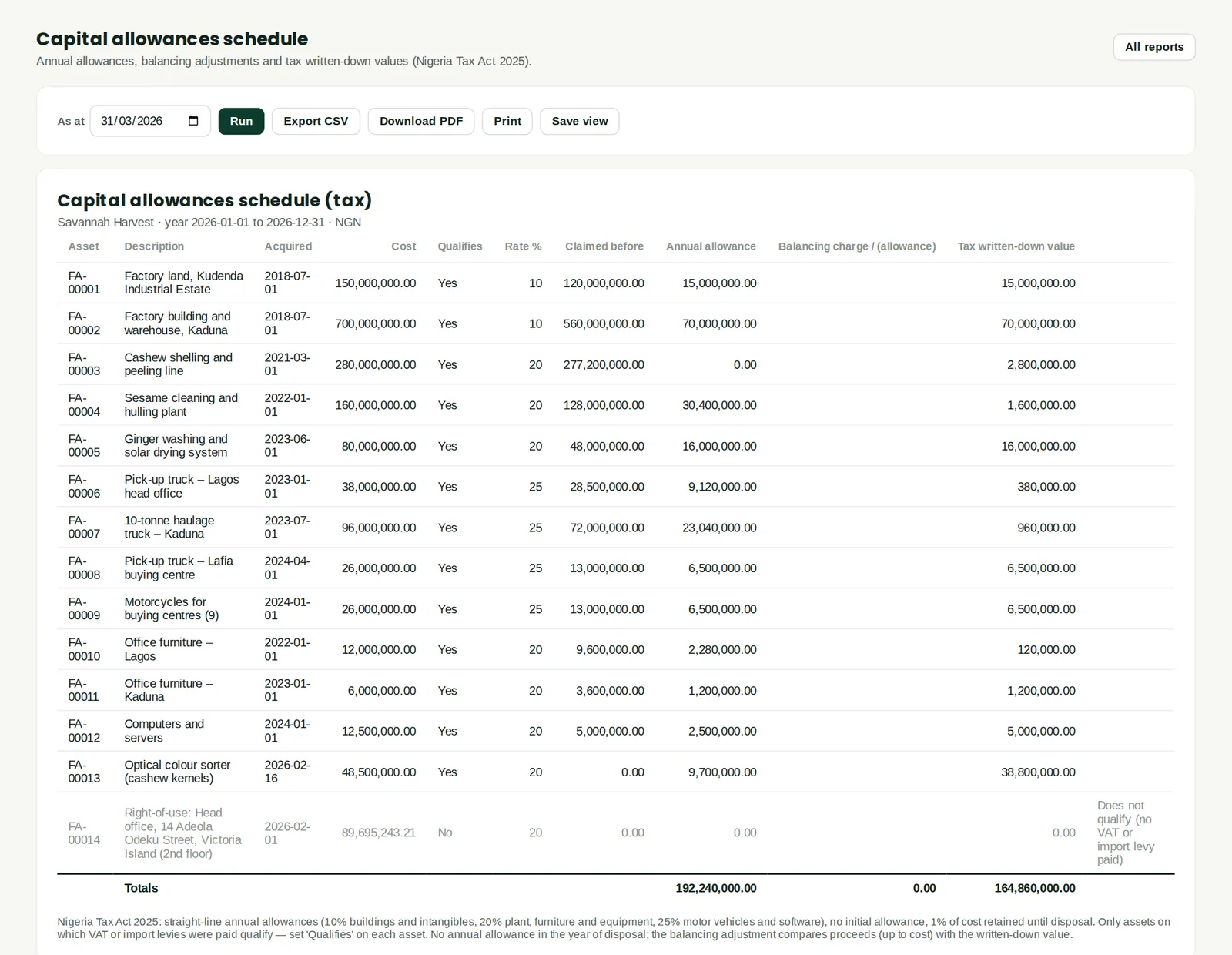
The annual allowances by pool (10%, 20% and 25% under the Nigeria Tax Act 2025), balancing adjustments on disposals and tax written-down values, for assets that qualify — those on which VAT was paid. The figures feed the income tax computation.
Who
Accountant or tax adviser.
11.7 Official exchange rates
Why
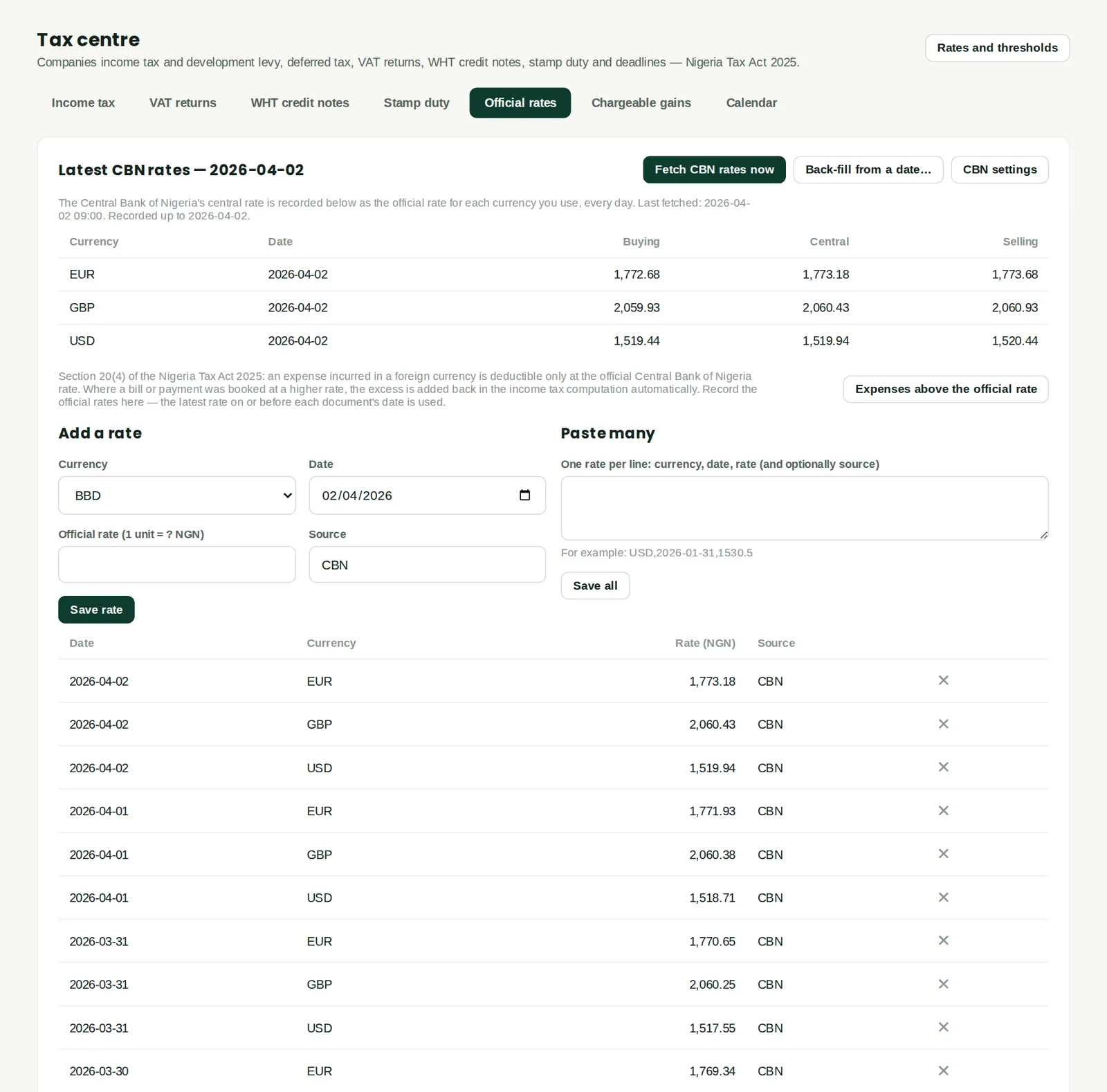
The CBN official rates fetched every day (chapter 2). Section 20(4) disallows the part of a foreign-currency expense booked above the official rate; the Foreign-currency expenses above the official rate report works it out. Rates from another source can be added or pasted here.
Who
Accountant.
11.8 Stamp duty on the lease
Why
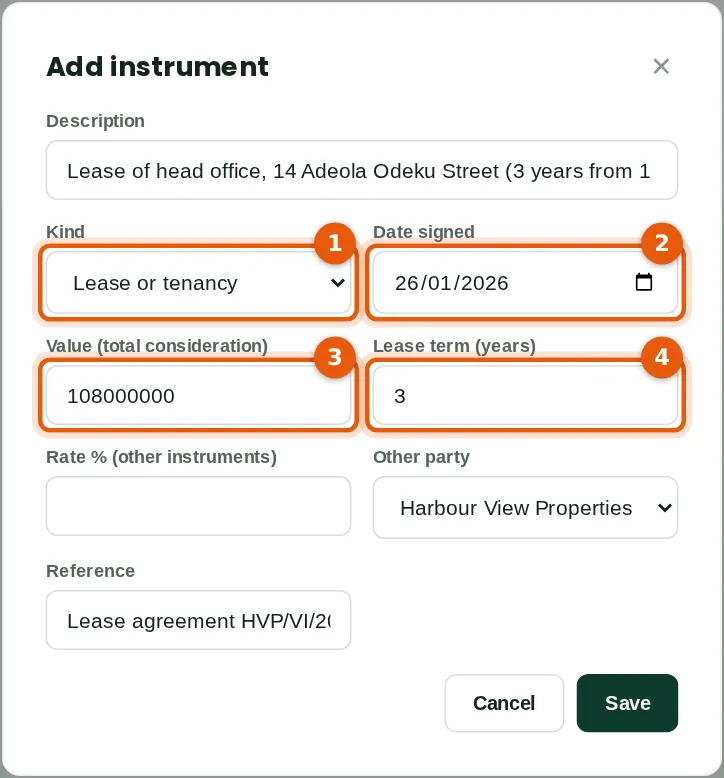
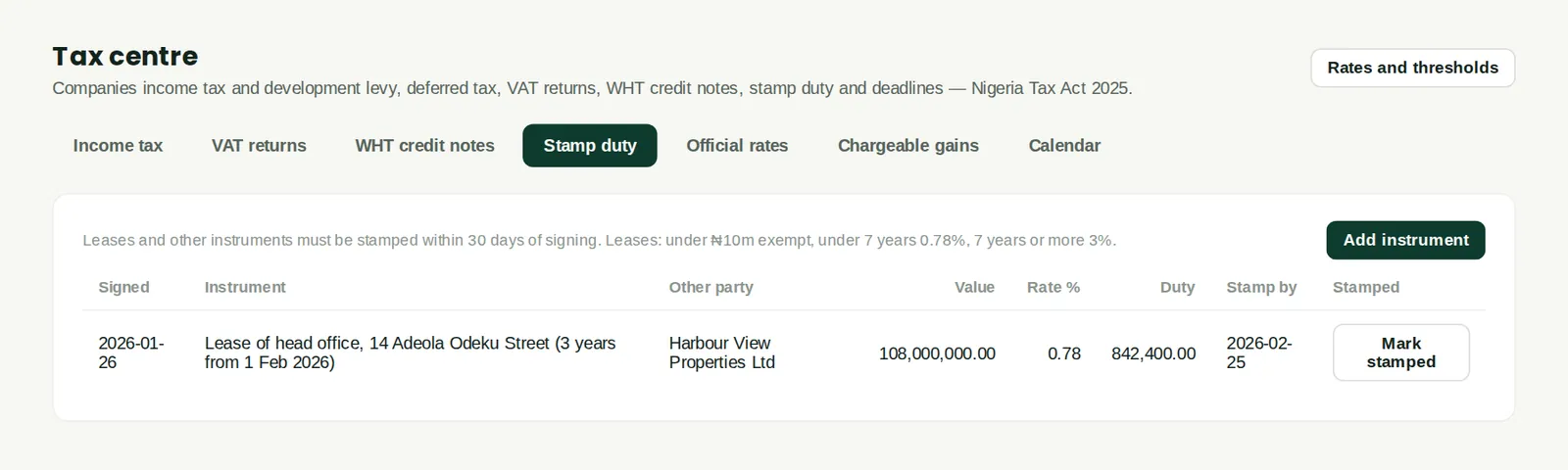
Leases and other instruments must be stamped within 30 days of signing. BookTrove works out the duty from the kind (1), the date signed (2), the total value (3) and, for a lease, the term (4), and tracks the deadline.
Who
Accountant.
What to do
- Click Add instrument, fill in the details and save. Mark it stamped when the duty is paid.
11.9 The stamp duty register
Why
The register lists each instrument, the duty, the deadline and whether it has been stamped.
Who
Accountant.
11.10 The tax calendar
Why
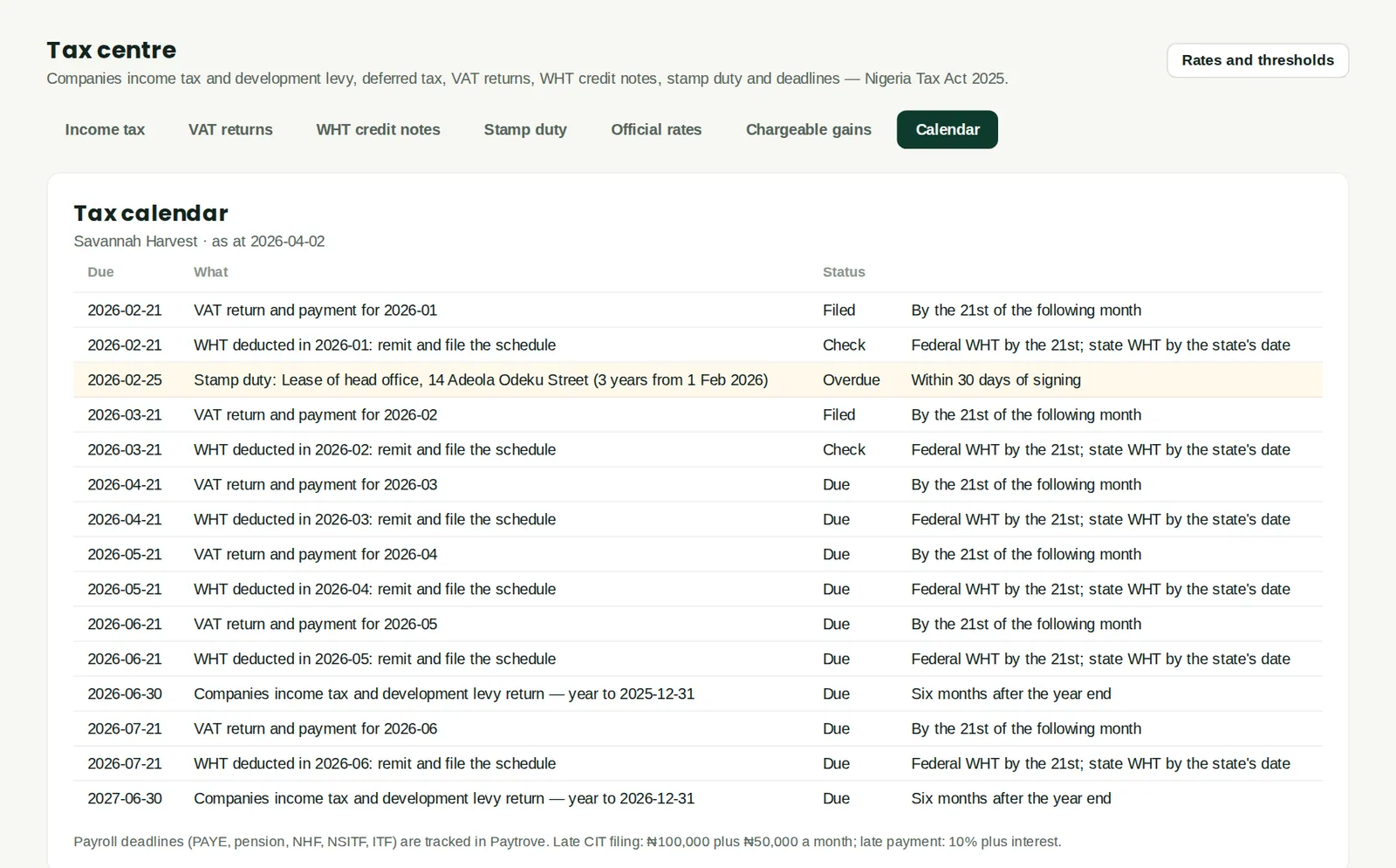
VAT, WHT, companies income tax and stamp duty deadlines with their status, so nothing is missed.
Who
Accountant.