Steps in this chapter (11)
Evaluate external experts before using their work, set up sustainability assurance engagements under ISSA 5000 and IESSA, record the credible basis for tax planning advice, and handle non-compliance with laws and regulations.
Four areas of the IESBA Code and the IAASB standards came into force recently or come into force soon. Using the work of an external expert (IESBA Sections 390 and 5390) applies from 15 December 2026: the firm evaluates the expert's competence, capabilities and objectivity, and the expert confirms in writing their interests, relationships and circumstances. ISSA 5000 and the International Ethics Standards for Sustainability Assurance (IESSA) apply to sustainability assurance for periods beginning on or after 15 December 2026. The tax planning sections (280 and 380) have applied since 1 July 2025. Non-compliance with laws and regulations (NOCLAR, Sections 260 and 360) needs a documented response.
In the illustration, on 29 September 2026 the Riverbend Foods 2026 audit team evaluates a property valuer; the firm hires Amina Garba, an environmental scientist, as Director of Sustainability Assurance and plans its first sustainability assurance engagement, for Riverbend's 2027 report; Nkechi Okafor records tax planning advice to Savannah Harvest; and Hauwa Abdullahi records unremitted pension contributions found at Rumuola Marine Supplies.
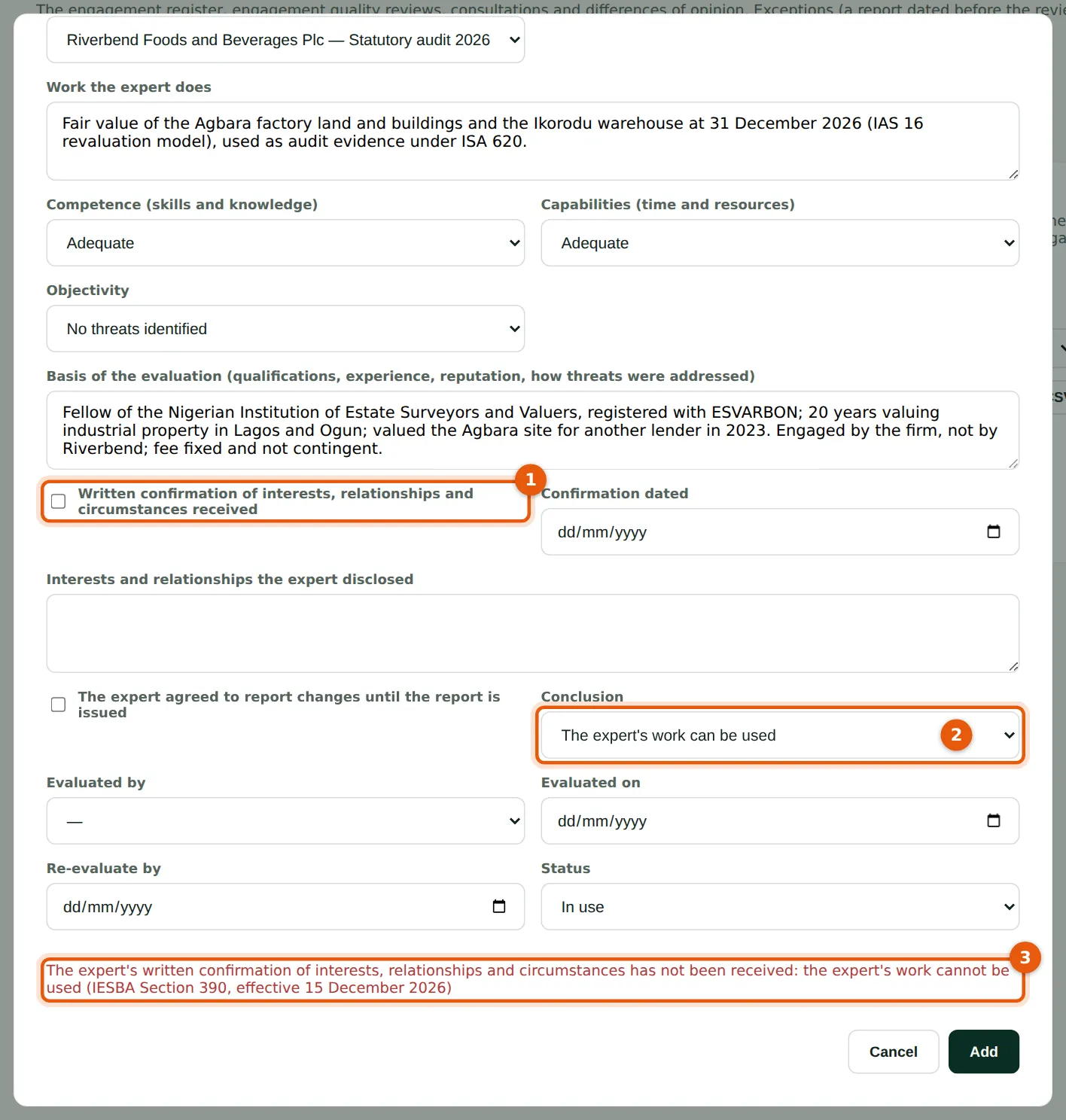
25.1 Without the expert's written confirmation, the work cannot be used
Why
Choosing The expert's work can be used (2) is refused (3) until the written confirmation of interests, relationships and circumstances is received (1) and dated. Competence and capabilities must be adequate, objectivity threats evaluated and at an acceptable level, and the basis recorded. An expert whose organisation is linked to the client's group cannot be marked as having no threats.
Who
Engagement partner or manager.
What to do
- Obtain the expert's signed confirmation before concluding.
- Tick (1), enter the date and the interests disclosed.
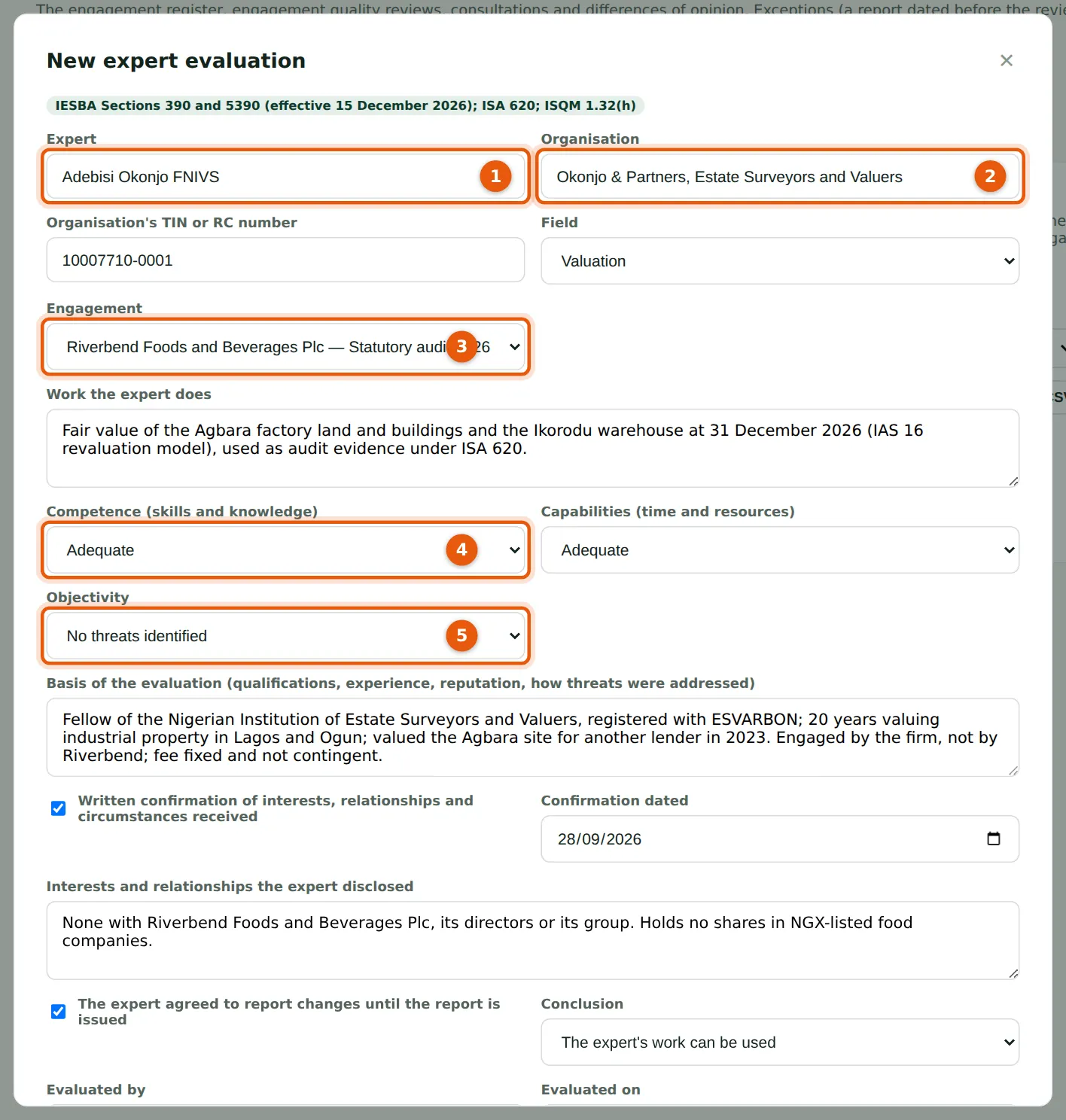
25.2 Evaluate an external expert
Why
Record the expert (1) and their organisation (2) with its TIN — both are checked against the restricted list — the field and the engagement (3), the work, and your evaluation: competence (4), capabilities, objectivity (5) and the basis. The re-evaluation date is set a year ahead, and the scheduled jobs remind you.
Who
Engagement partner or manager.
What to do
- Open Engagements & EQR → External experts and choose New expert evaluation.
- Fill in the expert (1, 2), the engagement (3) and the evaluation (4, 5); tick the confirmation and the undertaking to report changes; choose the conclusion and Save.
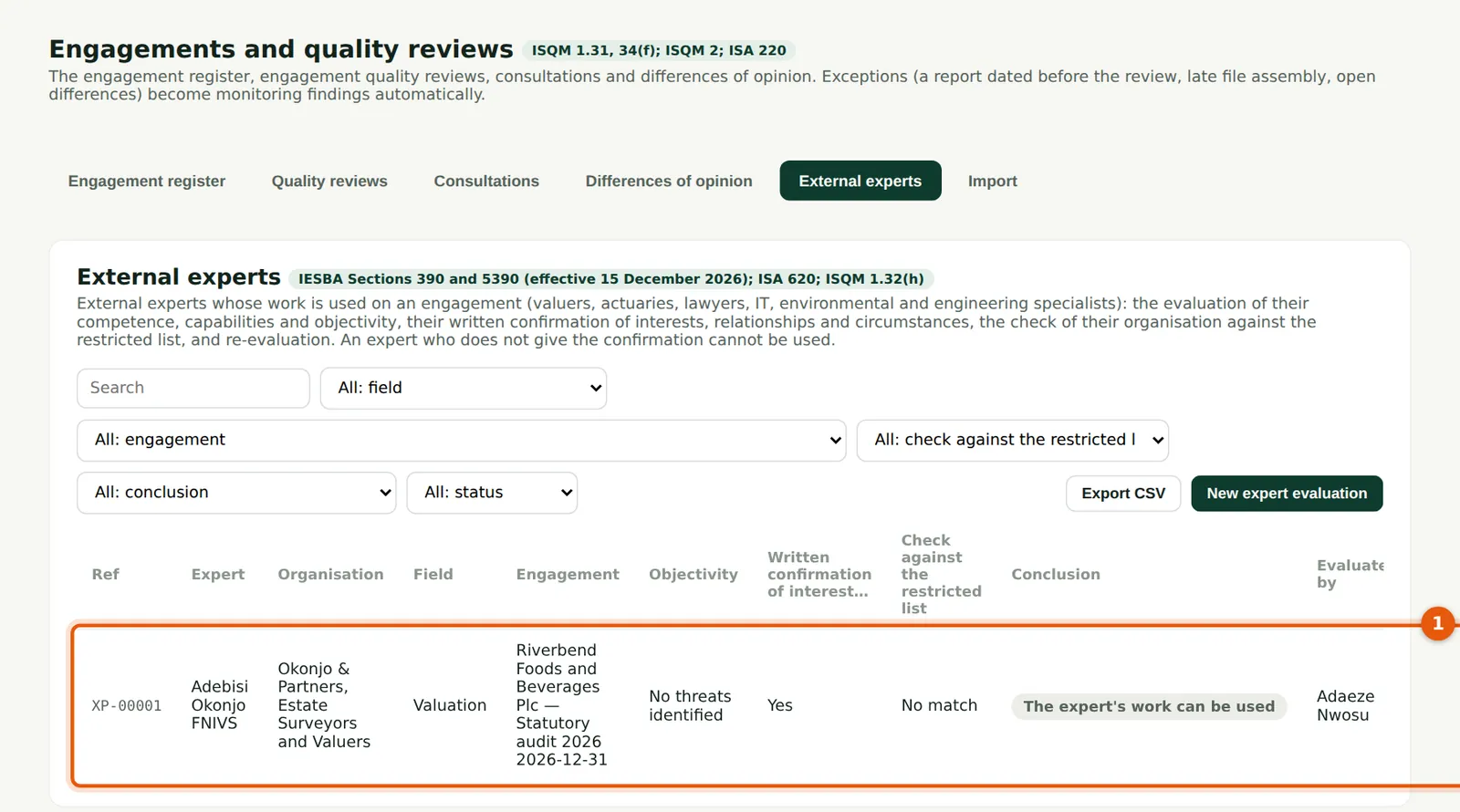
25.3 The external experts register
Why
Every expert with the engagement, the restricted-list check, whether the confirmation was received, the conclusion and the re-evaluation date (1).
Who
Engagement teams; quality lead.
What to do
- Filter by engagement or by conclusion; open a row to update it.
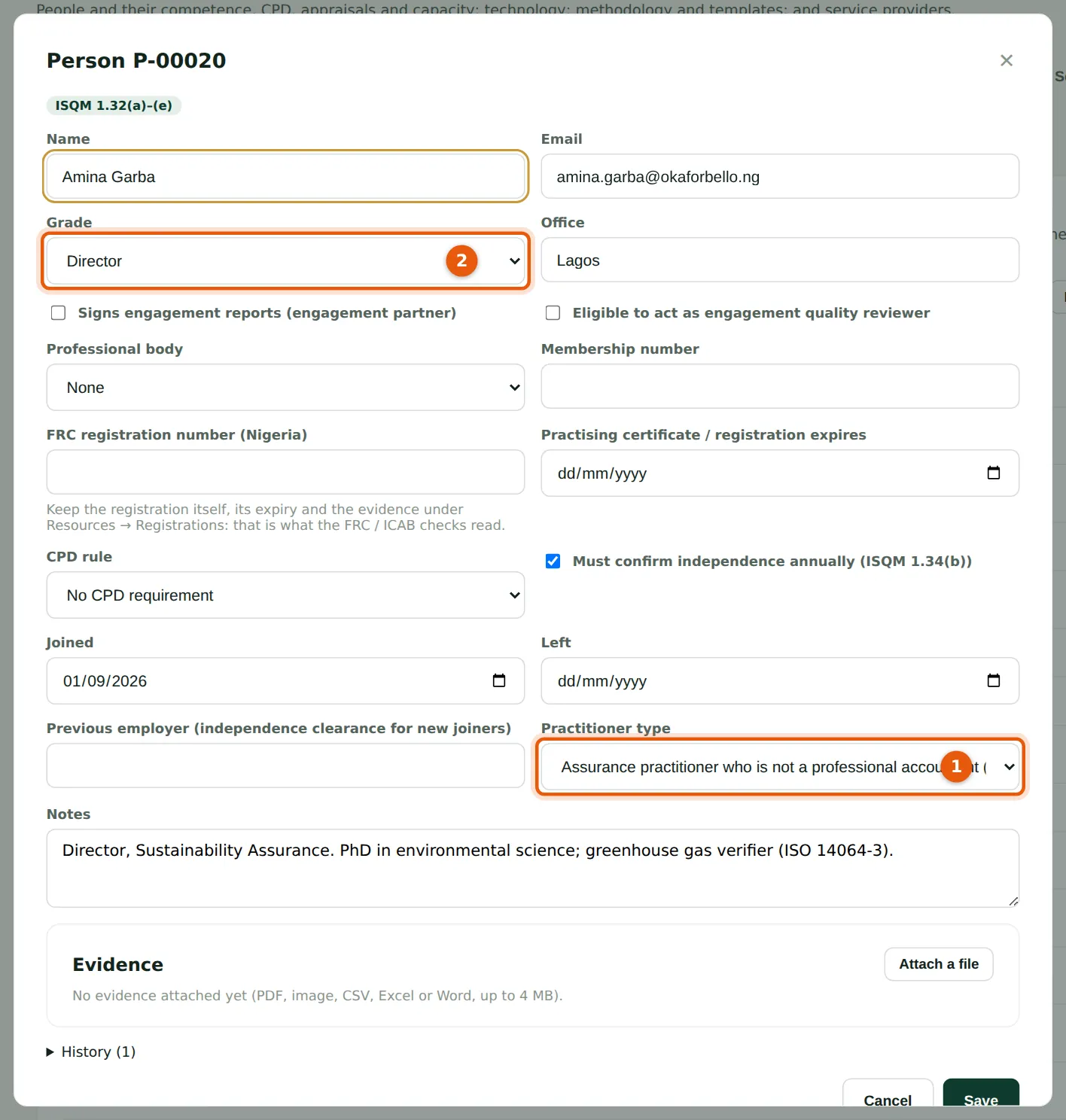
25.4 A practitioner who is not a professional accountant
Why
ISSA 5000 and IESSA apply to all sustainability assurance practitioners, including those who are not professional accountants. Record the practitioner type (1) on the person, with their grade (2); their competence goes in Resources → Competence (area Sustainability assurance).
Who
Firm administrator; quality lead.
What to do
- Open the person, choose the practitioner type (1) and save.
- Record their sustainability assurance accreditation under Competence.
25.5 Add the ISSA 5000 and IESSA quality risks
Why
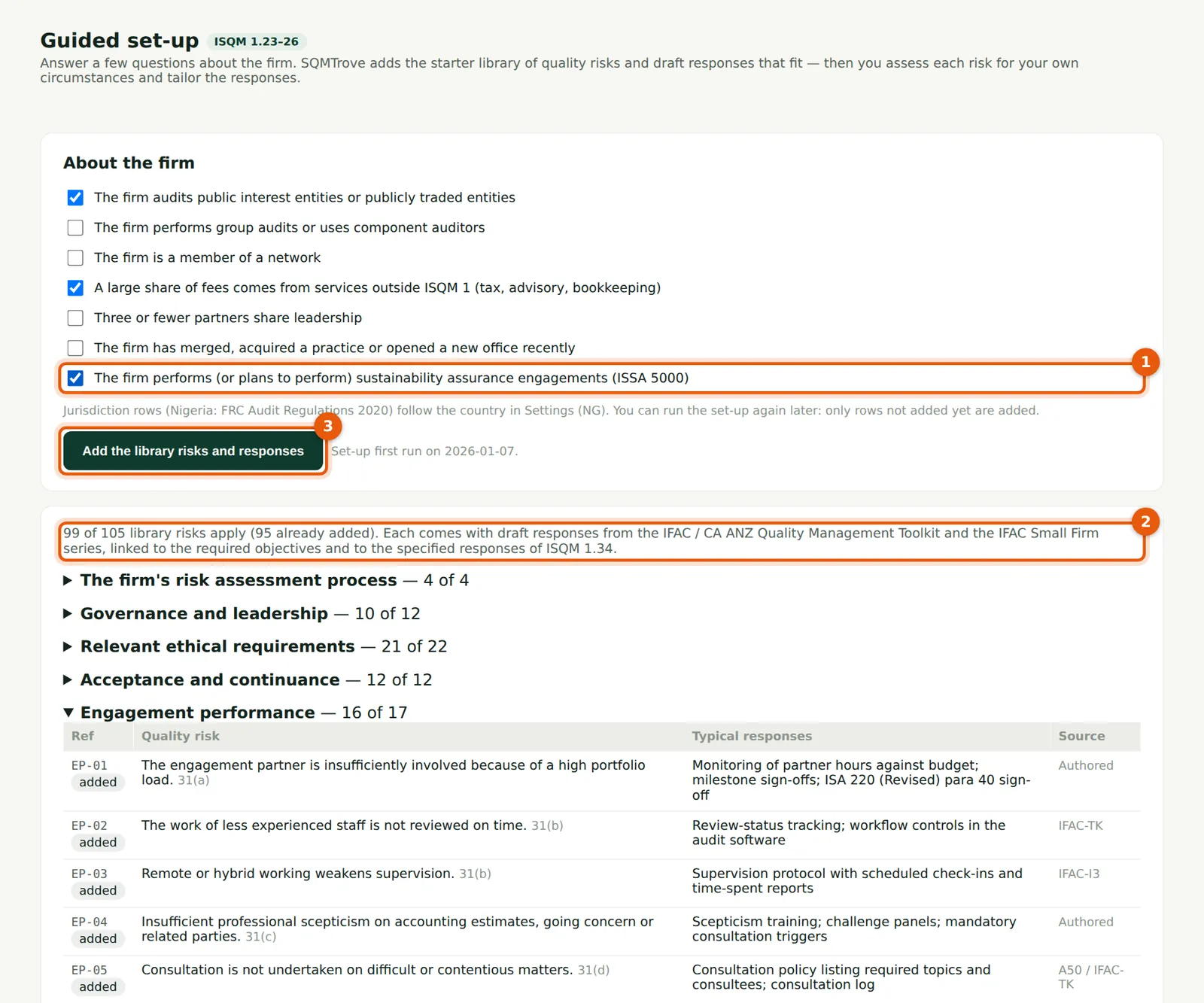
A new set-up question (1) adds the library risks and responses for sustainability assurance — among them the level of assurance and ISSA 5000 evidence, forward-looking information, independence for sustainability clients and non-accountant practitioners. The preview (2) shows how many apply and how many are already in the system; only the new ones are added (3).
Who
Quality lead.
What to do
- Open the guided set-up, tick the question (1) and choose Add the library risks and responses (3).
- Assess the new risks in Risk assessment → Quality risks (step 5.4).
25.6 Set up a sustainability assurance engagement
Why
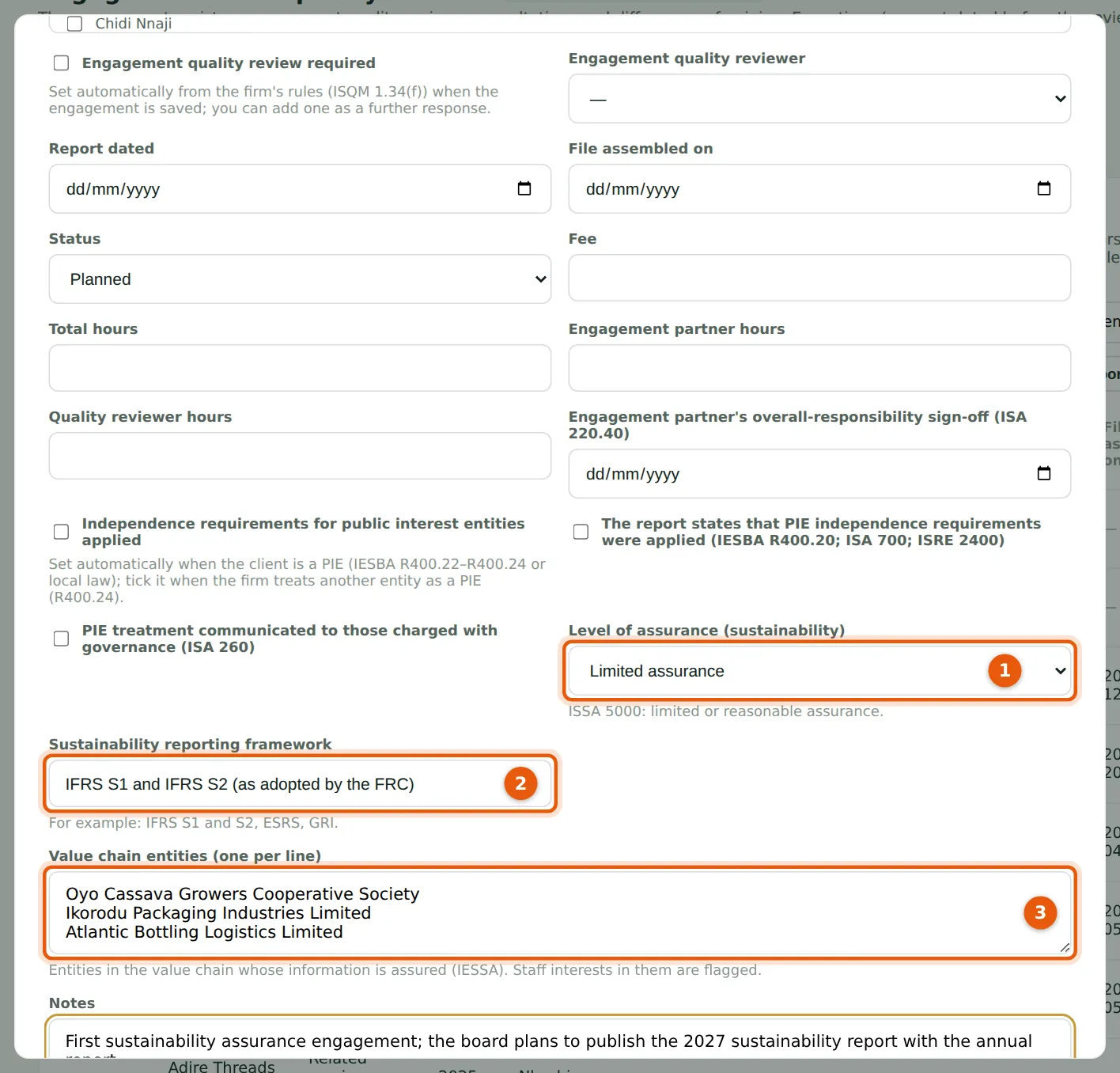
With the type Sustainability assurance (ISSA 5000) chosen at the top of the form, record the level of assurance (1) — limited or reasonable — the reporting framework (2) and the value chain entities whose information is assured (3), one per line. Value chain entities are matched against everyone's personal registers. For a public interest entity, a review is required by the firm's policy and the leader's rotation is tracked as a separate stream (IESSA R5540).
Who
Engagement leader; quality lead.
What to do
- Choose New engagement and fill in the client, the type Sustainability assurance (ISSA 5000), the period, the leader and the manager.
- Choose the level (1), enter the framework (2) and the value chain (3), and choose Save.
25.7 Warnings on a sustainability engagement
Why
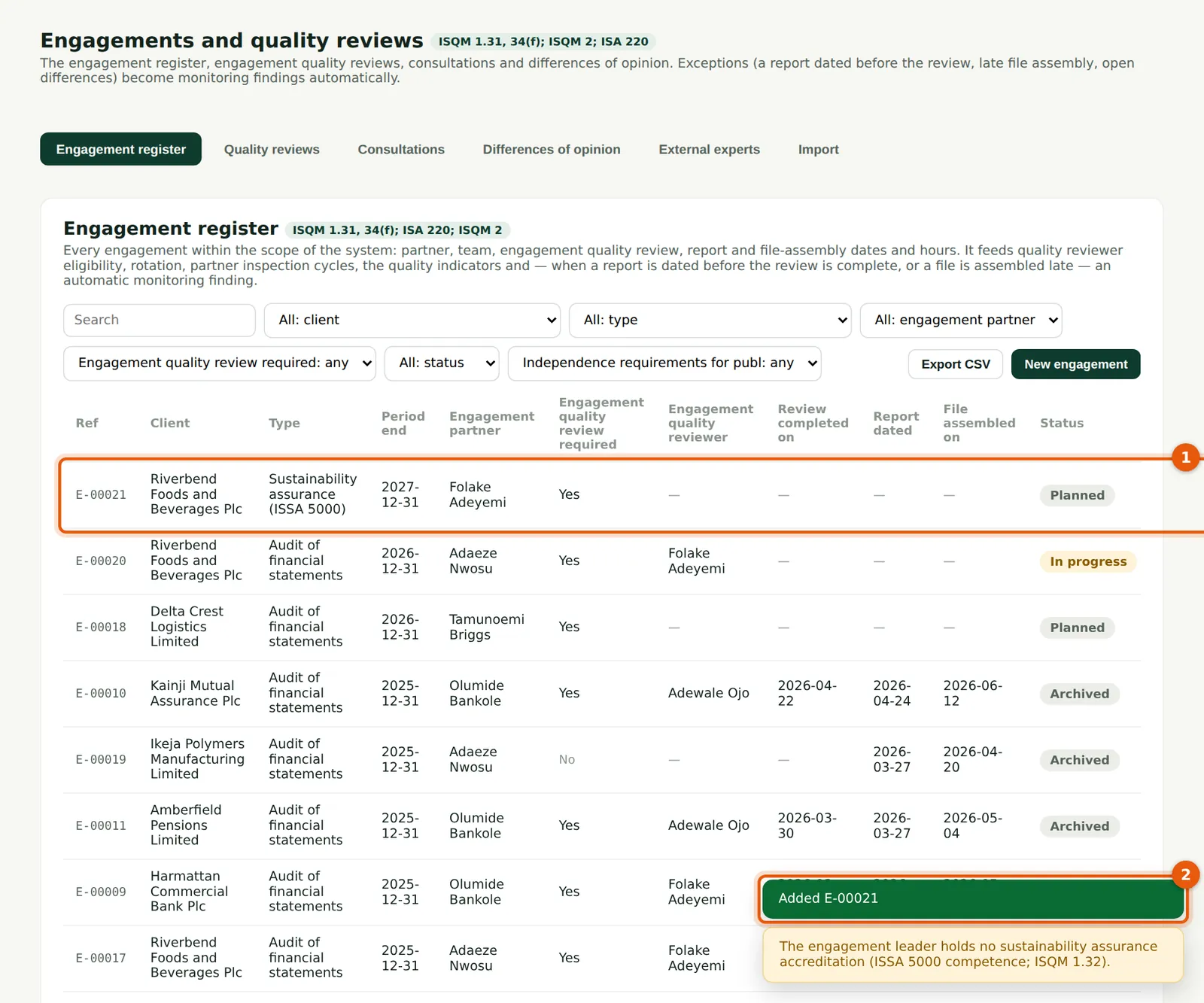
The engagement is saved (1) with warnings (2) where something needs attention — here that the engagement leader holds no sustainability assurance accreditation. Record the accreditation or change the leader before the work starts.
Who
Engagement leader; quality lead.
What to do
- Read each warning and act on it; the quality lead records accreditations under Resources → Competence.
25.8 Non-assurance services to a sustainability assurance client
Why
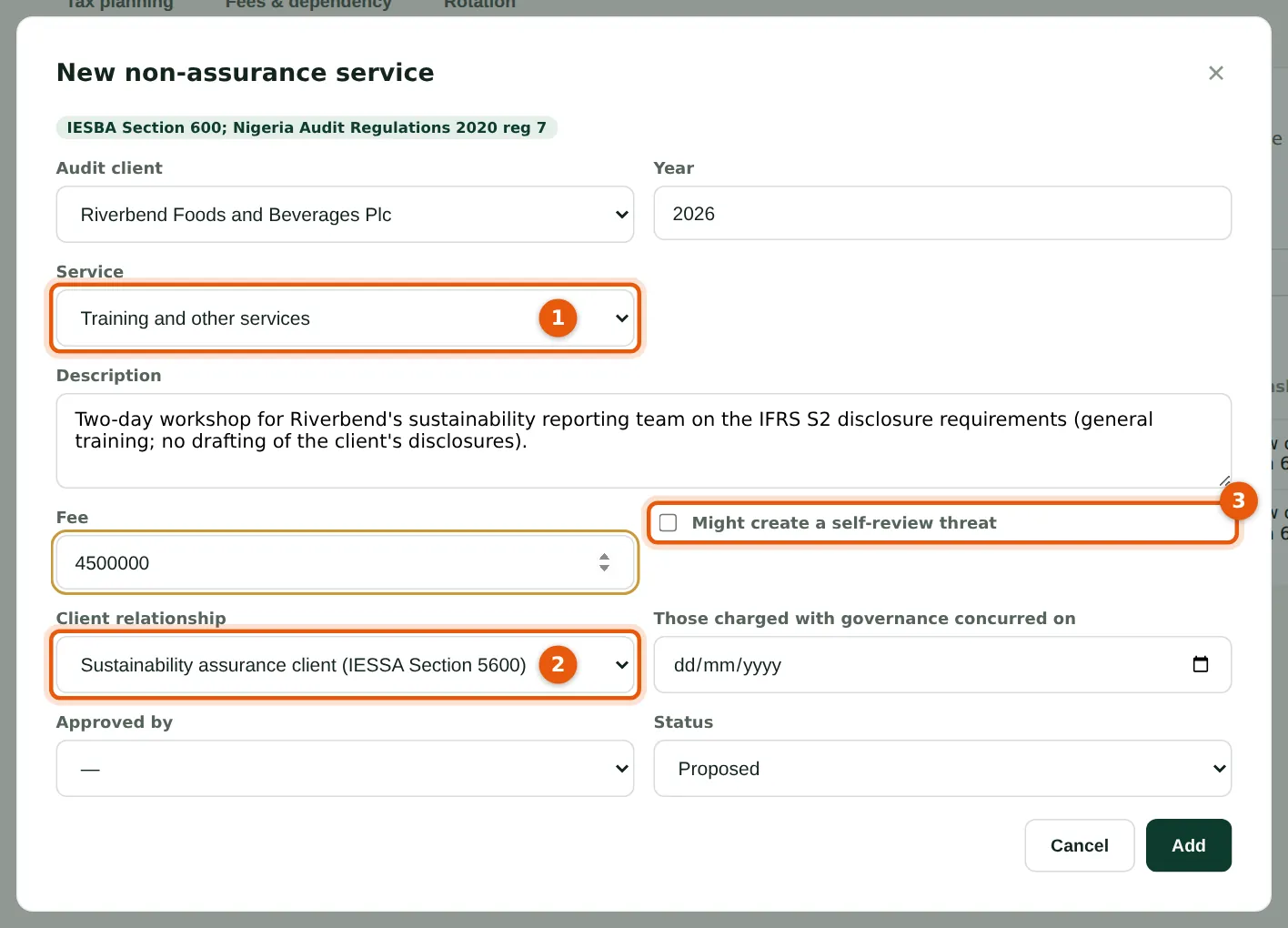
Choose the client relationship (2): a service to an audit client follows IESBA Section 600; one to a sustainability assurance client follows IESSA Section 5600, with its own prohibitions for public interest entities. Record the service (1) and whether it might create a self-review threat (3). Sustainability assurance fees are recorded in their own column of the client fees and count in the fee-dependency monitor.
Who
Engagement partners; ethics partner approves.
What to do
- Choose New service, choose the service (1), the relationship (2) and the self-review answer (3), and save.
25.9 Record tax planning advice
Why
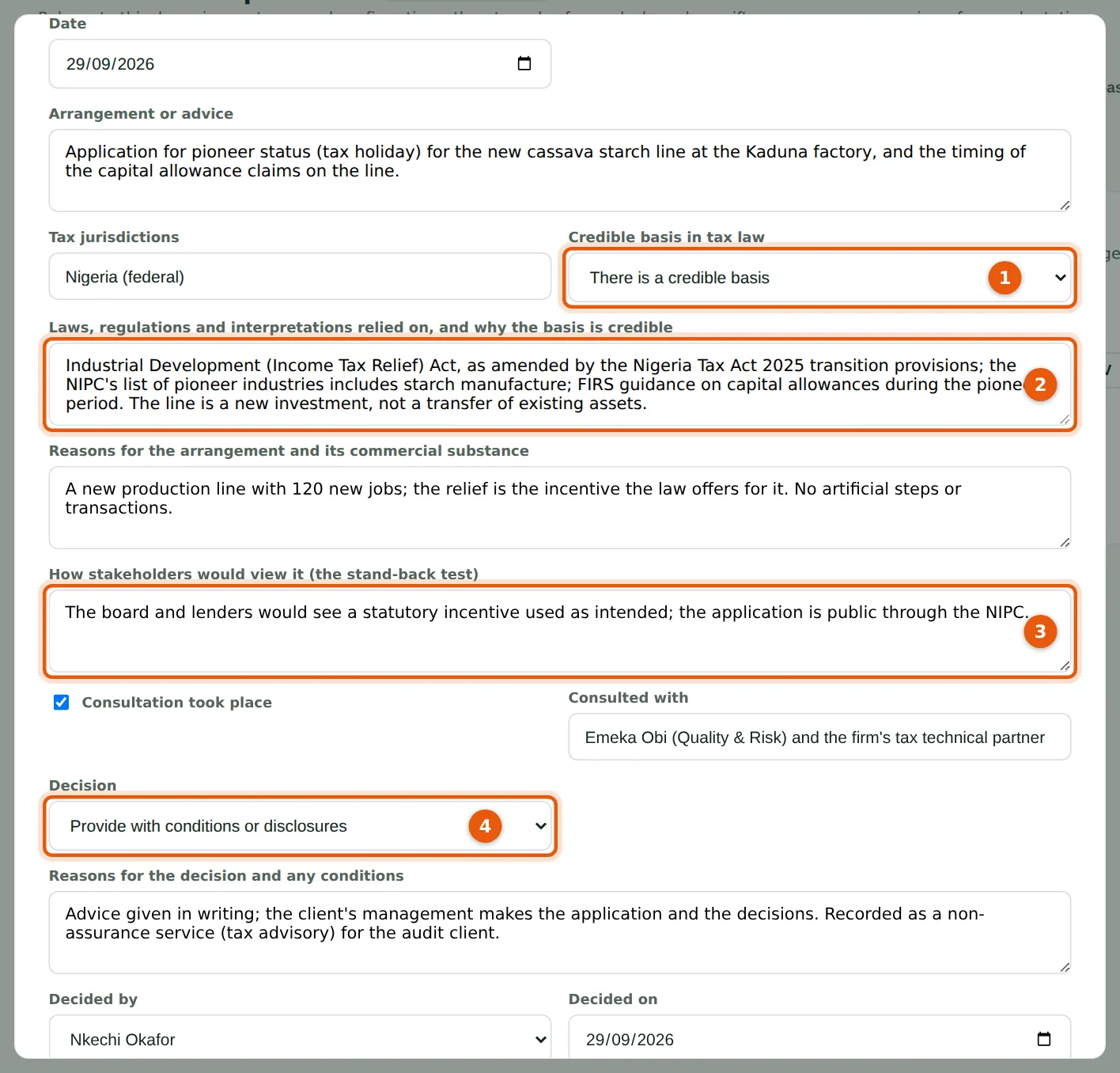
Tax planning advice may be given only when there is a credible basis in tax law (1). Record the laws and interpretations relied on (2), the reasons and commercial substance, and how stakeholders would view the arrangement — the stand-back test (3). “Uncertain” needs a consultation before deciding. Choose the decision (4); providing the advice needs the whole analysis, and the second review must be by someone other than the person who decided.
Who
Tax and advisory partners; a second reviewer.
What to do
- Choose New tax planning record; describe the arrangement.
- Record the credible basis (1) and the analysis (2, 3), the consultation, the decision (4), the reviewer, and save.
25.10 The tax planning register
Why
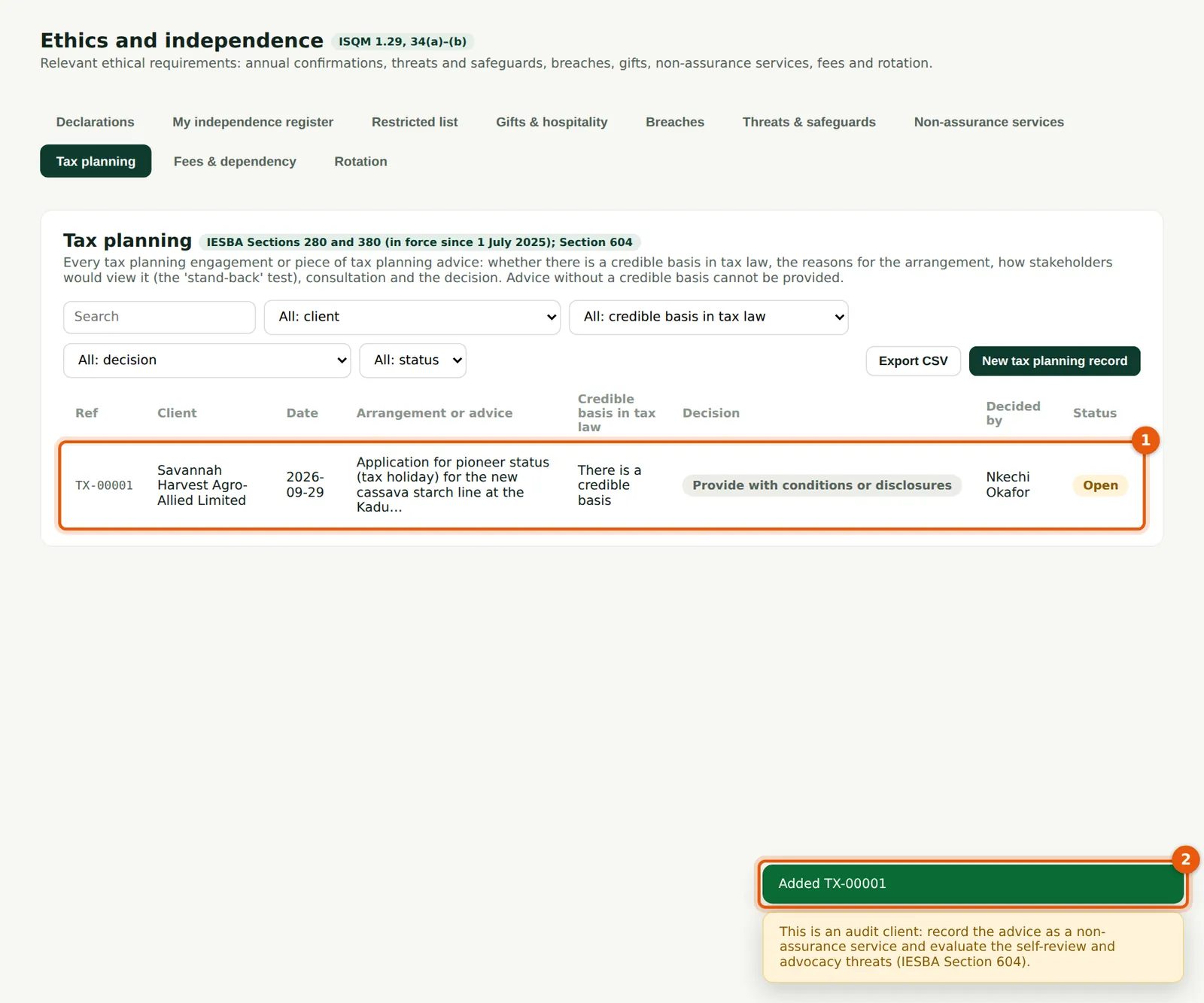
Each record with its credible basis and decision (1). For an audit client, SQMTrove reminds you (2) to record the advice as a non-assurance service; for a public interest entity audit client, tax planning that might create a self-review threat is prohibited (IESBA R604).
Who
Tax and advisory partners; ethics partner.
What to do
- Record the related non-assurance service (steps 7.14 and 7.15) when the client is an audit client.
25.11 Record non-compliance with laws and regulations
Why
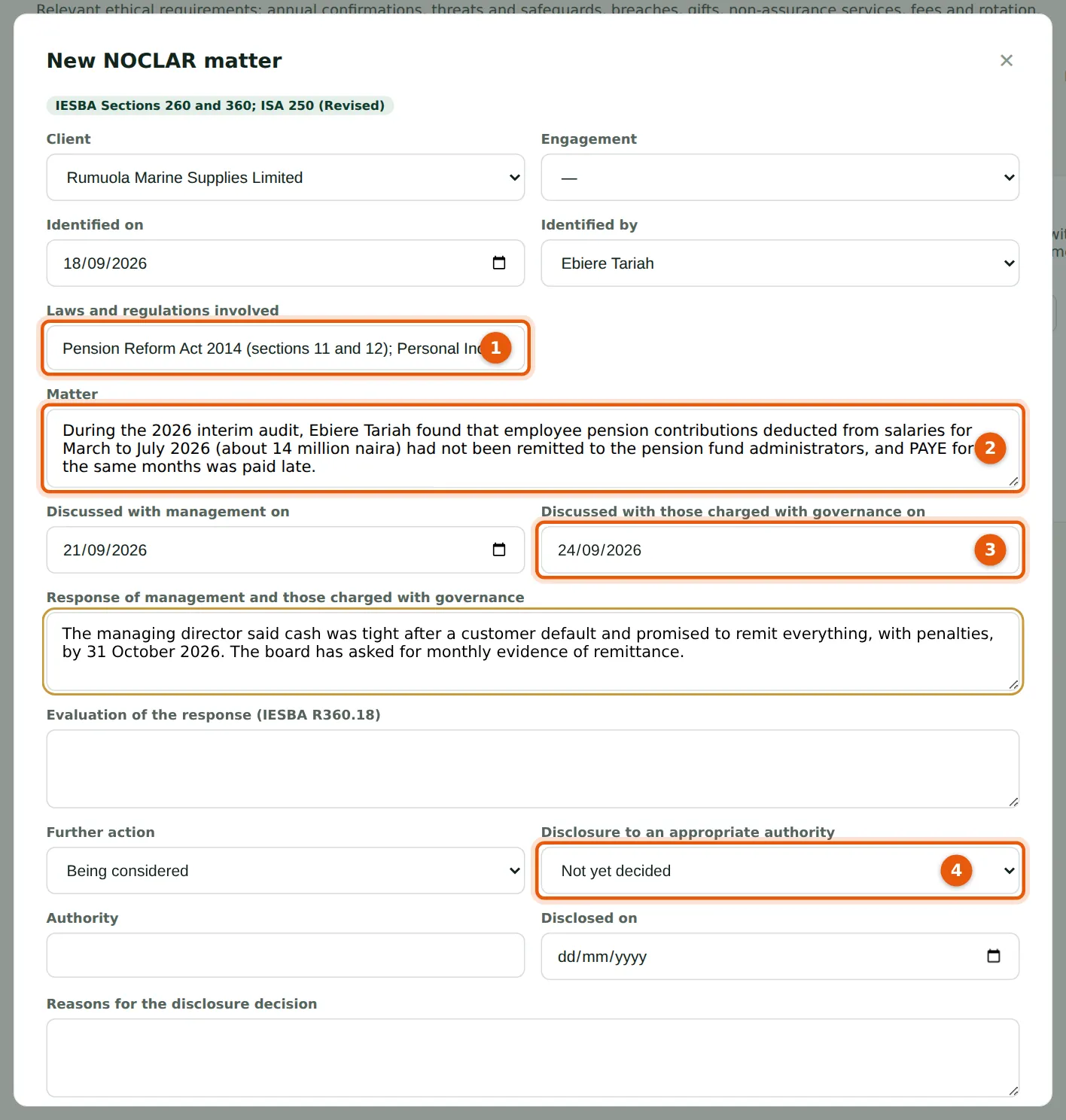
Record the laws involved (1), the matter (2), when it was discussed with management and with those charged with governance (3), their response and your evaluation of it (IESBA R360.18), the further action and the disclosure decision (4). A matter cannot be deleted; closing needs the discussion, the evaluation and the disclosure decision with reasons. The register is restricted to the ethics partner, the quality lead and administrators.
Who
Ethics partner.
What to do
- Choose New NOCLAR matter and record what is known.
- Update it as the matter develops; take legal advice before deciding on disclosure.